Education Evaluations for Employers: Ensuring USCIS Compliance and Smooth Hiring
Hiring skilled international professionals can be a game-changer for U.S. companies. However, sponsoring foreign employees for visas such as H-1B, L-1, O-1, EB-2, or EB-3 requires strict compliance with U.S. Citizenship and Immigration Services (USCIS) guidelines. One of the most effective ways employers can ensure compliance is by obtaining education evaluations from recognized experts. In this guide, we’ll explain why education evaluations are critical for employers, how they support USCIS requirements, and how they simplify the hiring process. What Is an Education Evaluation? An education evaluation is a professional assessment that compares a foreign worker’s academic background to the U.S. education system. Conducted by credential specialists and professors, these evaluations determine whether an international degree or coursework is equivalent to a U.S. bachelor’s, master’s, or doctoral degree. For employment-based visa petitions, USCIS often requires education evaluations to confirm that candidates meet the minimum degree requirements for their role. Why Employers Need Education Evaluations 1. Ensure USCIS Compliance Employers must prove that foreign workers meet degree requirements for their visa category. A professional evaluation provides official evidence that reduces the risk of RFEs (Requests for Evidence) or denials. 2. Streamline the Hiring Process With degree equivalency established upfront, HR teams and immigration attorneys can prepare petitions faster and more efficiently, avoiding delays. 3. Verify Specialized Positions Some visas (like H-1B) require degrees in specific fields. An evaluation not only proves the degree level but also confirms that the field of study aligns with the job requirements. 4. Combine Work Experience and Education If a candidate doesn’t hold a direct U.S. equivalent degree, evaluators can combine academic coursework and professional experience to establish equivalency — an approach USCIS accepts when supported by qualified experts. Key Situations Where Employers Need Evaluations Employers often need education evaluations when: Filing an H-1B petition for a foreign worker Supporting an EB-2 or EB-3 green card application Responding to an RFE or NOID related to degree equivalency Establishing U.S. equivalence for professional licensure or certifications Preparing for PERM labor certification cases How International Evaluations Supports Employers At International Evaluations, we provide accurate, USCIS-compliant assessments designed to support employers and immigration attorneys. Our services include: Education Evaluations (degree-level and course-by-course) Work Experience Evaluations (combining academic + professional experience) Expert Opinion Letters from qualified professors Rush Services with 24–48 hour turnaround for urgent filings RFE Support to strengthen employer responses With 150+ academic experts, 10+ years of experience, and over 17,000 successful cases, we help employers achieve smooth and successful immigration outcomes. Frequently Asked Questions (FAQ) 1. Who pays for the education evaluation — employer or employee? It depends. Employers usually cover the cost, but in some cases, employees may pay. Both options are acceptable if they comply with USCIS and Department of Labor guidelines. 2. What if the foreign degree does not exactly match U.S. requirements? In such cases, evaluators may combine coursework and work experience to establish equivalency, which USCIS accepts if done by qualified experts. 3. How long does an education evaluation take? Standard processing takes 5–7 business days, but rush services (24–48 hours) are available for urgent filings. 4. Are education evaluations mandatory for all visa types? Not always. They are most commonly required for H-1B, EB-2, EB-3, and PERM cases, but USCIS may request them in other visa categories as well. 5. What’s the difference between a “document evaluation” and a “course-by-course evaluation”? Document Evaluation: Provides overall equivalency (e.g., “Bachelor’s degree in Engineering from India = U.S. Bachelor’s degree in Engineering”). Course-by-Course Evaluation: Includes a detailed breakdown of courses, credits, and GPA — often needed for licensing or further education. Conclusion For employers, hiring international talent doesn’t need to be complicated. By obtaining professional education evaluations, companies ensure USCIS compliance, reduce risks of RFEs, and speed up the hiring process. If your business is preparing to sponsor a foreign worker, partnering with International Evaluations can make all the difference. Contact International Evaluations today to discuss your evaluation needs and ensure a smooth hiring process.
Work Experience Evaluation for H-1B: A Solution for Candidates Without a Degree
The H-1B visa is one of the most sought-after pathways for skilled foreign professionals looking to work in the United States. However, one of its strict eligibility requirements is that applicants must hold at least a U.S. bachelor’s degree or its foreign equivalent in a field related to the job. This poses a challenge for talented candidates who may not have a formal degree but possess years of practical, hands-on experience. The good news? Work experience evaluations can bridge the gap, helping candidates qualify for the H-1B without a traditional academic credential. What is a Work Experience Evaluation? A work experience evaluation is a formal assessment performed by authorized credential evaluators, university professors, or academic experts. It converts professional experience, training, and certifications into an academic equivalency that aligns with U.S. educational standards. For H-1B purposes, three years of specialized professional experience is typically considered equivalent to one year of university-level education. This means that even without a bachelor’s degree, candidates can qualify if they have significant work experience in their field. Who Needs a Work Experience Evaluation? You may need a work experience evaluation if: You do not hold a bachelor’s degree but have years of work experience in your specialty. You have a degree that does not match your H-1B job specialty. You completed your education in a different system and need U.S. equivalency documentation. You want to strengthen your H-1B petition with expert academic and experiential credentials. How Does the Evaluation Work? Gathering Documentation Detailed resume with professional roles, skills, and achievements. Letters from past employers verifying job duties and years of service. Certifications, training records, or industry recognitions. Expert Analysis An evaluator or professor reviews your professional background to determine its academic equivalence to a U.S. degree. Issuance of Evaluation Report The evaluator provides a written report that outlines how your work experience matches the degree requirement for H-1B eligibility. Why Work Experience Evaluation Matters for H-1B Eligibility Without a Degree: Provides a pathway for skilled professionals who didn’t pursue traditional higher education. Job-Relevant Qualification: Ensures that USCIS recognizes your skills as equivalent to academic training. Stronger Petition: An expert evaluation adds credibility and reduces the chances of Requests for Evidence (RFEs). Career Growth: Opens doors to H-1B opportunities and long-term immigration benefits in the U.S. Choosing the Right Evaluation Service Not all evaluations are accepted by USCIS. To avoid delays or denials: Use evaluators authorized by U.S. universities or recognized by USCIS. Ensure the evaluation highlights both education and work experience. Work with immigration attorneys or consultants to submit the strongest possible petition. Why Choose International Evaluations? When it comes to H-1B work experience and education evaluations, the quality of your report can make or break your case. Not all evaluators are equal—choosing the wrong provider may result in RFEs, delays, or even denials. That’s why working with International Evaluations makes a real difference. 1. USCIS-Trusted Experts Our evaluations are written by university professors and credentialed professionals with deep expertise in U.S. academic equivalency standards. This ensures your report meets the highest compliance expectations. 2. Tailored to Your Case Every candidate’s background is unique. International Evaluations customizes reports—whether you need a work experience evaluation, degree equivalency, or expert opinion letter—to highlight your strengths and align with USCIS requirements. 3. Fast Turnaround Times Immigration deadlines are time-sensitive. We offer rush services within 24–48 hours, helping candidates and attorneys meet critical H-1B filing windows without compromising quality. 4. Comprehensive Services From credential evaluations and work experience equivalencies to expert opinion letters for RFEs, International Evaluations provides all the documentation support you need under one roof. 5. Proven Success with RFEs Our team has extensive experience responding to Requests for Evidence (RFEs). By providing detailed, professor-backed reports, we help strengthen petitions and improve approval chances. 6. Trusted by Attorneys and Employers Immigration attorneys and HR departments across the U.S. rely on our evaluations to hire international professionals with confidence. Final Thoughts While the H-1B visa has strict academic requirements, lack of a degree doesn’t have to end your U.S. career dreams. With the right work experience evaluation, years of professional expertise can serve as the foundation for your H-1B eligibility. At Bay Area Immigration Services, we specialize in helping candidates navigate this process with professional evaluations, strong documentation, and expert legal guidance. Schedule a Free Consultation Order a Work Experience Evaluation
Fairness for High-Skilled Immigrants Act: Reform’s RFE Relevance
The Fairness for High-Skilled Immigrants Act (FHSIA) has long been a topic of debate in U.S. immigration. Designed to eliminate per-country limits on employment-based green cards, the reform aims to create a more balanced system for high-skilled workers from backlogged countries like India and China. But even if this legislation reduces wait times, one reality won’t change: USCIS will continue to scrutinize employment-based petitions with RFEs (Requests for Evidence). For attorneys and employers, that means credential evaluations remain a critical safeguard in ensuring cases meet the highest standards of compliance. Why the FHSIA Matters for High-Skilled Immigration If enacted, the Fairness Act would: Remove per-country caps on EB-2 and EB-3 visas, allowing applicants from high-demand countries to compete on equal footing Shorten wait times for backlogged applicants, especially in the tech and healthcare sectors. Increase diversity by leveling the playing field across all countries. While this reform may change the when of green card approvals, it doesn’t change the how. USCIS will still require airtight documentation and degree equivalency proof for every petition. RFEs in the Era of Immigration Reform Even with FHSIA, attorneys and employers should anticipate continued RFE activity in: EB-2 and EB-3 Petitions USCIS will scrutinize whether advanced degrees and Bachelor’s equivalencies align with U.S. standards. PERM Labor Certifications Course-by-course evaluations remain essential when a candidate’s degree title doesn’t exactly match the job requirements. National Interest Waivers (NIW) Applicants must still demonstrate that their advanced degrees or foreign equivalents justify NIW eligibility. How International Evaluations Helps Attorneys Navigate Reform + RFEs Immigration reform won’t eliminate RFEs—but the right preparation will minimize their impact. Here’s how we help: RFE Response Support – Targeted evaluations crafted to directly address USCIS concerns. Pre-Filing Reviews – Free consultations on transcripts and job descriptions to reduce risk before filing. Fast Turnaround – 48-hour and same-day evaluations available to meet filing or RFE deadlines. How Employers Benefit Under Reform For HR and global mobility teams, FHSIA could expand access to global talent pools. But compliance remains key. We provide: Job-Match Reports – Linking coursework to job duties, crucial for proving “specialty occupation” roles. Simplified Intake – Easy document upload, saving HR teams valuable time. Archive Access – Secure storage of past evaluations for quick reissue during audits or RFEs. What Sets International Evaluations Apart in Times of Change Expert Evaluators in STEM Professional Fields Alignment with USCIS, DOL, and AACRAO Standards Attorney-Approved Templates for PERM & EB Cases Rush Options Without Compromising Quality Real-World Success: A Reform-Ready Example “When USCIS issued an RFE questioning a candidate’s Indian Master’s degree for an EB-2 petition, International Evaluations delivered a detailed equivalency report in under 48 hours. The evaluation mapped coursework directly to U.S. standards, and the case was approved.” — Immigration Attorney, Washington D.C. “As we prepare for potential changes under FHSIA, International Evaluations has become our go-to partner. Their job-match reports and responsiveness help us file stronger cases with fewer RFEs.” — HR Director, Fortune 500 Tech Company Why Choose International Evaluations? When immigration reform meets real-world petitions, precision matters. International Evaluations stands out as the trusted partner for attorneys, employers, and HR professionals navigating USCIS scrutiny. Here’s why: Proven USCIS Compliance – Every evaluation is crafted to meet USCIS, DOL, and AACRAO standards, ensuring cases hold up under review. Attorney-Trusted Reports – Our evaluations are designed with immigration attorneys in mind, offering PERM-ready and EB-case templates that save time and strengthen filings. Expert Evaluators in STEM Specialized Fields – From engineering and IT to healthcare and business, our professors and subject-matter experts provide accurate equivalency assessments. Fast, Flexible Turnaround – Same-day and 48-hour rush services ensure you never miss an RFE or filing deadline. Tailored RFE Response Support – We craft targeted evaluations to address specific USCIS concerns, helping you overcome RFEs efficiently. Employer-Centered Solutions – With job-match reports, simplified intake, and secure archives, we make compliance easier for HR and global mobility teams. In a time of immigration reform and ongoing scrutiny, choosing International Evaluations means choosing accuracy, speed, and confidence in every petition. Reform Is Coming—But RFEs Are Here to Stay The Fairness for High-Skilled Immigrants Act may reshape immigration timelines, but it won’t eliminate the need for strong, defensible petitions. Attorneys and employers who prepare now—with credential evaluations that withstand RFE scrutiny—will be best positioned for success. Schedule a Free Consultation Today Get a Credential Evaluation Now
Recent Trends: Increased RFE Scrutiny in the Tech Sector
In today’s competitive immigration landscape, tech employers and immigration attorneys are facing a growing challengean increase in Requests for Evidence (RFEs) from USCIS, particularly in H-1B and employment-based green card cases. The tech sector, long reliant on global talent, is now under heightened scrutiny—making documentation and credential evaluations more important than ever. At International Evaluations, we help attorneys and HR teams prepare bulletproof petitions that withstand RFE challenges and keep hiring timelines on track. Why RFEs Are on the Rise in Tech RFEs are not new, but recent trends show a sharper focus in technology-related filings. USCIS has been increasingly questioning: Degree Relevance – Does the candidate’s field of study directly align with the job offered (e.g., Computer Engineering vs. Data Science)? Specialty Occupation Standards – Does the role truly require a specific degree, or can it be performed by someone with broader qualifications? Level of Education – Is a foreign Bachelor’s or Master’s degree equivalent to a U.S. degree in the relevant field? Job Descriptions vs. Credentials – Do the academic records, syllabi, and coursework clearly map to the role’s duties? Without precise credential evaluations and job-matching documentation, even strong petitions are vulnerable to delays—or denials Visa Categories Facing Higher Scrutiny Our recent case data shows the highest incidence of RFEs in tech across these categories: H-1B Specialty Occupation Visas USCIS is scrutinizing degree-job alignment, especially for software developers, data analysts, and systems engineers. PERM Labor Certification (EB-2 and EB-3) Course-by-course evaluations are often questioned if the degree title differs slightly from the job title (e.g., “Information Systems” vs. “Software Engineering”). EB-2 NIW (National Interest Waiver) Applicants in emerging tech fields like AI or cybersecurity face heightened proof requirements for advanced degree equivalency. How International Evaluations Helps Attorneys Respond to RFEs We know RFEs can derail timelines and frustrate clients. That’s why our services are designed to anticipate USCIS concerns before they arise: USCIS-Compliant Evaluations – Prepared by professors with expertise in tech fields, ensuring degree-job relevance is crystal clear. Fast Turnaround for RFE Responses – 48-hour and same-day services available when deadlines are tight. Pre-Evaluation Reviews – Free consultations on transcripts and job descriptions before filing to reduce RFE risk. Targeted RFE Rebuttals – Customized evaluations that address USCIS objections head-on. How We Support Tech Employers For employers navigating RFEs in bulk filings, we streamline compliance: Simplified Document Intake – Just upload degrees, transcripts, and job descriptions. Job-Match Reports – We explicitly link coursework to job duties, helping prove “specialty occupation” status. Archive Access – Secure storage of all evaluations for quick reissuance during audits or RFEs. What Sets Us Apart in High-Scrutiny Cases With RFEs climbing in the tech industry, precision matters. International Evaluations offers: Tech-Savvy Experts – Evaluations by subject-matter experts in engineering, IT, and data sciences. Strict USCIS & DOL Compliance – Every report formatted to government standards. Attorney-Tested Templates – Trusted by leading immigration law firms. Speed Without Sacrificing Quality – Rush evaluations remain thorough and defensible. Real-World Success: A Case in Point “A client’s H-1B petition for a software engineer was hit with an RFE questioning degree relevance. The candidate held a Master’s in Electronics with coursework in programming and algorithms. International Evaluations produced a course-by-course report linking the coursework to software engineering duties. USCIS accepted the evaluation, and the petition was approved.” — Immigration Attorney, San Jose, CA “As a tech employer filing dozens of H-1Bs, RFE rates were slowing us down. Partnering with International Evaluations cut our RFEs dramatically. Their job-match reports are invaluable.” — HR Manager, Bay Area SaaS Firm Why Choose International Evaluations for Tech Sector RFEs? With the tech sector under increasing scrutiny, RFEs have become more common—and sometimes more complex. Employers and applicants rely on International Evaluations for expert guidance in navigating these challenges: Proven Expertise – Years of experience managing complex RFEs in the tech industry, including specialized and rare requests. USCIS-Compliant Evaluations – Credential and work experience assessments that fully comply with USCIS standards. Specialized Opinion Letters – Expert letters that validate specialty occupations and technical qualifications when questioned. Personalized Guidance – Tailored strategies for each petition, ensuring applicants respond effectively to RFEs. Faster Resolutions – Accurate, clear documentation that helps prevent delays and supports successful petition outcomes. Stay Ahead of RFE Trends The message is clearRFEs in tech cases aren’t going away. But with the right credential evaluations and documentation strategies, attorneys and employers can stay one step ahead. Schedule a Free Consultation Today Get a Credential Evaluation Now
Unusual H-1B RFEs: What to Do When USCIS Demands Biometrics
The H-1B visa process is already challenging, but sometimes applicants encounter unusual Requests for Evidence (RFEs). One of the more surprising trends is when USCIS asks for biometrics as part of an H-1B petition review. While biometrics are common for green card or adjustment of status applications, seeing them in H-1B cases can leave employers and applicants uncertain about next steps. At International Evaluations, we help clients understand these uncommon RFEs and prepare the right documentation to address them effectively. Why Would USCIS Request Biometrics in an H-1B Case? Biometric requests in H-1B petitions are not standard, but they can happen under certain circumstances: Identity Verification – To confirm the applicant’s background and identity records. Security Concerns – If there are discrepancies in the application or prior records. Case-by-Case Review – Sometimes USCIS may apply additional scrutiny depending on the individual’s history or the nature of the employer’s petition. How to Respond to a Biometrics RFE If you or your employee receives this unusual request, here’s what to do: Don’t Panic – Receiving a biometrics RFE doesn’t mean denial is imminent. It often means USCIS needs additional confirmation. Follow Instructions Carefully – The RFE will specify the steps required, such as scheduling a biometrics appointment at an Application Support Center. Prepare Supporting Evidence – Ensure all documents (passport, prior visas, I-797 approval notices, etc.) are in order. Work with Experts – Immigration attorneys and evaluation experts can help strengthen your case response and provide clarification if requested. Real-World Scenario One H-1B applicant was issued an RFE requesting biometrics due to inconsistencies in past travel records. With proper legal guidance and submission of complete documentation, the case proceeded smoothly after the biometric appointment, and the petition was approved. Why Professional Support Matters Handling unusual RFEs requires both speed and accuracy. At International Evaluations, we support clients by: Providing expert opinion letters when RFEs involve questions of specialty occupation or qualifications. Ensuring credential and work experience evaluations are thorough and USCIS-compliant. Offering guidance to navigate uncommon requests like biometrics. Why Choose International Evaluations? When facing unusual H-1B RFEs, you need more than just quick answers—you need reliable, expert guidance. Here’s why employers and applicants trust International Evaluations: Proven Expertise – Years of experience handling complex RFEs, including rare biometrics requests. USCIS-Compliant Evaluations – Credential and work experience evaluations that meet USCIS standards. Specialized Opinion Letters – Expert letters that clarify specialty occupation and qualifications when questioned. Personalized Guidance – Tailored strategies for each case, ensuring applicants respond effectively to RFEs. Faster Resolutions – Clear, accurate documentation helps prevent delays and supports successful petition outcomes. Final Thoughts While biometrics RFEs in H-1B petitions are unusual, they don’t have to derail your case. By responding promptly, submitting accurate documentation, and working with experienced professionals, applicants can overcome these unexpected hurdles. Need help addressing an unusual H-1B RFE? Contact International Evaluations today for expert support. Schedule a Free Consultation Order a Work Experience Evaluation
The Rising Importance of Translations: Best Practices for Accuracy & USCIS Compliance
For individuals navigating the U.S. immigration process, even the smallest errors can cause delays or denials. One of the most overlooked—but highly critical—factors is the accuracy of document translations. As USCIS becomes more stringent, ensuring that your translations are precise, certified, and compliant has never been more important. At International Evaluations, we provide USCIS-accepted certified translations to help clients avoid unnecessary complications in their applications. Why Accurate Translations Matter Immigration cases often involve sensitive documents like birth certificates, diplomas, marriage licenses, and employment records. When translations are inaccurate or incomplete, USCIS can: Issue an RFE (Request for Evidence) Delay case processing Deny applications entirely Translate your documents correctly the first time to save time, money, and ensure peace of mind. USCIS Translation Requirements According to USCIS, any document written in a foreign language must be accompanied by a full English translation and a certification from the translator affirming its accuracy. Key requirements include: Word-for-word accuracy – Summaries are not acceptable. Certification statement – Must confirm the translator is competent to translate. Clear formatting –Translate names, dates, and places consistently to maintain clear formatting. Best Practices for USCIS-Compliant Translations Use Certified Translators – Work only with professionals who are experienced in immigration-related translations. Avoid Software-Only Tools – Machine translations often misinterpret context and legal terminology. Check Consistency – Spelling of names, dates, and official terms must match across all documents. Submit All Required Pages – Even blank pages with stamps or seals may be necessary. Maintain Confidentiality – Ensure your provider follows strict data protection protocols. Real-Life Example A client applying for a marriage-based green card submitted a translation completed by a non-professional. USCIS flagged errors in names and issued an RFE, delaying the case by months. After resubmitting with a certified translation from International Evaluations, the case was approved without further issues. Why Choose International Evaluations? Certified and USCIS-accepted translations Expert team experienced in legal, academic, and immigration documents Fast turnaround times with economy, standard, and express service options Confidentiality guaranteed With thousands of approved cases, we understand the high stakes of immigration applications. Final Thoughts Translations are more than just words on paper—they’re a gateway to your future in the U.S. By following best practices and working with trusted professionals, you can ensure compliance, avoid delays, and move closer to achieving your immigration goals. Need a certified translation for your immigration case? Contact International Evaluations today to get started. Schedule a Free Consultation Order a Work Experience Evaluation
Maximizing Work Experience Evaluations for Career Advancement
When building a career in the United States, international professionals often ask how employers will recognize their professional experience.While academic degrees are important, many individuals have built extensive expertise through years of hands-on work in their fields. That’s where work experience evaluations come into play. At International Evaluations, we specialize in providing evaluations that translate your years of experience into U.S. educational equivalency—helping you meet immigration, licensing, or employment requirements. What Is a Work Experience Evaluation? A work experience evaluation is a professional assessment that equates an individual’s career history and professional background to a U.S. academic degree. It is especially useful for: H-1B visa applicants who may lack a formal U.S. degree but have years of specialized experience. Employers who need to prove that a candidate’s background qualifies them for a specific role. Professionals seeking recognition for skills developed outside of traditional academic paths. Why Work Experience Evaluations Matter Career Advancement – Employers in the U.S. often require proof of educational equivalency. An evaluation officially recognizes your experience. Immigration Compliance – USCIS accepts work experience evaluations as supporting evidence for visa petitions. Specialty Occupation RFEs – Many H-1B requests for evidence (RFEs) can be overcome with a strong work experience evaluation backed by expert professors. How Does It Work? The evaluation process typically involves: Document Submission – Provide detailed resumes, employment letters, or proof of prior roles. Expert Analysis – Qualified professors in your field review your experience in relation to U.S. academic standards. Official Report Issued – The final evaluation outlines how your experience is equivalent to a degree in the U.S. Real-Life Benefits A software engineer with 12 years of experience but no formal bachelor’s degree was able to qualify for an H-1B visa through a work experience evaluation. A marketing professional leveraged her decade-long expertise to meet educational requirements for a management-level role. These examples show that your career path doesn’t end where your formal education did. With the right evaluation, doors open for professional growth in the U.S. Why Choose International Evaluations? 150+ expert professors across fields Fast turnaround times with express options Proven success in supporting visa approvals and overcoming RFEs Your career deserves recognition. A work experience evaluation ensures your skills and knowledge are valued the same way in the U.S. as they are abroad. Final Thoughts Maximizing your career potential means leveraging every resource at your disposal. For international professionals, a work experience evaluation can be the key to advancing in your career, securing a visa, or meeting employer requirements. Need help with a work experience evaluation? Contact International Evaluations today to get started. Schedule a Free Consultation Order a Work Experience Evaluation
Faster H-1B Approvals: How Specialty Occupation Expert Letters Can Help
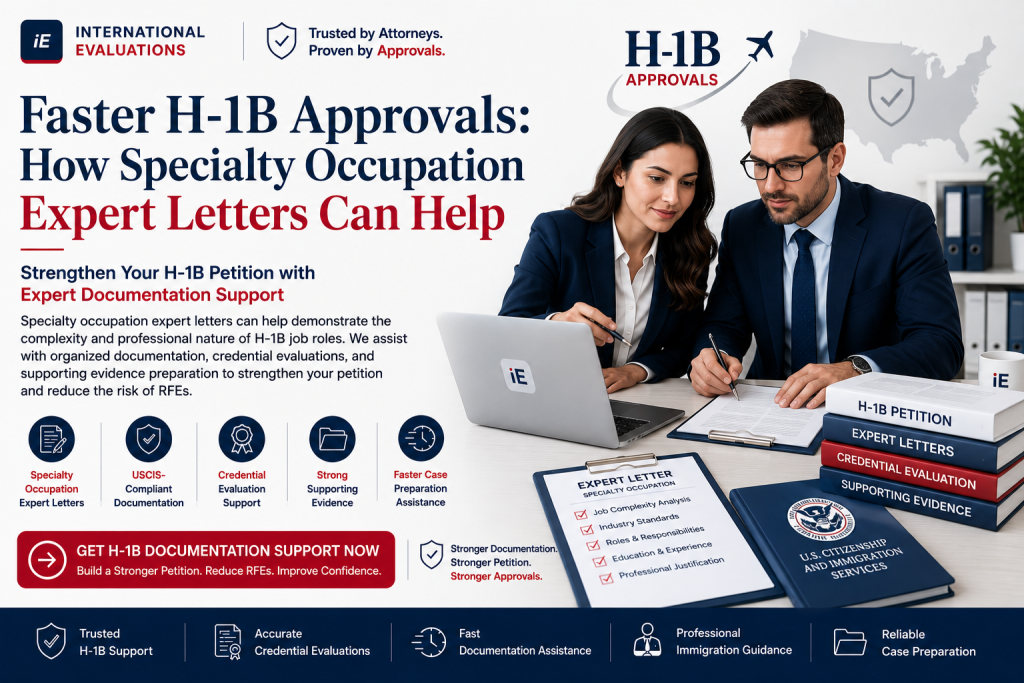
Navigating the H-1B visa process can be daunting—especially when USCIS requests proof that your role qualifies as a “specialty occupation.” This is where a Specialty Occupation Expert Letter can become a powerful ally, bridging the gap between your job duties and immigration requirements. With the right guidance and documentation, what once felt like an uphill battle can transform into a confident, well-supported application that moves swiftly through adjudication. Initial Case Review & Eligibility Assessment Our H-1B specialists begin with a comprehensive review of your position, educational background, and employer details. We evaluate job descriptions, industry norms, and SOC codes to determine if your role meets USCIS’s specialty occupation criteria. This proactive analysis ensures that your petition is built on a solid foundation before moving forward. Crafting a Tailored Specialty Occupation Expert Letter Strategy Once the eligibility is confirmed, we design a customized plan for obtaining an expert letter that aligns perfectly with your position. Whether your field is engineering, IT, finance, or healthcare, we identify a highly qualified industry expert whose credentials meet USCIS standards. This ensures the letter carries the professional weight needed to influence adjudication positively. Selecting the Right Expert Witness Not all experts are created equal. We vet specialists with advanced degrees, relevant industry publications, and real-world experience. The chosen expert carefully analyzes your role, required qualifications, and industry norms to produce an authoritative statement demonstrating why your position demands specialized knowledge and a bachelor’s degree or higher in a specific field. Drafting & Refining the Expert Letter Our team collaborates closely with the expert to ensure the letter is comprehensive, precise, and USCIS-compliant. It details: The complexity of your job duties Industry standards for similar roles Why your educational background is essential to the role How your position meets specialty occupation regulations This attention to detail minimizes the risk of Requests for Evidence (RFEs) and accelerates processing. Responding to RFEs with Confidence If USCIS issues an RFE questioning the specialty nature of your occupation, a strong expert letter can be the difference between approval and denial. We prepare targeted, persuasive responses that address each USCIS concern head-on—supplemented with additional evidence such as industry data, peer job postings, and employer attestations. Supporting Cap-Exempt and Cap-Subject Cases Whether your petition is cap-subject or filed under a cap-exempt employer (such as universities or research institutions), specialty occupation expert letters play a vital role in substantiating eligibility. We tailor the content to match the filing category and processing route for optimal results. Guiding Employers Through Compliance Beyond the letter itself, we advise employers on aligning job postings, LCA requirements, and internal records to avoid discrepancies that could raise USCIS concerns. This holistic approach safeguards both the petition and future compliance. Why Choose Us for Specialty Occupation Expert Letters? With decades of combined immigration experience, we’ve cultivated a network of over 170 credentialed specialists across STEM, finance, business, and healthcare. Our proven track record in securing H-1B approvals—often after complex RFEs—demonstrates the power of pairing legal strategy with authoritative expert testimony. Conclusion In the fast-moving world of H-1B adjudications, speed and precision matter. A well-crafted Specialty Occupation Expert Letter doesn’t just defend your case—it accelerates it. By combining deep immigration knowledge with access to top-tier industry experts, we help ensure your petition clears USCIS scrutiny and reaches approval faster, with fewer roadblocks. FAQs What is a Specialty Occupation Expert Letter? It’s a professional statement from a qualified industry expert explaining why your role requires specialized knowledge and a specific degree, as defined by USCIS. When should I get one? Ideally before filing, but it can also be obtained to respond to a USCIS RFE. Can an expert letter guarantee H-1B approval? No letter can guarantee approval, but a strong one can significantly strengthen your case. Who can write such a letter? Experts with advanced credentials, substantial industry experience, and professional credibility in your field. Does premium processing help with H-1B speed? Yes. When paired with a strong petition and expert letter, premium processing can deliver decisions in as little as 15 days. Schedule a Free Consultation Order a Work Experience Evaluation
Credential Evaluations Made Easy for Hiring International Employees
Unlock Global Talent with Confidence: Why Credential Evaluations Matter for Employers in 2025 Hiring internationally opens the door to an incredible wealth of talent. From tech innovators in India to healthcare specialists in the Philippines and engineers from Europe, the global talent pool is richer than ever. But for U.S. employers, there’s one common roadblock: understanding and verifying foreign qualifications. Credential evaluations bridge this gap by converting international education and experience into clear U.S. equivalents. This not only ensures compliance with immigration requirements but also helps companies hire the right people faster, without costly errors. In 2025’s fast-paced hiring landscape—where work visa processing timelines and immigration compliance are under increased scrutiny—credential evaluations are more essential than ever. Why Employers Should Prioritize Credential Evaluations When evaluating an overseas candidate, a diploma or transcript in another language—or from a grading system you’re unfamiliar with—can be a puzzle. Credential evaluations solve that puzzle by: 1. Ensuring Compliance with USCIS Requirements For employment-based visa categories like H-1B, EB-2, and O-1, the U.S. Citizenship and Immigration Services (USCIS) often requires proof that an overseas degree matches U.S. academic standards. A credential evaluation provides this verification in a USCIS-compliant format, ensuring your petition meets all requirements. For example, if your candidate’s degree from Brazil or South Korea doesn’t directly map to a U.S. bachelor’s or master’s degree, the evaluation explains equivalencies clearly—reducing the chance of RFEs (Requests for Evidence) or denials. 2. Streamlining Recruitment Across Borders Different countries have different academic structures—some award three-year bachelor’s degrees, others follow unique credit systems. Without a proper comparison, your HR department may struggle to assess whether a candidate meets your job criteria. Credential evaluations translate these records into U.S. terms—listing GPA equivalents, credit hours, and degree comparisons. This makes internal candidate comparisons straightforward, helping hiring teams move faster and onboard talent without delays. 3. Mitigating Risk and Avoiding Delays Hiring someone without verifying their credentials can lead to serious problems—ranging from visa petition denials to reputational damage. In industries like engineering, healthcare, and IT, unverified qualifications could also create compliance or safety risks. By working with a professional evaluation service, you safeguard against these risks. Reports are created by accredited experts who understand both foreign education systems and U.S. immigration rules, giving you peace of mind. 4. Supporting Records for Future Needs Once you obtain a credential evaluation, it doesn’t expire. The report can be reused for: Visa renewals Internal promotions Additional U.S. job applications for the same candidate This means one well-prepared evaluation can serve multiple purposes—saving time and budget in the long term. Quick Guide: How to Get It Right Here’s a step-by-step approach to ensuring your credential evaluations are accurate, compliant, and ready for immigration review. Step Action Why It Matters 1 Select an Accredited Provider Choose a NACES-recognized evaluator like International Evaluations—trusted by immigration officers and institutions. 2 Match the Evaluation Type to Your Needs Decide between document-by-document (overview of degree equivalency) or course-by-course (detailed credit and grade analysis). 3 Gather Documents Early Collect diplomas, transcripts, and work experience letters before starting the visa process. 4 Collaborate with Your Immigration Attorney Share evaluation requirements early to ensure they meet USCIS standards. 5 Store Reports for Reuse Keep evaluations on file for future hiring or compliance needs. Did You Know? Work Experience Can Equal a Degree Not every qualified candidate follows a traditional academic path. Some professionals build their expertise through years of hands-on experience rather than a formal degree. Work experience evaluations can translate years of professional practice into a U.S. degree equivalency. For example: 3 years of professional experience = 1 year of university study in a related field A candidate with 12+ years of progressive work in IT could qualify as the equivalent of holding a U.S. bachelor’s degree This is particularly valuable in industries where skills and achievements matter as much as formal education. Why International Evaluations Makes It Easy At International Evaluations, we know that hiring internationally can be complex—but your credential evaluation doesn’t have to be. Here’s why HR teams, recruiters, and immigration attorneys trust us: Fast Turnaround Times We understand visa deadlines are strict. That’s why we offer expedited services to deliver your evaluation when you need it—without sacrificing quality. USCIS-Compliant Deliverables Our reports are crafted to meet the exacting standards of immigration officers. This reduces the risk of RFEs and ensures your petition package is complete from the start. Support for RFEs If you’ve already received an RFE, we can prepare Expert Opinion Letters to address USCIS concerns—whether about degree equivalency, work experience, or job requirements. Personalized Client Service We work closely with employers, HR departments, and attorneys to ensure every evaluation meets your unique needs. Our team guides you through document collection, report preparation, and any follow-up questions. Real-World Example: From RFE to Approval One U.S.-based tech firm recently faced an H-1B RFE because USCIS questioned whether their candidate’s Indian bachelor’s degree matched U.S. standards. We provided a course-by-course credential evaluation and an Expert Opinion Letter from a recognized U.S. professor. The case was approved—allowing the company to onboard a highly skilled software engineer without further delays. Final Thoughts In today’s competitive hiring market, international recruitment gives your company a strategic advantage. But without proper credential evaluation, you risk delays, denials, and missed opportunities. By partnering with an accredited, USCIS-trusted provider like International Evaluations, you gain: Confidence in the accuracy of your candidate’s qualifications Compliance with immigration requirements Faster hiring decisions Long-term value through reusable reports Global talent is within your reach—make sure you unlock it with confidence, clarity, and compliance. Schedule a Free Consultation Order a Work Experience Evaluation
Certified Translations for Immigration: Avoid USCIS Delays and Denials
Submitting documents in a foreign language without a proper certified translation is one of the fastest ways to trigger a Request for Evidence (RFE), slow your case, or even face a denial. USCIS has strict guidelines, and failing to meet them can put your entire immigration process at risk. In this guide, you’ll learn what USCIS requires, how certified translations should be formatted, and how to avoid costly mistakes that could delay your approval. Why Certified Translations Matter for USCIS Every USCIS officer must be able to review your documents in English. If your evidence is in another language, you must provide: A complete, word-for-word translation — no summaries or partial translations. A signed certification statement from the translator affirming accuracy. Contact information for the translator or translation agency. Failure to meet these requirements can result in: RFEs requesting compliant translations Months of processing delays Denials if deadlines aren’t met Step-by-Step: How to Prepare a USCIS-Compliant Certified Translation 1. Gather Your Source Documents Identify all non-English documents in your immigration package, such as: Birth certificates Marriage or divorce certificates Academic transcripts and diplomas Police clearance records Employment verification letters 2. Use a Qualified Translator While USCIS doesn’t require “sworn” translators, they must be: Fluent in both the source language and English Experienced in translating official and legal documents Independent from the applicant or petitioner (avoid self-translation) 3. Include a Certification Statement Your translation must include a signed statement, for example: “I, [Name], certify that I am fluent in English and [Source Language], and that the translation of the attached document is accurate and complete to the best of my knowledge.” This statement must have: Translator’s printed name and signature Date of certification Contact details 4. Maintain the Original Format Translations should mirror the original document as closely as possible: Keep headings, seals, and stamps noted in brackets (e.g., [Seal: Ministry of Education]). Translate all text, including handwritten sections. Clearly note if any part of the original is illegible. 5. Present Originals and Translations Together In your USCIS submission: Place the original-language document first Follow with the certified translation Keep both together in the same section or exhibit Formatting Tips for Clear, Professional Submissions Use bold headers for document titles Clearly label each translation as “Certified Translation of [Document Name]” Add page numbers to both originals and translations Keep the layout clean and easy to read Advanced Tactics to Prevent Translation-Related RFEs Review all translations for spelling, date, and name consistency Use translators familiar with immigration-specific terminology Ensure formatting and language match the style USCIS expects For multi-page translations, have each page initialed by the translator How We Help Attorneys & Petitioners Win RFEs Whether you’re an immigration lawyer preparing a client’s package or a self-petitioner managing the process alone, we create expert opinion letters and organize response materials so they fully satisfy USCIS scrutiny. Why legal teams trust our services: Access to 170+ credentialed experts in STEM, business, healthcare, and more Fast turnaround to meet urgent RFE deadlines USCIS-compliant formats and language Strong track record in converting RFEs into approvals Final Word A single translation error can delay or derail your immigration case. By working with professional translators who understand USCIS requirements, you can avoid unnecessary RFEs and keep your application moving forward. We provide accurate, certified translations so you can submit with confidence and stay on track toward your immigration goals. Schedule a Free Consultation Order a Work Experience Evaluation