Expert Opinion letter, RFE’s, and H1-B visa
An expert opinion letter is a letter from an industry-level professional association stating that they have a Bachelor’s degree or higher in a specific specialty, a requirement for entry into the field. Or you can term it as a letter that supports your initial application or denial appeal. RFE’s RFE’s or requests for evidence come into play by the U.S. immigration department when they think they have incomplete evidence about the preferred position, completion of bachelor’s degree in a specific specialty, beneficiary status, or labor condition application. RFE’s are nothing but you can think of it as one more chance to get your petition approved. Special requests for RFE’s can include H1-B special occupation, beneficiary qualification, availability of work, and general requests. H1-B Special Occupation This nonimmigrant classification applies to people who wish to perform services in a special occupation, services of exceptional merit and ability. Specialty occupation can be termed as theoretical and practical application and highly specific knowledge, breaking it into simpler terms that one can perform a task that requires special skills which other workers don’t have relating to different departments. For a position to be termed as special occupation, the nature of specification duties should be so specific and complex that knowledge to perform such duties cab behold with a person with a minimum bachelor’s degree or the job is so complex that it can be performed by a certain individual with a degree. To Perform To perform one should be holding a U.S. bachelor or higher degree requested by a specific occupation from an accredited college or university or one should hold an unrestricted license, registration, or certification that authorizes one to fully practice the specialty occupation and be immediately engaged in that specialty in the state of intended employment. Labor Condition Application (LCA) Special occupation employers must obtain a certification from LCA and DOL. It includes that the employer will be subject to fines, bars if a violation is issued. Application Conditions The employer will pay the same amount and no less wage to the worker as compared to other workers or greater than the previous wage in the geographical area in which the employee is working. The employer will provide conditions that will not disturb other employed workers At the time of labor condition, there will be no strike at the place of employment Notice of filing of labor condition application with the DOL has been given to union bargaining representatives. Specialty Occupation and H1-B Given an overview of your position fits into a special occupation the chances of getting you an H1-B increase drastically. What’s need to be done As the denial rates are increasing thanks to COVID and much stricter norms because of previous U.S. government, you must showcase your application that it qualifies in the first attempt if not then our leading experts from various fields including professors, Ph.D. holders, managers will evaluate you both work experience as well as academic and showcases how it is equivalent to the necessary academic criteria as well as in terms of skill needed for a particular field. They have been in this field for quite some time, they know what they are doing. What’s needed Academic related documents like transcripts, mark sheets All detailed resumes specifying jobs held, job duties from previous employers specifying periods of employment. Supporting letter from previous employers specifying periods of employment, job duties. Our experts cover a wide variety of from mechanical, fashion design, medicine, nursing, construction management, finance, and more. So go ahead without a doubt and succeed in your professional working goals Trust International Evaluations. We know your goals are important. A well written Expert Opinion letter can be very helpful for work permit in usa.
Working in the US with Beneficiary Qualification Letter
Beneficiary Qualification Letter – You must know about the reality before applying for the H1-B visa for working purposes, don’t panic it’s just a heads up before we get to the solution. The visas declined to an all-time low as a stat 12.6% in the year ending September 2021 thanks to the pandemic and stricter policies stemming from the pandemic according to immigration lawyers. But a ban has been lifted by Biden’s government on the ban of H1-b visas to expire which allows foreign skilled workers to cover up for the shortages in the tech industry. The program allows 85,000 new visas annually but the worker can change their companies and roles within companies to extend their visas. There were record layoffs in STEM jobs, but the sector recovered quickly as compared to others. There were 230,000 jobs in the IT sector according to the U.S. Bureau of Department of Labor, which means what we are seeing is a resurgence in employment and that’s great news. Beneficiary Qualification Letter A Beneficiary qualification letter is a letter that helps a petitioner make his case stronger when applying for a foreign position that he is qualified in the specialty category to attain the requested position. Usually, due to USCIS, strict standards, an RFE is issued, that’s where it will come in handy. Specialty Occupation and H1-B H1-B This nonimmigrant classification applies to people who wish to perform services in a specialty occupation, services of exceptional merit and ability. Specialty Occupation Eligibility Theoretical and practical application and highly specialized knowledge. Should have a Bachelor’s degree in the specific specialty (or its equivalent), a condition for entering the U.S. Position to qualify for specialty occupation Bachelor’s or higher degree or its equivalent is a minimum condition for entry into a particular condition. The degree required should be common to parallel position among same organization or the job is so complex that it can be performed by a certain individual with a degree. The employer required a degree or its equivalent for the position. The nature of specific duties is so special and complex that knowledge to perform such duties can be held with a person with a minimum Bachelor’s degree. For a Person to Qualify to Perform a Specialty Occupation Holds a U.S. bachelor’s or higher degree required by the specialty occupation from an accredited college or university. Holds a foreign degree that is equivalent to a U.S. bachelor or higher degree required by the specialty occupation from an accredited college or university. Holds an unrestricted state license, registration, or certification that authorizes you to fully practice the specialty occupation and be immediately engaged in the specialty in the state of intended employment. Have education, specialized training, or responsible experience that is equivalent to completion of a U.S. bachelor’s degree or higher in a specialty occupation and have recognition of expertise in the specialty through progressive positions directly related to specialty occupation. Period of Stay An H1-B specialty occupation worker will be allowed for 3 years or an extended maximum of up to 6 years though some exceptions may apply under (AC 21). H1-B Cap The H1-B classification is subjected to 65,000 new visas each fiscal year; however, it may change from time to time given the conditions, outside related. However, the point to note is 20,000 petitions filed with those with master’s degrees or higher from U.S. institutions are exempted from this cap. The RFE’S So why I’m talking to you about RFE, for the same reason you are here, you applied the USCIS didn’t seem you fit for the particular position and requested for RFE’s or if you are new to this, let me break it for you. The thing is if you apply for any type of visa and the USCIS, the immigration organization seems that you don’t fit or proofs are not enough for the given position or scenario you are applying they will request you for RFE’s, and trust me it’s not the end of the world if such a situation persists. The Solution The solution is just a click away, Beneficiary qualification letter as said above it’s a letter that helps you strengthen your position that you fit for the particular profile. How it Works It determines job about qualification falls under specialty occupation, a job that requires theoretical and practical knowledge in a particular field like architecture, physical science, medicine, law, health. What’s Needed Your academic work-related documents are to be submitted like degree letters and more to be submitted and notarized. resume including jobs held, responsibilities if any. Transcripts, postgraduate degrees, publication copies. Reference letter from industry colleagues, employers. So, what are you waiting for get yourself out of the hassle and trust our experts who have been dealing with you like a pro and have your dream come true of working in the U.S? Trust International Evaluations and we will not let you down, we know your dreams are important.
A Guide Through Specialty Occupation Evaluation and H1-B Correlation
Specialty Occupation Evaluation can be termed as nonimmigrant classification which applies to people who wish to perform services in a specialty occupation with an area of expertise and exceptional merit in a given field. Eligibility criteria for specialty occupation Theoretical and practical application in the given area and highly specific knowledge about the particular field. Should have a bachelor’s degree in the specific specialty (or its equivalent) condition for entering the U.S. Position to qualify for specialty occupation Bachelors’ degree or higher or equivalent minimum criteria for entry into a particular position. The degree required should be common to the same position among parallel organizations or the job is so complex that it can be performed by a certain individual with a degree. The employer required a degree or its equivalent for the position The nature of specific duties is so specific and complex that knowledge to perform such duties can be held by a person with a minimum bachelor’s degree. Qualification of person to perform in a specialty occupation Holds a U.S. bachelor’s or higher degree required by a specific occupation from an accredited college or university. Holds a foreign degree that is equivalent to a U.S. bachelor or higher degree required by a specific occupation from an accredited college or University. Holds an unrestricted state license, registration, or certification that authorizes you to fully practice the specific occupation and be immediately engaged in that specialty in the state of intended employment. Have education, specialized training, or responsible experience that is equivalent to completion of a U.S. bachelor’s degree or higher in a specific occupation and have recognition of expertise in the specialty through progressive positions directly related to specialization. H1-B Electronic registration process In 2020 USCIS started an electronic registration process. The main point to note down is that it will not be considered if it’s not filled in the same fiscal year or based on a valid beneficiary. Labor condition application (LCA) Specific employers must obtain a certification from LCA and DOL.IT includes that the employer will be subject to fines, bars if a violation is issued. Conditions for Application The employer will pay the same and no less wage to workers as compared to those already working there or greater than the previous wage in the geographical area in which the employee is working. The employer will provide conditions that will not disturb other employed workers. At the time of Labor condition, there will be no strike at the place of employment. Notice of filing of Labor condition application with the DOL has been given to the union bargaining representative. Period of stay An H1-B specialty occupation worker will be allowed for 3 years or a max extended 6 years though some exceptions may apply under (AC act). Your employer is responsible for the return cost if they terminate your employment before the end of the period of stay. They will not be responsible if you voluntarily resign from the organization. H1-B Cap The H1-B classification is subject to 65,000 new visas each fiscal year. 20,000 petitions filed with those with master’s degrees or higher from U.S. institutions are exempted from this cap. H1-B workers who are employees at higher education institutions or nonprofit organizations or government research organizations are not subject to this cap. Specialty Occupation Evaluation These are used in response to USCIS RFE’s that challenge whether petitions for H1-B visas involve specialty occupation Specialty Occupation Letter It establishes an offered H-1 position as a USCIS specialty occupation, our experts are a master to demonstrate and put your case in your favor in case of an RFE as they will highlight your educational and work experience that matches the given criteria of specialty occupation. Requirements Employers support letter and a description of the petitioner and a detailed list of required job duties for the offered position Overview If your petition matches as a specialty occupation the chances of you getting an H1-B visa increase manifolds so trust our leading experts and succeed in your career and life goals. You are one step away from your goals, let International Evaluations help you achieve that.
How Expert Opinion Letter may help you achieve your foreign goals
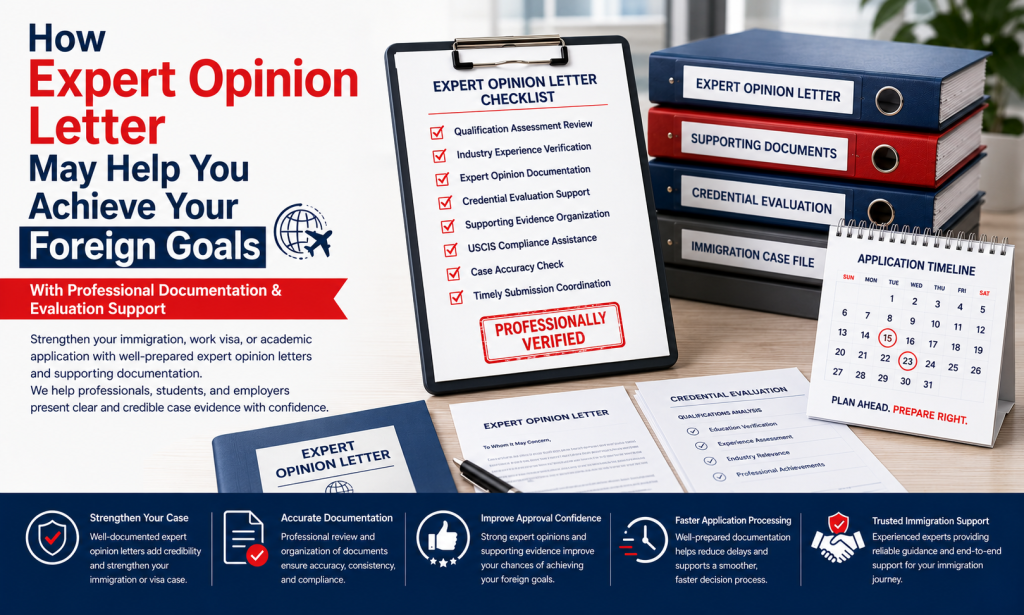
Each year 140,000 immigration visas are available for noncitizens who seek to immigrate to the U.S. on job skills. If you have the right skills, education, work experience you can have your foreign goals of permanently living in the U.S. achieved. The Issues There will come some hindrances in the path of your foreign goals. USCIS is quite stern while overlooking the application of petitioners who seek to work in the U.S. as it provides a great opportunity for a well-balanced life. Looking from the officer’s point of you if they doubt that your education, work experience is not up to the mark for the position you filed in a given particular field of interest, they can send out Request For Evidence seeking additional documents proving that you fit for the profile. Time matters If you are being sent an RFE you must make it a priority to reply in time, here’s where our experts will come in handy also denial rates are increasing day by day, the time lost in delays can cost many dollars. Why the RFE or denials? They can be issued if you do not meet the USCIS criteria that you fit for the particular profile mainly due to: Insufficient educational certificates, diplomas Lack of support that your work experience doesn’t match the time interval and area as equivalent to U.S. academic gradings. Types of Visas one can apply If you plan to work and live permanently in the U.S. there are several options available. Some require you to already have a job offer, the employer in the U.S. will be your respective sponsor. Some employers need to get a Labor Certification from the U.S. Department of Labor before submitting an immigration petition to USCIS. If you apply based on classifications such as extraordinary ability or as nonimmigrant E-1, E-2, you are eligible to file your application. Labor Certification: It highlights that there is a crunch of skilled and willing U.S. workers to fill up the particular position and that it won’t affect the rest of the same level employees in terms of wages and working conditions. EB-1: If your case stands for or your area of expertise lands in extraordinary ability in science, arts, outstanding professors, managers, you need not get a Labor certification. EB-2: If you are a member of professionals holding an advanced degree for a person with extraordinary ability in science, arts, and more such fields, you may need a Labor certification unless the applicant can obtain a national interest waiver (Labor Certification). EB-3: These are reserved for skilled workers; professionals and you need a Labor Certification if you fall under this category. EB-4: Special immigrants which include religious workers employees of U.S. foreign service posts, retired employees of international organizations, and you don’t need a Labor certification for this. The Solution- Expert Opinion Letter An Expert Opinion Letter addresses academic and employment experience qualifications which support your case how your position relates to your knowledge and abilities. Here your case is made stronger than your qualification and educational qualifications are equivalent to the academic and abilities required for the position filled by you sponsored by the respective employer. What’s Needed Your academic documents like your degree, publications, transcripts, postgraduate degree, (work-related documents) – the name of companies, a period in previous companies in English and notarized. Detailed resume specifying jobs held, Name of companies, jobs held, job duties, month/year of joining and leaving. Supporting letters from previous employers specifying periods of employment, job titles, proving that you have valid work experience. Why International Evaluations? We have a wide variety of experts from executives, Ph.D. holders, professors, and more who have the best knowledge of how to present and analyze your case in the best way possible. Also, we cover a wide range of disciples from engineering, medicine, arts, fashion designing, and more. Try and test yourself.
A Guide through H1-B RFE (Request for Evidence)
An RFE stands for Request For Evidence, this is issued upon by USCIS (US Citizenship and Immigration Services) mainly due to lack of primary evidence issued by the petitioner (employee). RFE for H1-B Visas Usually, people come into panic mode when an RFE is issued, just put it simply that your application is not rejected and is being considered that you give required or satisfactory proofs required for an H1-B visa. USCIS is stern considering the H1-b visa policy, especially when under Trump Administration, so if an officer feels that the proofs are not enough, they will send out an RFE. Why RFE (Request for Evidence) is issued? There are many reasons why an Request For Evidence is issued, some of them are as follows: Work experience proofs, not enough: When considering an application for an H1-B visa, the officer takes notes that your work and academic proofs should be equivalent to the requirement for a particular position if they seem like something missing like academic proof like a diploma, they can issue an RFE and more such cases related to academic proofs. Relation between employee and employer: The proofs can be asked that there is valid relation between employer and employee such as that the employee reports to a specific manager who works in the company and that the company where he works and who has filed the petition are the same. Specialty Occupation: This comes in very handy if the officer doubts that the given petitioner doesn’t qualify theoretically and practically for that particular role, they can have this up against for sending out an RFE, you should provide enough proofs that you have a specialization for the given position by handing out documents from previous employers, mark sheets in area of position and experience proofs in the same area as applied. There is a deadline! When the RFE is issued, a period is given to hand out documents, usually 60-90 days. The point to be noted is that you should start counting the days when it was issued and not when you received it. Also, if you travel extensively, you should have a backup because you do not want to miss an RFE, if You do miss the deadline your application is most likely to be rejected. You must meet the deadline otherwise the organization will consider it as abandoned and in which case it will most likely come out as a denial. What you can do Expert opinion letter An expert opinion letter is an evaluation done by an expert/professor, it’s a combination of academic, experiential credentials and evaluation of a candidate in context to a specific visa category usually H1-B. Our expert will take into account your experience and academic qualifications and put that in a way to issue a degree equivalent as per USCIS regulations. Our experts will take into account the work responsibilities, position, time interval of occupation, and issue an academic equivalent as per USCIS standards and will be accompanied by expert credentials that they have the authority to grant University-level credits. What’s needed? Resume detailing jobs held, responsibilities, ethics letter, the time interval at the given position. Reference letters from previous companies verify that you have valid work experience from that particular organization. Academic records, university transcripts, and English translation of all the documents. Conclusion The H1-B visa is most likely to be issued if you have a specialist occupation, that you fit for that profile given your experiences and academic background so don’t go for any other positions rather than your area of specialty. You can go ahead with International Evaluations experienced experts if you get into this scenario. We have experts who can handle Request for Evidence.
What is Work Experience Evaluation to issue an H1B visa?
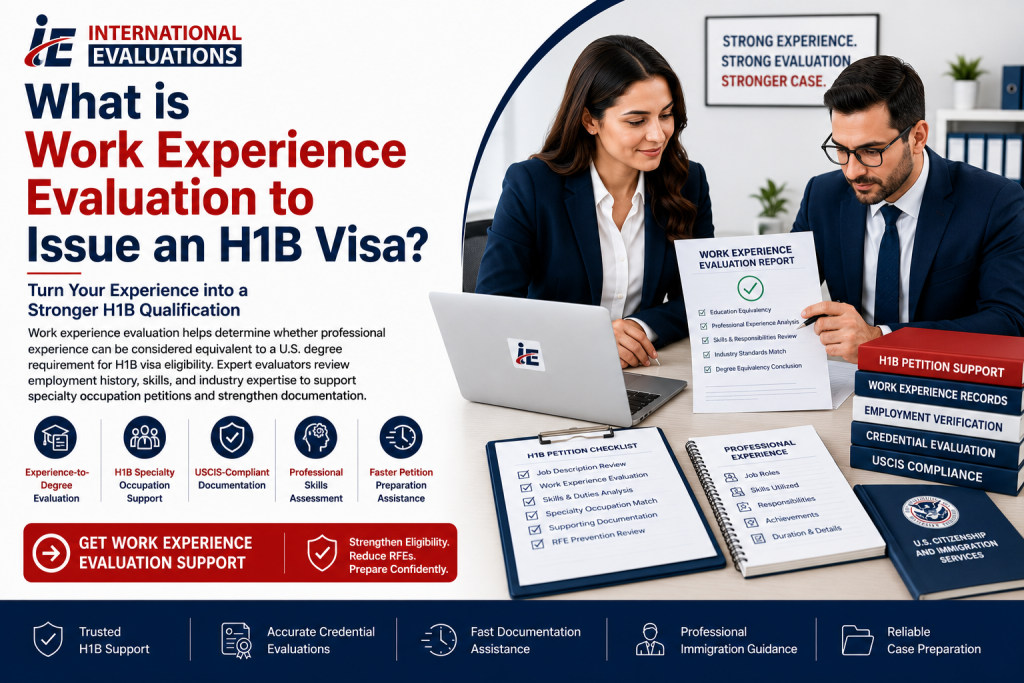
The Work Experience evaluation is required when a consultant’s formal education is not equivalent to the minimum education requirement of the consultant’s prospective employment. At International Evaluations, we take care that our expert panel takes into account the individual’s professional experience and issue a degree equivalency based on the USCIS regulations. Therefore, an International Evaluations expert/professor can help in issuing an H1B visa. What is Work Experience Expert Letter? The Work Experience Expert Letter is an evaluation from an expert, typically a college professor, that can be based exclusively on work experience credentials or on a combination of academic/experiential credentials. International Evaluations will assign the evaluation to an appropriate expert in a field directly related to the candidate’s experience. Our professors look at how training and overall employment duties filled by the candidate equate to academic credit based on USCIS standards. These letters will be accompanied by the evaluating expert’s credentials which will typically include their resume and proof that they have the authority to grant university-level credits based on experience. In order to produce a Work Experience Expert Letter, we require the following: A thorough resume detailing specific jobs held, names of employers, dates of employment, and responsibilities of the positions held. Reference letters from previous employers verifying all details of the employment mentioned in the resume. All academic records, including university transcripts, diplomas, and English translations The work experience evaluation is provided for immigration purposes predominantly for those applying for H-1B visas. The report evaluates both an individual’s professional work history (using the USCIS “three-for-one rule”) along with his/her academic qualifications in order to achieve a Bachelor’s degree equivalency. It means when making a determination whether a foreign national possesses the required academic credentials necessary for an H-1B occupation, the USCIS will consider three years of specialized training and/or work experience to be the equivalent of one year of college education. A Master’s degree equivalency may also be achieved through work experience under the USCIS “Bachelor’s plus five rules” in which an individual who possesses a U.S. Bachelor’s degree or foreign equivalent and a minimum of five years of professional work experience may be considered to have the equivalent of a U.S. Master’s degree. International Evaluations is a dedicated organization providing the highest quality evaluation services for all your H1B specialty occupation-related queries. Our services include RFE solutions, Expert Opinion Letters, Education/Work Experience Evaluations.
How To Avoid RFE in Marriage Based Green Card
An Marriage Based Green Card RFE, the name suggests, is solely a call for participation for additional documentation. It means the USCIS officer reviewing your application desires additional data before he or she will build a call. An RFE doesn’t mean that your application goes to be denied or perhaps that it’s additionally possible to be denied than if you hadn’t gotten the RFE. Think of an RFE as a second likelihood to review your application and make sure that you have got provided the foremost compelling proof that your wedding is real, which you or your spouse are eligible for a marriage-based identification. It is vital that you simply reply to the Request for proof and supply the maximum amount of the requested proof as potential by the point in time indicated on the notice. If your RFE requests quite one document, you have got to send everything along in one response packet. If you don’t meet the point in time, USCIS can decide a call based on documents it already has, which usually means that your application is going to be denied. How to Avoid an RFE? The best way to handle a USCIS for proof is to avoid obtaining one within the 1st place. Despite the fact even though essentially mean that your application is going to be denied, it’ll continually end in extra delays. In most (but not all) cases, RFEs are often avoided with a completely ready application. In general, RFEs are sent any time by USCIS officer reviewing your application desires additional information—but many specific reasons are particularly common: Proof Missing of Legal Entry If the Spouse seeking a green card is already in the US you need to prove that he or she entered the US Legally. For most people, this suggests providing a duplicate of your sealed passport and/or a duplicate of your I-94 travel history, the shape that U.S. Customs and Border Protection (CBP) uses to trace arrivals and departures. If you arrived within the US by plane or boat before 2013, you bought a paper I-94. You furthermore might still get a paper I-94 if you enter the US by land from a North American nation or North American country. If you arrived by plane or boat after 2013, however, your data was entered into information, and you didn’t get a physical slip of paper. Therein case, obtaining a duplicate of your I-94 online is comparatively straightforward. If you lost your original I-94 and your records aren’t out there on the CBP website, you’ll be able to file type I-102 to request a replacement I-94. Missing Initial Proof If you did not give any documents, forms, or alternative proof necessary to prove that you’re eligible for a marriage-based positive identity, you may get an Marriage Based Green Card RFE and that’s an honest thing—certainly desirable over USCIS outright denying an application that was missing needed initial proof. The Sponsoring Spouse Lacks Sufficient Income When applying for a marriage-based green card, the U.S. national or green card holder should demonstrate enough monetary resources to support the family within the US (typically by earning a minimum of one hundred and twenty-fifth 125% of the federal impoverishment line). Failing to supply enough documentation to prove comfortable financial gain may be a common reason for RFEs. If the sponsoring significant other doesn’t earn enough, he or she will notice a co-sponsor—often a family member—who agrees to support the couple within the US. You’ll be able to see our handy guide to search out if you meet the support needs. Missing Document Translations If any of your documents are in a language apart from English, you need to give a translation created by somebody apart from you or your significant other. These translations have to be compelled to be certified, which simply means the translator should certify in writing that he or she has translated the document accurately. The certification ought to embody the translator’s name, address, and signature, further because of the date the interpretation was completed. Uncommon Cases If there are any uncommon aspects of your case, give extra explanations or proof to pre-empt queries from USCIS. As an example, if your antecedent applied for green card identification for somebody else (an ex-spouse), however, finished up retreating your identification application, you must embody a written rationalization of that scenario. Why is RFE important? If you receive AN RFE, do not panic. It doesn’t mean that the denial of your application is inevitable; solely that USCIS desires or needs additional data from you to form a call. In a way, you must be glad you did not receive an outright denial, as USCIS has the facility to issue. An Marriage Based Green Card RFE offers you a chance to correct data, give additional documentation, and win over immigration officers to approve your case. Make sure that you simply come back your RFE before the point in time given by USCIS. If you fail to reply, USCIS can either confirm that you simply abandoned your application or issue a denial, or {it can it’ll} build a final call on your case, while not the knowledge that it requested (which presumably will end in denial as well). This is why it’s necessary to vary your address with USCIS if you progress, or build arrangements for your mail to be forwarded to you if you travel extensively. If USCIS sends you an RFE, you do not wish to miss it. We, at International Evaluations will help you to solve your RFE. Our clients praise us for our great results, personable service, expert knowledge and on-time delivery.
What is a Credential Evaluation for a Foreign Student?
You need to understand about Credential Evaluation for a Foreign Student. Education is the basic building block of one’s future. If your future course doesn’t retain recognition from foreign universities, then it’ll diminish your possibilities of obtaining a consecutive degree from abroad. Therefore, it’s knowing to get your degree examined by a professional organization like International Evaluations before you apply to International Universities. What is Credential Evaluation? The credential analysis is often understood because of the estimation of your current degree in a global platform. it’s principally dispensed by countries just like the USA or North American nation since their academic ministry doesn’t measure foreign degrees during which tutorial and skilled degrees attained in one country square measure compared to those attained in another university, faculties, and employers around the world The conception of international papers analysis isn’t solely restricted to effort a degree; instead, it applies to a far off worker still. Since it’s a vital method, you want to solely take into account professional bodies like International Evaluators for the duty. The international Evaluation is one of the best organizations which provide the Credential Evaluation usually and customarily. It generally offers 3 forms of evaluations: Course by Course Credential Evaluation The Course by Course Evaluation report identifies and describes every diploma/certificate and provides an equivalency for every document. It indicates an outline of periods of education, courses, credit hours, grades, and degrees, still as overall tutorial performance in terms of the tutorial system within us. The US generally uses semester credits and a mark average, or GPA, on a 4.0 scale. This sort of report is usually needed for school admissions, crucial transfer credits, or once applying for a complicated degree, still as for skilled licensing and certification matters. Documents needed during this case embody, however, don’t seem to be restricted to, originals or certified copies of college transcripts (mark sheets) showing subjects studied, grades, and credit hours attained for every course of study. Academic Credential Evaluation (document by document) The document by document Credential Evaluation analysis report describes and lists the tutorial institution(s) attended and also the education credential(s) attained during a foreign country and states their U.S. equivalence (e.g. Bachelor, Master, Doctorate, etc.). This sort of papers analysis is most typical to be used in a job, immigration matters, and university admission once transfer credit isn’t expected. Skilled Work Expertise Evaluation The skilled work expertise Credential Evaluation is provided for immigration functions most typically for those applying for H-1B visas within the US. This Credential Evaluation for Foreign Student report evaluates each Associate in Nursing individual’s skilled work history and academic credentials to determine a Bachelor’s degree equivalency. This sort of Credential Evaluation can’t be used for academic or licensure functions. How does it help? A papers analysis report will facilitate university admissions officers to create admissions choices by taking your previous education and knowledge under consideration. The time and energy invested within education are paid off once your tutorial credentials square measure understood and recognized properly.
Your Foreign Credential Evaluation- The Myths
There have been many myths about foreign credential evaluation. Here, we are talking about some common myths that people have about credential evaluation. Myth 1: The academic certificate or degree of the applicant will be equivalent in the United States. It is important to know that the academic degree obtained in another country may not be equivalent to a degree obtained in the US. For example, a 3-year honors bachelor’s degree from Australia, UK, or South Africa is equivalent to a 4-year bachelor’s degree in the US. It’s not about just the number of years the degree takes to complete. It depends upon so many other factors while we doing the evaluation. Myth2: Many think that foreign credential evaluation companies will just issue another academic transcript or certificate. This is to make clear that we do foreign transcript evaluation have no legal authority to issue any educational certificate, transcript, or diploma. Only duly the U.S. accredited educational institutions have the authority to do so. The only document we issue is the report called credential evaluation report. This report has information pertaining to the applicant’s academic degree/diploma awarded by a non-US institute. Also, has the equivalency of the credentials in the United States. Myth 3: The process is tedious and time-consuming for foreign credential evaluation. This is not true. The process is easy if we have obtained all academic documents from the applicant. The verification of education credentials might take some time but it’s definitely not tedious. So, the process can be easy if the evaluators have access to all the required documents. Myth 4: The evaluation report has no expiry date. Please note that some evaluation report has a validity of two years, while others can be valid for three years. There are credential evaluation companies that have a policy in place regarding the validity or expiration of the report. Myth 5: The evaluation report prepared by evaluators are the same format and are accepted throughout the United States. The format of the report differs just like transcripts and diplomas issued by education institutions (college and universities) are different. The format can not be the same for all the reports. For example, we follow a format that is different from another foreign evaluation company. It is always advised to check with the employer or educational institutions they are applying whether they will accept the format. Myth 6: The credential evaluation companies charge the same fees for the reports. The fees of the evaluation company can vary. At, International Evaluation, we do not charge the same fees. The fees are charged depending upon the type of credential evaluation the applicant wants to have. For example, it may vary whether Academic or Work Experience evaluation. It can be an RFE case and to evaluate that we can charge a little high. Myth 7: Foreign credential evaluation is only for educational purposes. The credential evaluations besides gaining admission into college or university can be for employment, immigration, or for professional licensure. It depends upon the purpose you are applying for coming to the US. International Evaluations, thus, can help you for your purpose of coming to the US and make your dream come true. Myth 8: Evaluation companies do not provide translation services. It is a myth that evaluation companies do not provide translation services. The majority of them are known to provide translation services. International Evaluations is one of the examples of companies that provide certified translation services. Conclusion International Evaluations is here to answer any questions you may have. We are reliable, affordable, and trusted with quick and easy application processes. Contact us today.
Why is it necessary to have your Credentials Evaluated?
Credentials Evaluated: Education is an elementary foundation stone of one’s career. We spent a considerable amount of time and energy in education to secure our future and thus invest to attain educational degrees. In case someone wants to come to the USA, these degrees can play a fundamental part. If these degrees do not get recognized by US foreign universities, then all the hard work seems a waste. It is vital to get your degrees/diplomas evaluated by experts or organizations before applying to US universities. Obtaining a credential evaluated degree is the first step for a skilled worker aspiring to work in the US. In short, your credential evaluation helps you to achieve recognition for your entire academics. International Evaluations is the trusted agency that provides an evaluation of your credentials. Before you get to know us more, let’s understand the concept and requirements of a credential evaluation. Importance of Credential Evaluation So, what exactly is a credential evaluation? In simple terms, a credential evaluation is the valuation of your degrees/diplomas through an expert. S/he analyses your national education degrees those you have attained in your native land to provide a US equivalent. It means conversion of your academic credentials to fall in line with the academic credential system of the USA. There are universities, employers, etc who expect an evaluated degree from independent credential auditors. Generally, if you are applying for US universities, you need evaluated degrees. The university can ask for your evaluated degree. Even if you apply for employment in the US, you need to submit an evaluated degree for the documentation process. It is a very critical process, only experts with knowledge of international education systems can perform a full credential evaluation document. Why do we need a credential evaluation? The necessity of a credential evaluation arises from the fact that each country has its education system. Thus, accurate and precise validation is required of a candidate’s marks/percentage & their degrees to be calculated through a proper evaluation for Credentials Evaluated. Conclusion International Evaluations is a trusted organization, where we analyze and compare your given degrees of a certain university to that of the U.S equivalent. We assess your credentials on the basis of the education system of your native country, reputation of the university you attended & curriculum of your program me. We understand your requirements and all the hard work you have put in your academics and work experience to be duly recognized, in the US.