How to Ensure Your Degree is Recognized by U.S. Universities

For students and professionals who want to pursue higher education or career opportunities in the U.S., it is essential to verify that their foreign degree meets U.S. academic standards. Proper evaluation ensures schools, licensing boards, and employers can clearly understand your academic background. With the right credential evaluation, you can move forward confidently with admissions, advanced study, or professional licensing. At International Evaluations, we help students, graduates, and institutions evaluate foreign degrees to determine U.S. equivalency. This not only prevents delays and rejections but also strengthens your academic and career prospects. Here’s how to ensure your degree is recognized by U.S. universities. Why Degree Recognition Matters U.S. universities rely on standardized criteria to assess foreign academic qualifications. Recognition of your degree ensures that: Your application meets admission requirements – Universities can compare your academic background with U.S. standards. You qualify for scholarships or funding – Many scholarships require degree equivalency. Your professional credentials are valid – Some licenses and certifications depend on recognized academic qualifications. You avoid delays or rejections – Admissions offices may issue conditional acceptance or reject applications if your degree cannot be evaluated. Degree recognition is often the first step toward academic and professional success in the U.S. Key Steps to Ensure Your Degree is Recognized 1. Obtain Official Academic Transcripts US universities require official transcripts directly from your institution: Include course names, grades, and degree awarded Ensure transcripts are sealed and signed by the issuing institution Provide translations if the transcripts are in a non-English language Official documents form the foundation of any evaluation or recognition process. 2. Get a Credential Evaluation Credential evaluations compare foreign degrees to U.S. educational standards. There are two main types: Course-by-Course Evaluation – Breaks down each course, credits, and grades for U.S. equivalency Document-by-Document Evaluation – Confirms the degree and institution without detailed course analysis Credential evaluations: – Ensure your degree aligns with U.S. academic requirements – Help universities assess credit transfer and program eligibility – Are often required for admissions, employment, and licensing 3. Verify Accreditation Accreditation matters when evaluating degree recognition: Degrees from recognized, accredited foreign institutions are more likely to be accepted Check if your institution is listed in official educational directories or recognized by your country’s education ministry Universities may refuse degrees from unaccredited or unrecognized institutions 4. Provide Certified Translations Foreign-language transcripts and diplomas must have USCIS-compliant certified translations for evaluation: Ensure translations are accurate, complete, and certified Include all pages, stamps, and signatures Maintain consistent terminology and formatting Certified translations prevent misunderstandings and speed up the recognition process. 5. Include Detailed Course Descriptions U.S. universities may require course descriptions to understand your curriculum: Outline subjects, credit hours, and content covered Include syllabi, textbooks, or program outlines if available Helps universities determine equivalency and transfer credits Providing detailed information increases the likelihood that your degree will be recognized. 6. Consult with Experts Working with credential evaluation experts ensures your documents are reviewed accurately and professionally: Experts verify course content, degree levels, and grades against U.S. standards They produce evaluations accepted by most universities and licensing boards Professionals anticipate potential questions or gaps USCIS or universities might identify International Evaluations has a team of experts across multiple fields to guide you through this process. Benefits of Ensuring Degree Recognition Ensuring your degree is recognized by U.S. universities provides several advantages: Smooth Admission Process – Avoid delays, conditional acceptances, or rejections. Eligibility for Advanced Degrees – Demonstrate qualification for master’s, PhD, or professional programs. Professional Licensing – Meet requirements for regulated fields such as engineering, nursing, or law. Scholarships and Funding – Access financial aid and grant opportunities. Career Opportunities – U.S. employers value verified academic credentials. How International Evaluations Helps At International Evaluations, we help students and professionals ensure their foreign degrees are properly recognized by U.S. universities, employers, and licensing boards. Credential Evaluations – Course-by-course and document-by-document evaluations accepted by universities. Certified Translations – Accurate, USCIS-compliant translations of transcripts and diplomas. Expert Guidance – Advice on course descriptions, credit transfers, and admission requirements. Fast Turnaround – Timely evaluations to meet university deadlines. Multi-Field Expertise – STEM, business, healthcare, law, and more. Common Mistakes to Avoid Even minor oversights can delay degree recognition: Submitting unofficial transcripts or incomplete documents Using non-certified translations for foreign-language documents Failing to provide course descriptions or syllabi Overlooking accreditation verification Ignoring credential evaluation requirements for admissions or licensing Avoiding these mistakes ensures a smooth, efficient process. Real-World Impact Students and professionals who ensure their degrees are recognized experience: Faster University Admission – Evaluations streamline the application process. Better Academic Planning – Universities can advise on credit transfer and program eligibility. Higher Scholarship Opportunities – Verified credentials improve eligibility for funding. Career Advancement – Recognized degrees open doors to U.S. employment and licensing. Take Action Today Your foreign degree can unlock opportunities in U.S. education and careers—but only if it is recognized. By obtaining credential evaluations, certified translations, and expert guidance, you can confidently apply to universities and advance professionally. Contact International Evaluations today to ensure your degree is recognized by U.S. universities. Fast, reliable, and professional services keep your academic journey on track. Email: info@internationalevaluations.com Phone: +1 (510) 876-0900 Website: www.internationalevaluations.com International Evaluations — Ensuring Your Foreign Degree is Recognized in the U.S.
Prevent F-1 Visa Rejection by Preparing the Right Documents
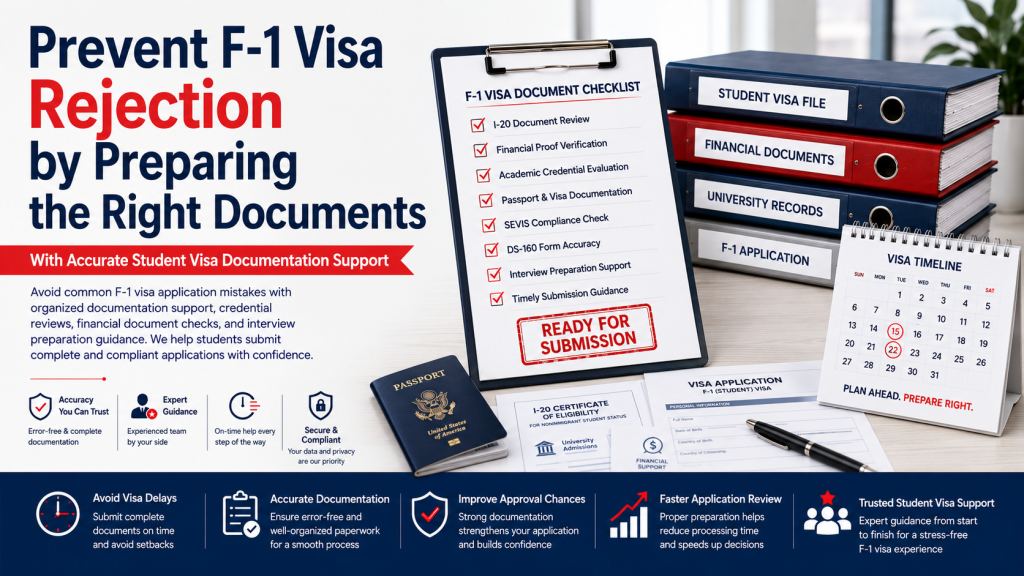
Applying for an F-1 student visa is an exciting step toward studying in the U.S., but it can also be stressful. USCIS carefully reviews every application to ensure eligibility, and even minor mistakes or missing documents can result in delays, RFEs (Requests for Evidence), or outright visa denials. The key to preventing F-1 visa rejection is preparing the right documents in a clear, complete, and USCIS-compliant manner. At International Evaluations, we help students, parents, and educational institutions ensure every document meets U.S. requirements—minimizing risks and maximizing approval chances. Why Proper Documentation Is Crucial for F-1 Visas USCIS requires evidence that the student: Is admitted to a U.S. SEVP-certified institution Has sufficient financial resources to cover tuition and living expenses Intends to return home after completing studies
Why Leading HR Teams Outsource Immigration Paperwork to Experts
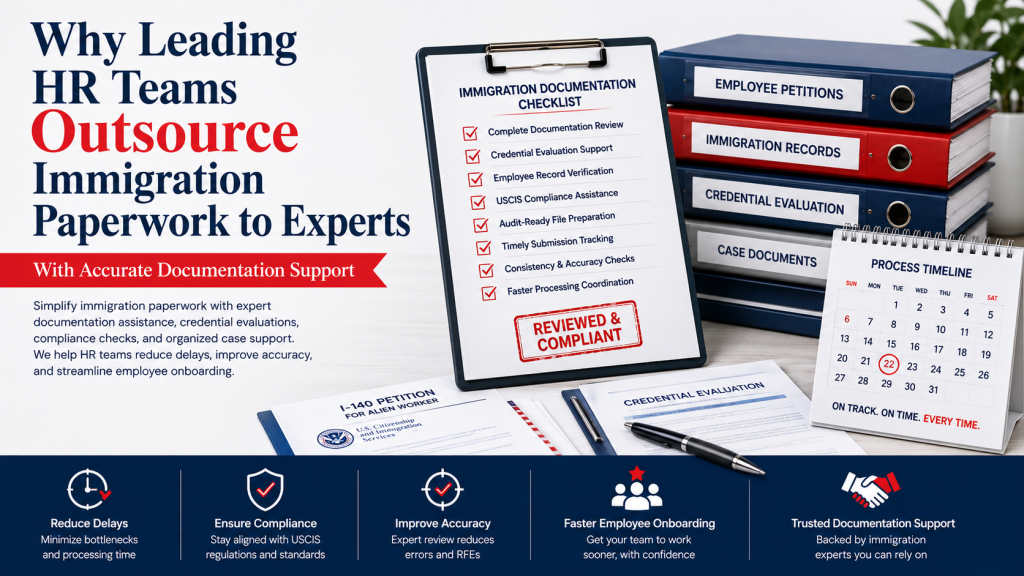
In today’s fast-paced global job market, hiring international talent has become essential for many U.S. companies. But along with the benefits of diverse, skilled professionals comes a mountain of immigration paperwork — complex forms, tight deadlines, and constant updates to USCIS regulations. For HR teams already juggling recruitment, onboarding, and compliance, managing immigration filings internally can quickly become overwhelming. That’s why many leading HR departments now outsource immigration paperwork to professional evaluation and documentation experts — ensuring accuracy, compliance, and faster approvals. At International Evaluations, we’ve worked with hundreds of HR leaders, helping them manage immigration documentation seamlessly while staying compliant with USCIS standards. Here’s why outsourcing has become a strategic choice for top-performing HR teams. The Benefits of Outsourcing Immigration Paperwork for HR Departments 1. Immigration Paperwork Is Time-Consuming and Complex HR professionals know that every immigration case — whether it’s an H-1B, PERM, or green card petition — involves pages of documentation, from degree evaluations and employment verification to translations and expert opinion letters. The process requires precision. A small mistake — a missing page, inconsistent job title, or unclear translation — can lead to a Request for Evidence (RFE) or even denial. By outsourcing to immigration documentation experts like International Evaluations, HR teams free themselves from hours of form-filling, reviewing, and re-verifying details. Our specialists handle every document according to USCIS guidelines, ensuring submissions are complete and compliant the first time. 2. Experts Help Prevent Costly Mistakes One overlooked error in an immigration file can have serious consequences. A wrong degree equivalency, missing certification, or improperly formatted evaluation can cause delays — or worse, jeopardize the employee’s visa status. Our team at International Evaluations specializes in: Academic & Work Experience Evaluations – Ensuring foreign degrees and work histories meet U.S. equivalency standards. Expert Opinion Letters – Written by credentialed professionals who validate education, job roles, or specialty occupation requirements. Certified Translations – Delivering USCIS-ready translations for non-English documents. By partnering with professionals, HR teams avoid last-minute scrambles, re-submissions, and unnecessary RFEs. 3. Save Time and Focus on Core HR Priorities For HR leaders, time is one of the most valuable resources. Instead of spending hours double-checking foreign credentials or researching USCIS document requirements, your HR department can focus on what truly matters — hiring, retention, and employee engagement. Outsourcing immigration paperwork shifts the administrative burden to trained specialists who know exactly what USCIS expects. Our documentation experts manage everything from evaluation requests to translation certifications, letting your HR team stay focused on supporting your workforce. 4. Access to Certified Evaluators and Industry Experts Not all documentation is created equal. USCIS often requires evaluations or opinion letters from accredited experts with specific credentials. Submitting generic or unverified documents can cause more harm than good. At International Evaluations, we work with over 170 credentialed experts across a variety of industries — including STEM, healthcare, business, and education. Our professionals provide specialized evaluations that align with USCIS standards and industry-specific job requirements. This means your HR team can be confident every document is authentic, relevant, and fully compliant. 5. Faster Turnaround During Tight Deadlines Immigration paperwork often comes with tight deadlines. When an RFE or audit notice arrives, HR must act quickly to protect the employee’s status. Our team offers expedited processing for urgent cases, ensuring reports, evaluations, and translations are ready within days — not weeks. With clear communication and fast delivery, HR managers never have to worry about missing critical USCIS deadlines. 6. Ensure Consistency Across Multiple Employee Petitions Large organizations often file multiple petitions simultaneously for different employees, each requiring unique documentation. Managing these internally can lead to inconsistencies — different formats, missing information, or mismatched degree equivalencies. Outsourcing ensures a standardized, USCIS-approved format across all cases. Whether your company is filing for five engineers or fifty analysts, our team maintains consistency in documentation quality and presentation. This not only builds trust with USCIS officers but also streamlines your company’s entire immigration process. 7. Stay Updated on Changing USCIS Policies USCIS rules and requirements change frequently. HR departments that manage immigration paperwork internally may struggle to stay current with the latest updates — leading to unintentional noncompliance. Professional evaluation agencies stay informed about every USCIS policy update, ensuring all reports meet the most recent standards. When you work with International Evaluations, your documents are always aligned with current immigration regulations. 8. Support for Attorneys and Legal Teams Many HR departments coordinate directly with immigration attorneys during the visa or green card process. Outsourcing documentation simplifies that collaboration. We provide attorney-friendly reports, meaning every evaluation, translation, and expert letter is formatted for direct submission — saving time and reducing back-and-forth communication between HR and legal teams. Attorneys appreciate receiving ready-to-use, compliant documentation, and HR departments appreciate the peace of mind. 9. Scalable Solutions for Growing Companies As your company expands, your immigration documentation needs grow too. Outsourcing allows HR departments to scale seamlessly — no need to hire additional internal staff or train employees on complex immigration paperwork. Whether you need one evaluation or a hundred, International Evaluations can handle your volume efficiently, maintaining the same level of quality and accuracy for every case. 10. Build a Reputation for Compliance and Employee Care Outsourcing immigration paperwork sends a clear message to your global employees: your company values compliance, precision, and professionalism. By ensuring every visa petition, evaluation, and translation is handled correctly, HR teams demonstrate reliability — building employee confidence and avoiding unnecessary delays that affect onboarding or project timelines. When immigration processes run smoothly, your organization attracts and retains top international talent. Why Leading HR Teams Trust International Evaluations USCIS-Compliant Formatting – All our documents meet official U.S. immigration requirements. Certified Experts in 170+ Fields – Covering STEM, business, healthcare, and more. Fast and Reliable Delivery – Urgent cases handled within tight timelines. Proven Success Rate – Thousands of clients have achieved approvals with our documentation. Attorney-Ready Reports – Streamlined collaboration between HR and
Avoid Costly Visa Denials: How Document Accuracy Impacts Immigration Success
Applying for a U.S. visa or immigration benefit is a major step — whether you’re a student, a professional, or an employer sponsoring skilled workers. But even the most qualified applicants face one common risk: errors or inconsistencies in their documents. In the eyes of USCIS (U.S. Citizenship and Immigration Services), accuracy is everything. A small typo, missing translation, or incorrect degree evaluation can lead to requests for evidence (RFEs) or, worse, visa denial. At International Evaluations, we’ve seen how a single inaccurate document can delay or derail an otherwise strong case — and how precise, USCIS-compliant documentation can make all the difference. Here’s why document accuracy is the foundation of immigration success — and how to ensure your paperwork helps, not hurts, your case. Why Accuracy Matters in Immigration Documentation Every visa petition is built on proof. From academic credentials and employment records to translations and expert evaluations, each document must demonstrate eligibility clearly and consistently. USCIS officers rely on these documents to verify your qualifications, intent, and eligibility under U.S. law. When evidence is incomplete, inconsistent, or incorrectly formatted, it raises red flags — forcing USCIS to issue an RFE or deny the case entirely. Even honest mistakes can cause serious consequences. For instance: An incorrect degree equivalency can make an applicant appear unqualified. A mismatched job title can lead to doubts about the position’s eligibility for an H-1B visa. Uncertified translations can be rejected outright. The result? Lost time, wasted money, and sometimes the loss of a valuable immigration opportunity. The Most Common Document Errors That Lead to Visa Denials Even experienced applicants and attorneys sometimes miss details that USCIS scrutinizes. Here are the most common mistakes we see: Inaccurate Degree Evaluations – Submitting a general degree comparison instead of a USCIS-compliant academic or work-based evaluation. Incomplete Translations – Failing to include certified English translations for all foreign-language documents. Unclear Employment Proof – Missing or inconsistent job verification letters, unclear job titles, or outdated company details. Mismatched Information – Different versions of names, dates, or job titles across documents. Lack of Expert Support – Submitting documents without professional expert letters that explain specialized education or experience. Formatting Errors – Missing signatures, incorrect headers, or poorly organized attachments that confuse reviewers. Each of these issues can make USCIS question the credibility of your entire case — even when your qualifications are legitimate. How Accurate Documentation Strengthens Your Immigration Case When your paperwork is accurate, verified, and properly formatted, it sends a clear message: you meet the requirements and have provided solid proof. Here’s how accurate documentation helps: – Builds Credibility: Consistent, clear, and verified information establishes trust with USCIS adjudicators. – Reduces Delays: Well-prepared documents minimize RFEs and re-submissions. – Boosts Approval Chances: Properly evaluated degrees and work experience align perfectly with visa requirements. – Simplifies Attorney Workflows: Immigration lawyers can focus on legal arguments instead of fixing document errors. At International Evaluations, we specialize in ensuring every piece of your documentation meets USCIS standards, helping applicants and attorneys avoid unnecessary risks. The Role of Professional Evaluations in Visa Approval One of the most common reasons for visa denials is degree mismatch or insufficient documentation of qualifications. That’s where professional evaluations make a difference. Our team provides: Academic & Work Experience Evaluations – Converting foreign education and professional experience into U.S. equivalency for H-1B, PERM, and other visa categories. Expert Opinion Letters – Written by credentialed professors and industry leaders to explain how your background qualifies for a specific visa. Certified Translations – Ensuring every document is accurately translated, signed, and USCIS-approved. Every evaluation we issue follows USCIS formatting and terminology, helping immigration officers easily verify eligibility. Why Employers and Attorneys Trust International Evaluations HR teams, legal professionals, and individuals across the U.S. rely on International Evaluations for documentation that meets immigration standards every time. Here’s why: USCIS-Compliant Formatting – Every evaluation, letter, and translation adheres to current USCIS policies. 170+ Credentialed Experts – Covering all major fields, from STEM and business to healthcare and education. Proven Success Rate – Many cases we’ve supported turned RFEs into approvals. Fast Turnaround – Expedited service available for urgent filing deadlines. Attorney-Friendly Documentation – Our reports integrate seamlessly into petition packages. We understand how critical timing and accuracy are in immigration — and we ensure every document you submit supports, not weakens, your case. How to Ensure Document Accuracy in Your Next Filing Follow these steps to make sure your next immigration filing is accurate and USCIS-ready: Review Every Document Carefully: Double-check names, dates, and details across all forms and evidence. Use Professional Evaluations: Always submit evaluations and expert letters from accredited professionals familiar with USCIS standards. Verify Translations: Ensure all foreign-language materials include certified English translations. Maintain Consistency: Job titles, degree names, and company details should match across your petition, resume, and evaluations. Stay Updated on USCIS Requirements: Rules change often; always confirm documentation requirements before filing. If this feels overwhelming, professional documentation services can make the process seamless — ensuring compliance without stress. Real Results from Accurate Documentation We’ve worked with hundreds of clients whose cases were initially delayed due to incomplete or inaccurate documentation. After resubmitting with our accurate evaluations and expert letters, they received approvals within weeks. From software engineers applying for H-1B visas to healthcare professionals pursuing green cards, our documentation accuracy has helped applicants overcome obstacles and secure approvals faster. Don’t Risk Your Visa on Inaccurate Paperwork Even the strongest immigration case can fall apart if the paperwork isn’t right. Don’t let preventable mistakes cost you time, money, or opportunity. At International Evaluations, we make sure your documents — from degree evaluations to expert letters — are accurate, compliant, and ready for USCIS review. If you’re preparing a visa petition or responding to an RFE, contact us today to make your case stronger and avoid costly denials. info@internationalevaluations.com +1 (510) 876-0900 www.internationalevaluations.com International Evaluations — Where Accuracy Meets Approval.
How Foreign Degree Evaluation Helps You Qualify for U.S. Immigration
Applying for a U.S. visa or employment-based immigration benefit requires more than just strong credentials — it requires proof that your foreign education meets U.S. academic standards. This is where foreign degree evaluations play a crucial role. Even highly skilled professionals face visa denials because their education documents weren’t properly evaluated. U.S. Citizenship and Immigration Services (USCIS) requires precise, compliant documentation that clearly explains how a foreign degree compares to an American degree. At International Evaluations, we specialize in creating USCIS-compliant academic and work experience evaluations that help applicants, attorneys, and employers build stronger, more credible immigration cases. Here’s how a foreign degree evaluation can make all the difference in your U.S. immigration journey. Why Foreign Degree Evaluation Is Essential for U.S. Immigration When you apply for a visa such as H-1B, PERM, EB-2, or EB-3, USCIS must verify that your education matches U.S. requirements for the position or category.A degree earned outside the U.S. does not always match the value of a U.S. bachelor’s or master’s degree, even if the program length and coursework appear similar. A foreign degree evaluation provides a detailed analysis by qualified experts to determine your U.S. educational equivalency. USCIS relies on these evaluations to: – Confirm that your foreign degree meets minimum educational standards. – Validate the field of study relevant to your job or petition. – Ensure compliance with immigration eligibility requirements. Without a professional, USCIS-compliant evaluation, your application may face an RFE (Request for Evidence) or even a denial. When Is a Foreign Degree Evaluation Required? You’ll typically need an evaluation when applying for: H-1B Visa: To prove that your foreign education qualifies you for a “specialty occupation. PERM (Green Card): To demonstrate that you meet the job’s minimum education requirements. EB-2/EB-3 Petitions: To verify advanced or professional degree equivalence. Educational Credential Verification: For academic admissions, licensing, or employment screening in the U.S. Each visa type has specific documentation requirements, and submitting the wrong type of evaluation can lead to unnecessary delays. Types of Foreign Degree Evaluations At International Evaluations, we provide a range of USCIS-approved documentation services tailored to your case: Academic Evaluation: Compares your foreign degree, transcripts, and coursework to a U.S. educational equivalent. Work Experience Evaluation: This evaluation shows how your professional experience can count toward a U.S. degree equivalent. In many cases, three years of relevant work experience = one year of academic study. Expert Opinion Letters: Written by professors or industry experts explaining how your education and experience qualify you for a specific visa. Certified Translations: We provide accurate, professional translations for all foreign-language documents so they meet USCIS requirements. Each report follows official USCIS formatting standards, helping ensure your documents are properly reviewed and approved. How a Professional Evaluation Strengthens Your Case An accurate, USCIS-compliant degree evaluation provides far more than just a comparison — it builds credibility and trust in your application. Here’s how it helps: Avoids Delays & RFEs: Properly formatted and verified evaluations minimize back-and-forth with USCIS. Boosts Approval Chances: Clearly demonstrates that your credentials meet U.S. standards. Simplifies Legal Review: Attorneys and HR teams can easily include the evaluation report in their petition filings.Supports Career Growth: Your qualifications are clearly recognized, helping you pursue future employment or licensing opportunities. Common Mistakes to Avoid in Foreign Degree Evaluation Even small documentation errors can cause major delays. Here are some common mistakes applicants make: – Submitting non-USCIS-compliant evaluations or using general comparison reports. – Using uncertified translators for foreign-language documents. – Providing incomplete or outdated transcripts. – Failing to match the field of study with the job description or visa category. – Ignoring RFE requirements for detailed evaluation breakdowns. A professional evaluation service ensures your documentation meets all USCIS formatting and credential requirements — saving time, stress, and money. Why Choose International Evaluations At International Evaluations, we combine accuracy, speed, and compliance to deliver evaluation reports trusted by attorneys and employers nationwide. Here’s what sets us apart: USCIS-Compliant Formatting: Every report follows the latest USCIS guidelines. Credentialed Experts: Evaluations prepared by qualified professors and industry specialists. Fast Turnaround: Standard and expedited services available. Proven Success Rate: Our evaluations have helped countless applicants turn RFEs into approvals. Attorney-Friendly Documentation: Ready-to-submit reports that integrate seamlessly with legal filings. We don’t just evaluate credentials — we help build stronger, more credible immigration petitions. How to Request a Foreign Degree Evaluation Getting started is simple: Gather Documents: Degree certificates, mark sheets, transcripts, and resume. Submit Online: Upload your documents securely through our website. Select Evaluation Type: Choose academic, work experience, or combined evaluation. Review and Approve: Our experts prepare your evaluation for your review before finalization. Receive Your Report: Get your USCIS-ready evaluation via email or hard copy. For urgent cases, expedited delivery options are available to meet filing deadlines. Don’t Let Documentation Hold You Back Your education and experience deserve recognition. Don’t risk visa delays or denials because of improper document preparation. At International Evaluations, we ensure your foreign degree evaluation meets all USCIS requirements — helping you move forward confidently in your U.S. immigration process. info@internationalevaluations.com +1 (510) 876-0900 www.internationalevaluations.com International Evaluations — Turning Global Education into U.S. Opportunity. FAQs: Foreign Degree Evaluation for U.S. Immigration 1. What is a foreign degree evaluation? A foreign degree evaluation compares your international education credentials to their U.S. equivalents to confirm eligibility for immigration or employment purposes. 2. Who needs a degree evaluation for immigration? Anyone applying for U.S. visas like H-1B, PERM, EB-2, or EB-3 where education qualifications are required must submit a degree evaluation. 3. How long does the evaluation process take? Standard processing takes about 3–5 business days, with expedited options available for urgent filings. 4. Is work experience considered in the evaluation? Yes. For some visa categories, work experience can be used to meet degree equivalency — typically 3 years of work equals 1 year of academic study. 5. Are International Evaluations’ reports accepted
How Attorneys Can Meet RFE Deadlines Efficiently with Outsourced Support
When an RFE (Request for Evidence) arrives from USCIS, time starts ticking immediately. Attorneys know how critical it is to respond quickly — and accurately — to avoid case denials or delays. But with multiple cases, complex documentation, and tight filing deadlines, even experienced immigration law firms can find it challenging to manage every RFE efficiently. That’s where outsourced immigration support services come in. Partnering with specialized documentation experts can help attorneys meet RFE deadlines with confidence, ensuring each submission is complete, compliant, and persuasive. At International Evaluations, we work alongside immigration attorneys to prepare USCIS-ready evaluations, expert opinion letters, and certified translations — helping firms streamline responses and strengthen case outcomes. Here’s how outsourcing key RFE tasks can help attorneys save time, reduce stress, and maintain consistent approval success. Why RFEs Pose a Challenge for Immigration Attorneys A Request for Evidence means USCIS needs additional proof before making a decision. While common, RFEs often require detailed documentation and quick turnaround — leaving attorneys racing against the clock. Common RFE reasons include: Missing or incomplete degree evaluations Insufficient evidence of specialized work experience Unclear job descriptions for H-1B or PERM filings Mismatched details between forms and supporting documents Unverified translations or outdated credential reports Responding to RFEs requires deep knowledge of USCIS documentation standards and the ability to present accurate, verifiable evidence. Even small inconsistencies can lead to denials, undoing months of legal preparation. The Role of Outsourced Support in RFE Management Outsourced support doesn’t replace legal expertise — it enhances it. By delegating time-intensive documentation tasks to credentialed specialists, attorneys can focus on legal strategy while ensuring every RFE response meets USCIS expectations. Professional evaluation agencies like International Evaluations help by providing: USCIS-Compliant Degree Evaluations – Academic and work experience reports that confirm educational equivalency. Expert Opinion Letters – Written by professors or industry leaders supporting visa eligibility for specialized positions. Certified Translations – Accurate, verified translations for all foreign-language materials. Document Review & Verification – Ensuring names, job titles, and qualifications match across all submissions. This partnership ensures attorneys meet deadlines without compromising quality or accuracy. How Outsourced Services Help Attorneys Meet Tight RFE Deadlines When USCIS issues an RFE, firms typically have 30 to 90 days to respond — and often far less time once internal reviews and documentation gathering begin. Outsourcing can dramatically speed up that process. Here’s how: Fast Turnaround Times: Expert evaluation teams deliver completed reports within 24–72 hours, depending on urgency. Reduced Workload for Attorneys: Legal staff can focus on case arguments while external experts handle technical documentation. Error-Free Submissions: Professional reviews prevent inconsistencies and non-compliance that can trigger further RFEs. Scalable Support: Outsourced teams can manage multiple cases simultaneously, ideal for busy law firms handling large petition volumes. This synergy ensures every RFE response is accurate, timely, and complete, giving your clients the best chance for approval. Examples of RFE Scenarios Solved Through Outsourcing Here are real-world examples where outsourcing documentation made a difference: H-1B Specialty Occupation RFEs: Attorneys submitted expert letters and academic evaluations clarifying degree relevance to job duties, turning RFEs into approvals. PERM Labor Certification RFEs: Incomplete education documentation was corrected with verified degree equivalency reports. Experience-Based EB-2/EB-3 RFEs: Work experience evaluations helped applicants qualify when academic documentation alone was insufficient. Translation and Formatting Issues: Certified translation and corrected formatting avoided case rejection for technical reasons. In each case, the collaboration between attorneys and outsourced experts saved time — and secured successful outcomes. Why Law Firms Trust International Evaluations At International Evaluations, we understand how crucial timing and compliance are for immigration attorneys. Our team works directly with legal professionals to provide reliable, USCIS-compliant documentation tailored to every RFE. Here’s why attorneys nationwide partner with us: USCIS-Compliant Formatting: Every report follows the latest agency standards. 170+ Credentialed Experts: Covering all major industries and visa types. Attorney-Centered Workflow: Seamless integration with law firm systems and RFE templates. Proven RFE-to-Approval Record: Our evaluations and expert letters consistently turn RFEs into approvals. Expedited Delivery: Fast processing options for urgent filing deadlines. Our role is simple — to make sure your RFE response is complete, compliant, and ready for submission on time, every time. Steps Attorneys Can Take to Streamline RFE Responses To improve efficiency and avoid unnecessary stress, immigration firms should follow these steps when managing RFEs: 1️. Start Early: Review all RFE notices immediately upon receipt and identify document needs. 2️. Delegate Strategically: Outsource credential evaluations and expert letters to trusted specialists. 3️. Verify Consistency: Ensure all job titles, education details, and employer data match across documents. 4️. Communicate Clearly with Clients: Gather missing materials promptly to prevent last-minute delays. 5️. Use Trusted Partners: Collaborate with reliable evaluation providers who understand USCIS formatting. A proactive, organized workflow ensures that every RFE response is strong, complete, and submitted before the deadline. Meet Your Next RFE Deadline with Confidence Every RFE is an opportunity to strengthen your case — not a setback. By partnering with International Evaluations, attorneys gain access to expert documentation, faster turnaround times, and a team that understands the urgency behind every filing. Don’t let tight deadlines or missing documents stand in the way of client success. info@internationalevaluations.com +1 (510) 876-0900 www.internationalevaluations.com International Evaluations — Helping Attorneys Turn RFEs into Approvals. FAQs: RFE Support for Immigration Attorneys 1. What is an RFE in U.S. immigration cases? An RFE (Request for Evidence) is a USCIS notice asking for additional documentation before making a decision on a visa or petition. 2. How can outsourcing help meet RFE deadlines? Outsourced experts handle credential evaluations, expert letters, and translations quickly — allowing attorneys to focus on legal responses and meet deadlines. 3. What types of RFEs can outsourced teams assist with? They can help with education equivalency RFEs, experience verification, translation issues, and document formatting inconsistencies. 4. How fast can International Evaluations deliver documentation? Standard turnaround is 3–5 business
Top Reasons USCIS Denies Cases and How to Prevent Rejections
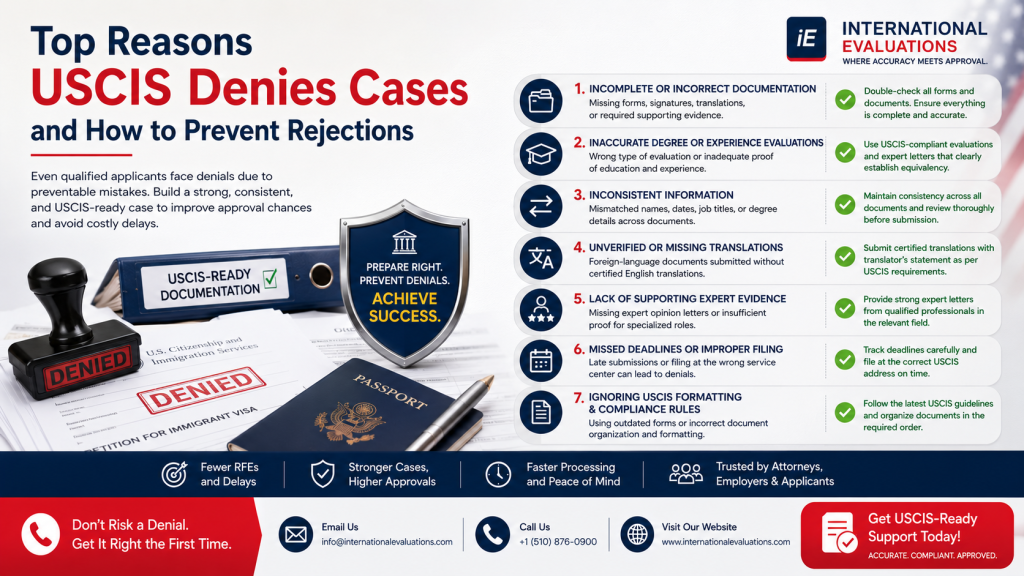
When it comes to U.S. immigration, even the strongest case can face a USCIS denial due to minor documentation issues or inconsistencies. Whether you’re an attorney, employer, or applicant, understanding why cases are denied — and how to prevent those mistakes — is the key to achieving immigration success. At International Evaluations, we’ve seen hundreds of petitions delayed or denied for preventable reasons. From missing documents to inaccurate evaluations, most rejections stem from issues that could have been avoided with careful preparation and professional documentation support. Here’s a complete guide to the most common reasons USCIS denies petitions — and how to ensure your case stands out for the right reasons. Top Reasons USCIS Petitions Get Denied (and How to Prevent Them) 1. Incomplete or Incorrect Documentation USCIS decisions are based primarily on documentation. Missing forms, unverified signatures, or incorrect attachments are among the most common reasons for denials. Examples include: Missing translations for foreign-language documents Incomplete forms or unchecked boxes Incorrect supporting documents or outdated evidence Missing degree evaluations or experience proofs How to Prevent It: – Review every form before submission. – Use professional documentation services to verify accuracy and formatting. – Ensure every supporting document matches USCIS requirements. A properly reviewed and verified petition drastically reduces the risk of rejection. 2. Inaccurate Degree or Work Experience Evaluations Many USCIS denials occur when the applicant’s education or work background is not properly verified or presented. For example: Submitting a general degree comparison instead of a USCIS-compliant evaluation. Failing to document how foreign experience equates to U.S. qualifications. Missing expert opinion letters for specialized roles (H-1B, EB-2, etc.). How to Prevent It: – Always use credential evaluation agencies recognized for USCIS-compliant reports. – Include expert opinion letters that explain job relevance and qualifications. – Ensure every evaluation clearly states equivalency to a U.S. degree level. At International Evaluations, every academic and experience evaluation is reviewed by credentialed experts to meet USCIS standards. 3. Inconsistent Information Across Documents USCIS cross-checks every detail across forms, resumes, employment letters, and evaluations. Inconsistencies — even small ones — can raise red flags and trigger RFEs or denials. Examples of inconsistencies: Different job titles or dates in resumes vs. employment letters Variations in name spellings across documents Mismatched degree names or institutions in evaluation reports How to Prevent It: – Maintain consistency across all supporting materials. – Review names, dates, and designations carefully. – Request a document verification review before submission. A unified, error-free document package signals professionalism and reliability to USCIS officers. 4. Unverified or Missing Translations Any document not in English must include a certified translation — yet many applicants overlook this requirement. USCIS immediately rejects or delays cases with unverified translations. How to Prevent It: – Always submit certified English translations that meet USCIS format requirements. – Include translator certification statements in every submission. – Partner with professional translation providers familiar with immigration documentation. At International Evaluations, every translation is certified, signed, and accepted by USCIS and the Department of Labor. 5. Lack of Supporting Expert Evidence In many employment-based visa categories, USCIS requires expert support to validate claims about specialized skills, education, or job relevance. Submitting applications without these letters often results in denials. How to Prevent It: – Use expert opinion letters from credentialed professors or professionals. – Make sure the expert’s credentials align with the applicant’s field of study or work. – Ensure letters follow USCIS formatting and terminology. Professional opinion letters add legitimacy and strengthen case credibility. 6. Missed Deadlines or Improper Filing Even well-prepared cases can be denied if they’re filed late or sent to the wrong service center. USCIS is strict about filing deadlines, and even one day’s delay can lead to rejection. How to Prevent It: – Plan filings early and confirm all submission dates. – Double-check USCIS mailing addresses before sending petitions. – Keep digital and physical copies of all submissions for tracking. Outsourced documentation support can help attorneys manage large caseloads efficiently, avoiding missed deadlines. 7. Ignoring USCIS Formatting and Compliance Rules Each visa category — from H-1B to EB-3 — comes with its own filing format, form type, and documentation standard. Using outdated forms or ignoring USCIS layout rules can trigger automatic rejections. How to Prevent It: – Always download the latest USCIS forms directly from the official site. – Verify that supporting documents are arranged in the required order. – Partner with documentation experts who stay current with policy updates. At International Evaluations, our reports and letters are formatted exactly as USCIS requires — ensuring a smooth review process. Prevent USCIS Denials with Professional Documentation Support Most USCIS denials can be avoided through attention to detail, consistency, and compliance. By partnering with a trusted documentation provider, attorneys and applicants can ensure every file is prepared to professional standards. At International Evaluations, we help you: – Avoid RFEs and denials through document precision. – Get USCIS-compliant evaluations and expert letters. – Save time with fast, accurate turnaround. – Build confidence with verified, credible documentation. Don’t let avoidable mistakes jeopardize your immigration goals — let accuracy lead your success. info@internationalevaluations.com +1 (510) 876-0900 www.internationalevaluations.com International Evaluations — Where Accuracy Meets Approval. FAQs: Preventing USCIS Denials 1. What are the most common reasons USCIS denies visa cases? USCIS often denies cases due to incomplete forms, inaccurate degree evaluations, inconsistent information, or missing translations. 2. How can I prevent my case from being denied? Ensure all documentation is accurate, complete, and USCIS-compliant. Using professional evaluation and translation services greatly reduces risks. 3. What is a USCIS-compliant evaluation? It’s an education or work experience evaluation formatted to meet USCIS standards, including clear equivalency and expert credentials. 4. Can an expert opinion letter improve approval chances? Yes. Expert letters add credibility by explaining how the applicant’s qualifications meet visa requirements. 5. Does International Evaluations
Choosing the Right Credential Evaluation for U.S. Immigration Success

When applying for a U.S. visa or green card, your educational qualifications play a vital role in determining eligibility. Whether you’re pursuing an H-1B, EB-2, TN, or PERM application, USCIS requires foreign degrees to be evaluated in terms of U.S. educational equivalency. Not all credential evaluations are the same. Submitting the wrong type can lead to RFEs (Requests for Evidence) or even visa denials. Choosing the right evaluation service can make the difference between smooth approval and a delayed or rejected petition. At International Evaluations, we help attorneys, employers, and applicants select and prepare the right type of credential evaluation that meets USCIS standards and supports immigration success. Why Credential Evaluations Matter in U.S. Immigration A credential evaluation translates your foreign education into its U.S. equivalent. This process helps USCIS adjudicators verify that your degree or experience meets the academic and professional requirements for your visa type. For example: H-1B applicants must show that their degree is equivalent to a U.S. bachelor’s degree or higher in a specific specialty field. EB-2 or EB-3 petitions often require proof that education and experience align with the position’s professional requirements. Submitting a general or non-USCIS compliant evaluation can result in RFEs delays, or even case denials. Types of Credential Evaluations for Immigration Purposes Not every evaluation fits every case. Depending on your visa type, background, and USCIS requirements, you’ll need one of the following: 1. Course-by-Course Evaluation Provides a detailed review of each subject, grade, and credit hour — typically used for academic admissions or PERM applications where detailed coursework comparison is required. 2. Document-by-Document Evaluation Summarizes your foreign degree, institution, and equivalent U.S. level (e.g., “Equivalent to a U.S. Bachelor’s Degree in Computer Science”). This is the most common type used for H-1B and employment-based visas. 3. Educational + Work Experience Evaluation Combines formal education and professional experience to establish equivalency — especially useful for applicants without a direct academic match but with significant professional experience. Example: If an applicant has 3 years of experience for every year of missing education, this can sometimes substitute for a degree. 4. Expert Opinion Letters When academic qualifications alone aren’t enough, expert letters written by university professors or industry specialists clarify how a candidate’s experience meets USCIS requirements. Each type of evaluation has a specific purpose — choosing the right one ensures your petition meets the exact USCIS standards for your visa category. Common Mistakes When Choosing a Credential Evaluation Even qualified applicants can face rejections if the evaluation is not USCIS-compliant. Some frequent errors include: – Submitting a general comparison report instead of a USCIS-specific evaluation – Using non-accredited or non-recognized evaluators – Ignoring work experience equivalency where applicable – Missing or inconsistent information between documents – Submitting evaluations without expert support letters when needed At International Evaluations, we’ve helped hundreds of applicants and attorneys correct these issues — often turning RFEs into approvals with properly formatted, expert-backed evaluations. How the Right Evaluation Strengthens Your Case Choosing the correct credential evaluation does more than just meet requirements — it builds credibility and clarity in your immigration petition. – Meets USCIS Compliance: Ensures your documents follow official requirements for your visa category. – Reduces RFEs and Delays: Properly formatted evaluations prevent confusion or requests for clarification. – Supports Legal Strategy: Attorneys can build stronger cases with accurate educational equivalency reports. – Boosts Approval Chances: Clear documentation helps USCIS officers verify eligibility quickly. Why Attorneys and Employers Choose International Evaluations At International Evaluations, we combine academic expertise with immigration law insight to deliver evaluations that are accurate, compliant, and ready for submission. Here’s what makes us trusted nationwide: – USCIS-Compliant Reports: Tailored for H-1B, PERM, EB-2, TN, and other visa categories. – 170+ Credentialed Experts: Covering all major academic and professional fields. – Attorney-Led Oversight: Every report reviewed for accuracy and legal relevance. – Fast Turnaround Times: Standard and expedited services for urgent filings. – Proven Success: Trusted by immigration attorneys and HR teams across the U.S. Whether you’re an attorney handling complex petitions or an applicant preparing for your dream job, the right credential evaluation can make all the difference. How to Choose the Right Evaluation for Your Case Here are simple steps to ensure your credential evaluation supports your immigration goals: Identify Your Visa Type: Different visas have different requirements. H-1B and EB-2 often require education + experience evaluations. Verify Evaluator Credentials: Always choose a recognized and USCIS-compliant evaluation agency. Confirm Experience Applicability: Combine work experience if your degree isn’t a perfect academic match. Request an Expert Letter (if needed): For borderline cases or technical fields, add an expert opinion letter to strengthen your case. Review All Details for Accuracy: Names, dates, and institutions should match across all documents. Conclusion: Your Education Deserves the Right Evaluation Every successful U.S. immigration case starts with accurate, compliant documentation — and your credential evaluation is at the heart of it. Don’t risk your approval with incomplete or incorrect evaluations. At International Evaluations, we specialize in delivering USCIS-ready credential evaluations that help attorneys, employers, and applicants achieve immigration success with confidence. info@internationalevaluations.com +1 (510) 876-0900 www.internationalevaluations.com International Evaluations — Translating Your Credentials into U.S. Immigration Success. FAQs 1. What type of credential evaluation does USCIS require? USCIS accepts evaluations that determine the U.S. equivalency of your degree and experience, typically a document-by-document or education + experience evaluation. 2. Can work experience replace missing years of education? Yes, under certain visa categories like H-1B, three years of professional experience can sometimes substitute for one year of academic study. 3. Who prepares expert opinion letters? Expert opinion letters are written by credentialed professors or industry experts qualified to evaluate specialized education or experience. 4. How long does a credential evaluation take? Standard reports are typically completed within 3–5 business days, with expedited 24–48-hour services available. 5. Are your evaluations accepted by USCIS and major law firms? Absolutely. Our
Secrets to Creating Flawless USCIS-Ready Documentation for Faster Visa Approval
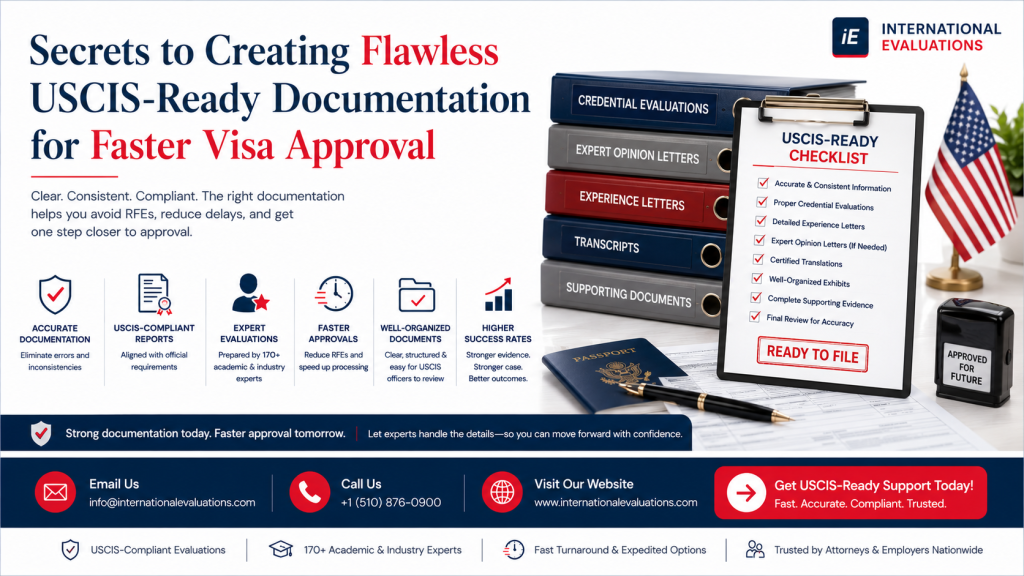
When it comes to U.S. immigration, documentation is everything. Even highly qualified applicants face delays, RFEs (Requests for Evidence), or denials simply because the supporting documents were incomplete, inconsistent, or not formatted according to USCIS standards. Whether you’re filing for an H-1B, EB-2, O-1, family-based petition, or a green card through employment, the quality and accuracy of your documentation directly determine how smoothly your application moves through the system. At International Evaluations, we work closely with attorneys, employers, and applicants to prepare clean, compliant, and USCIS-ready documentation that eliminates guesswork and speeds up approval timelines. Why USCIS-Ready Documentation Matters USCIS officers review thousands of immigration petitions every year. Clear, consistent, and well-presented documentation helps them verify eligibility faster and with fewer questions. Poorly organized or incomplete documentation leads to: RFEs (extra processing time) NOIDs (Notices of Intent to Deny) Delays in case adjudication Visa or green card denials Submitting flawless documents helps USCIS officers easily understand your qualifications — resulting in faster decisions and higher approval rates. Key Documents USCIS Reviews in Most Visa Categories Each visa type has specific documentation requirements, but some core categories apply to nearly all petitions: Educational Documents Degrees, transcripts, and evaluations proving U.S. equivalency. Employment Records Experience letters, job descriptions, and salary records. Supporting Evidence Licenses, certifications, publications, awards, or specialized skills. Identity & Biographical Documents Passports, name-change records, translations, and affidavits. Ensuring every document matches, aligns, and supports the legal strategy is essential for a smooth approval. The Top Secrets to Creating Flawless USCIS-Ready Documentation Below are the insider strategies used by attorneys and immigration experts to keep petitions error-free and compliant. 1. Consistency is Everything USCIS cross-checks every detail across your entire application. Common inconsistencies include: Different graduation dates on transcripts vs. resumes Name spelling variations Mismatched job titles across letters Missing middle names or initials Untranslated foreign documents Even small errors create red flags and lead to RFEs. At International Evaluations, we ensure every detail aligns across all documents before submission. 2. Always Provide a USCIS-Compliant Credential Evaluation If your degree was earned outside the U.S., submitting the wrong type of evaluation can delay your case. You may need: Document-by-Document Evaluation Course-by-Course Evaluation Education + Experience Evaluation Expert Opinion Letter The correct evaluation depends on your visa category, education, and work experience. Choosing the right one helps USCIS understand your qualifications instantly. 3. Use Accurate, Detailed Experience Letters Experience letters are crucial for H-1B, EB-2, EB-3, and PERM cases. A strong letter must include: Exact job title Full-time or part-time status Tasks and responsibilities Start and end dates Company contact details Official signature Missing information is one of the leading causes of RFEs in employment-based petitions. 4. Strengthen Technical Cases with Expert Opinion Letters For borderline or specialized cases — like IT, engineering, or advanced sciences — an expert opinion letter can make the difference between approval and denial. Universities and industry experts can verify: Degree specialization Technical skills Industry-level experience Job-role alignment These letters help USCIS understand complex qualifications clearly and accurately. 5. Organize Evidence Clearly and Professionally Professional formatting increases credibility. Your documentation should: Follow a logical order Include a clear table of contents Use labeled and numbered exhibits Present translations with certificates Avoid clutter, duplicates, or mixed formats Well-organized petitions are processed faster — and often receive fewer questions. 6. Review for Accuracy Before Submission Always double-check: Names Dates Degree titles Company names Translations Credentials A final review catches errors that may cause delays. How Strong Documentation Increases Approval Success When your documents are clean, accurate, and USCIS-ready, you get: – Faster processing – Fewer RFEs – Stronger legal arguments – Higher approval rates – Less stress for applicants & attorneys Well-prepared documents show professionalism, credibility, and compliance — three things USCIS values highly. Why Immigration Attorneys Trust International Evaluations We combine academic expertise with immigration knowledge to deliver flawless, USCIS-ready documentation. – USCIS-Compliant Credential Evaluations – 170+ Academic & Industry Experts – Attorney-Reviewed Reports – Fast & Expedited Processing – Trusted by Top U.S. Immigration Firms Our goal is to help applicants, employers, and law firms submit strong petitions that get approved faster. How to Ensure Your Documentation Is USCIS-Ready Follow these steps before filing: – Identify your visa category requirements – Use verified, accredited evaluators – Ensure perfect document consistency – Add expert letters when needed – Verify translations and certifications – Review for errors before submission These steps will dramatically reduce the risk of RFEs or denials. Conclusion: Strong Documentation Is the Secret to Faster Visa Approval Your immigration journey depends on accurate, organized, and compliant documentation. Submitting flawless, USCIS-ready documents not only speeds up your case but also strengthens your chances of approval. At International Evaluations, we help applicants and attorneys prepare documentation that meets and exceeds USCIS standards — so you can move forward with confidence. info@internationalevaluations.com +1 (510) 876-0900 www.internationalevaluations.com International Evaluations — Building Stronger Immigration Cases with Perfect Documentation. FAQs 1. What documents need USCIS compliance? Anything related to education, experience, identity, translations, and specialized skills. 2. What happens if documents are inconsistent? USCIS issues RFEs or delays processing. 3. Who prepares expert opinion letters? Credentialed professors and industry specialists. 4. How long does documentation preparation take? Most evaluations take 3–5 business days; expedited options are available. 5. Are your evaluations accepted by USCIS? Yes — our reports are used by major law firms and approved nationwide.
How Employers Can Save Weeks on PERM Processing With Expert Guidance
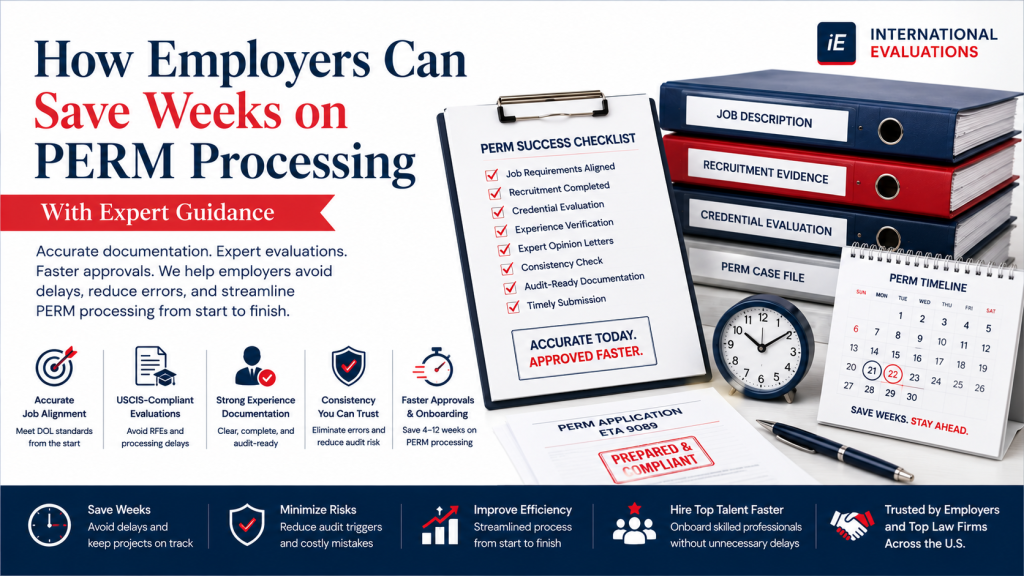
The PERM labor certification process is one of the most time-sensitive and documentation-heavy steps in the U.S. employment-based green card journey. Even small errors, missed steps, or incorrect documentation can delay certification — adding weeks or even months to the employer’s hiring timeline. For companies trying to onboard global talent quickly, slow or inaccurate PERM preparation can disrupt business operations, affect project delivery, and increase overall immigration costs. At International Evaluations, we work with employers, HR teams, and immigration attorneys to reduce processing time, avoid costly mistakes, and streamline PERM approvals through expert evaluation guidance and compliant documentation. Why PERM Processing Often Takes Longer Than Expected PERM requires a highly structured, multi-step process with strict compliance rules. Delays usually happen due to: Incorrect job requirements Missing or inconsistent documentation Inaccurate degree equivalency or experience claims Using the wrong credential evaluation Minor errors that trigger audits or RFEs Lack of expert support on specialized roles Even a small oversight — like mismatched job duties or unclear educational equivalency — can extend your timeline significantly. How Expert Guidance Speeds Up PERM Processing Working with specialists helps employers complete each step correctly the first time, eliminating avoidable delays. Here are the proven ways expert guidance saves weeks in the PERM process: 1. Accurate Job Requirement Alignment From Day One PERM requires an exact match between: Job duties Minimum education Minimum experience Required skills and specializations Experts ensure that your job requirements: – Meet DOL standards – Align with industry norms – Avoid triggering unnecessary audits – Match the applicant’s credentials accurately This prevents re-drafting or re-running recruitment — saving 2–6 weeks. 2. USCIS-Ready Credential Evaluations to Avoid RFEs For candidates with foreign degrees, a credential evaluation is essential — but choosing the wrong type can trigger delays. Depending on the PERM requirements, experts ensure employers select the right evaluation: Course-by-Course Evaluation (for detailed comparison) Document-by-Document Evaluation Education + Experience Evaluation Expert Opinion Letters for specialized roles Submitting the correct evaluation the first time prevents RFEs and avoids another 4–8 weeks of processing. 3. Perfectly Structured Experience Letters Many PERM delays happen because an employee’s prior experience is not documented correctly. Experts help you create compliant experience letters that include: Exact job titles Duties & responsibilities Full-time/part-time details Employment dates Company contact details Proper signatures Clear, verified experience letters prevent DOL questions and unnecessary audits. 4. Eliminating Common Consistency Errors PERM requires every detail to match across all documents, including: Job title Location Minimum requirements Education level Dates of employment Transcripts, resumes, and advertisements Expert reviewers detect inconsistencies early — preventing RFEs, denials, or the need to repeat recruitment steps. 5. Expert Opinion Letters for Complex Positions Certain roles — especially in tech, engineering, and research — may require specialized justification. Expert letters help: – Clarify complex duties – Validate degree relevance – Align foreign credentials with U.S. requirements – Strengthen job-related justifications Adding these letters early prevents DOL scrutiny later. 6. Faster Decision-Making With Clear, Organized Documentation Well-organized evidence dramatically speeds up case review. Experts prepare: Numbered exhibits Clean timelines Easy-to-read summaries DOL-ready compliance files Clear comparison charts for education & experience When documentation is flawless, employers avoid time-consuming back-and-forth with attorneys and evaluators. How Expert Support Reduces PERM Timelines Expert guidance leads to: – Fewer delays – Zero unnecessary audits – Faster submission timelines – Stronger documentation – Smooth collaboration between HR and legal teams – Higher success on the first attempt Most employers save 4–12 weeks simply by avoiding avoidable PERM mistakes. Why Employers Trust International Evaluations We help HR teams simplify the PERM process by delivering precise, compliant, and attorney-reviewed evaluations. – 170+ Academic Experts – USCIS-Ready & PERM-Compliant Evaluations – Detailed Education + Experience Reports – Expert Opinion Letters for Specialized Roles – Fast Turnaround for Recruitment Deadlines – Trusted by Employers & Top Law Firms Nationwide Whether you’re preparing for recruitment, filing a PERM case, or handling a tight onboarding deadline — our guidance ensures smooth, fast, and compliant processing. How Employers Can Ensure Faster PERM Results Follow these proven steps: – Finalize job requirements before recruitment – Verify degree equivalencies before drafting ads – Use USCIS-compliant credential evaluations – Request expert letters for highly technical roles – Ensure experience letters meet DOL standards – Review all documents for accuracy and consistency Doing it right the first time is the fastest way to PERM approval. Conclusion: Speed Up PERM Processing With the Right Experts PERM does not have to be slow or complicated. With accurate evaluations, expert letters, and fully aligned documentation, employers can avoid delays and get approvals faster. At International Evaluations, we streamline PERM documentation so employers can hire global talent on schedule and with confidence. info@internationalevaluations.com +1 (510) 876-0900 www.internationalevaluations.com International Evaluations — Faster PERM Success Through Expert Precision. FAQs 1. Can expert guidance prevent PERM audits? Yes. Correct job requirements, consistent documentation, and expert letters greatly reduce audit risk. 2. Do employers need a credential evaluation for PERM? Yes, when foreign degrees are involved — especially for roles requiring specific coursework. 3. What is the biggest cause of PERM delays? Inaccurate job requirements and mismatched documentation. 4. How long does a credential evaluation take? Standard processing takes 3–5 days, with expedited options available. 5. Do you work with employers and attorneys? Absolutely. We support HR teams, law firms, and corporate immigration departments.