Fast and Reliable Business Plan Delivery for E-2 Visa Filings
For entrepreneurs seeking an E-2 Investor Visa, a strong business plan is essential. USCIS requires that applicants demonstrate not only their qualifications and investment capability but also that the business is viable, profitable, and able to create a positive economic impact in the U.S. Delays or errors in submitting your business plan can result in RFEs (Requests for Evidence), prolonged processing times, or even visa denials. That’s why fast and reliable business plan delivery is critical for E-2 visa success. At International Evaluations, we help investors, attorneys, and business owners craft and deliver USCIS-compliant business plans quickly without compromising quality. Here’s how speed, accuracy, and expertise work together to improve your E-2 visa approval chances. Why Timely Business Plan Delivery Matters USCIS filings are time-sensitive. Missing deadlines or submitting incomplete plans can lead to: RFEs or Requests for Additional Documentation – USCIS often asks for clarification if your business plan lacks detail. Delays in Visa Processing – Late or incomplete submissions can prolong review times. Increased Stress and Uncertainty – Entrepreneurs and attorneys face avoidable anxiety. Potential Denials – Inadequate documentation can result in outright rejection. A fast and reliable business plan ensures your application is complete, professional, and compliant from the start. Key Components of a USCIS-Compliant E-2 Business Plan A business plan for an E-2 visa must clearly demonstrate that the business is viable, substantial, and beneficial to the U.S. economy. Core components include: 1. Executive Summary Clearly outlines the business, investor role, and visa eligibility. Summarizes investment amount, business objectives, and projected economic impact. Provides a snapshot for USCIS to understand the venture at a glance. 2. Company Description Legal structure (LLC, Corporation, Partnership). Products or services offered. Market opportunity and business objectives. Background of the business owner and their qualifications. 3. Market Analysis Target audience and customer demographics. Competitor analysis and positioning. Industry trends and potential growth in the U.S. market. Clear explanation of how the business addresses market needs. 4. Organizational Structure Key roles and responsibilities within the business. Investor’s managerial or operational role. Demonstrates how your role aligns with E-2 visa requirements. 5. Financial Plan Start-up costs and capital investment details. Projected revenue, profit and loss statements, and cash flow analysis. Break-even calculations and long-term sustainability plan. Evidence that the business is not marginal and can support more than just the investor. 6. Job Creation Strategy Projected number of employees over time. Job descriptions and qualifications required. Timeline for hiring and training employees. Contribution to the U.S. economy through job creation. 7. Risk Assessment and Contingency Plans Potential challenges and market risks. Strategies for mitigating operational, financial, or competitive risks. Shows USCIS that the business is prepared and professionally managed. How Fast Business Plan Delivery Helps E-2 Visa Applicants Quick, reliable delivery of a USCIS-ready business plan provides several advantages: Reduces Risk of RFEs – A complete, detailed plan leaves little room for questions. Supports Timely Filing – Meet strict E-2 visa submission deadlines. Demonstrates Professionalism – Shows USCIS that your business is well-organized and credible. Minimizes Stress – Applicants and attorneys can focus on other aspects of visa preparation. Improves Approval Chances – Well-structured, compliant plans strengthen the overall application. How International Evaluations Ensures Fast and Reliable Delivery At International Evaluations, we specialize in producing USCIS-compliant business plans for E-2 visa applicants with speed and precision: Tailored Business Plans – Customized for each investor’s business, investment amount, and industry. Credential & Experience Verification – Validates the investor’s qualifications and professional experience to support visa eligibility. Expert Financial Planning – Accurate revenue projections, investment summaries, and sustainability plans. Rapid Turnaround – Fast, reliable delivery without compromising compliance or quality. RFE Prevention Guidance – Ensures the business plan anticipates USCIS questions and preempts requests for additional evidence. Common Mistakes to Avoid in E-2 Business Plans Even minor oversights can jeopardize your E-2 visa approval: Submitting a vague or generic plan without industry-specific detail. Missing or inaccurate financial projections. Failing to demonstrate substantial investment or economic impact. Overlooking job creation or hiring plans. Ignoring risk assessment or contingency planning. Working with professionals ensures these mistakes are avoided. Benefits of Partnering with Experts USCIS-Compliant Plans – Every business plan meets government standards. Faster Submission – Avoid delays and meet strict filing deadlines. Increased Approval Odds – Detailed, credible documentation strengthens your case. Peace of Mind – Investors and attorneys can focus on operations and strategy. Custom Solutions – Each plan is tailored for your business, investment, and visa category. Take Action Today A strong E-2 business plan delivered quickly and reliably is your ticket to a smoother visa process. Don’t risk delays, RFEs, or denials with incomplete or poorly structured documentation. Contact International Evaluations today for professional, USCIS-compliant business plan services tailored to E-2 visa filings. Email: info@internationalevaluations.com Phone: +1 (510) 876-0900 Website: www.internationalevaluations.com
How a Strong Business Plan Minimizes Visa Denial Risk
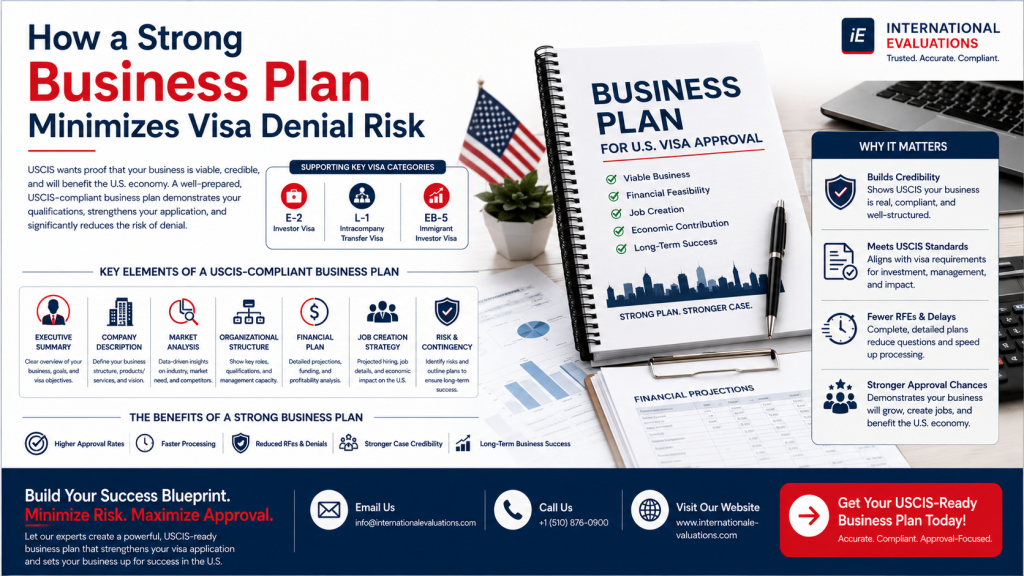
For entrepreneurs, investors, and business owners seeking U.S. visas, a well-prepared business plan is more than a formal document—it can be the key to approval. USCIS evaluates visa applications carefully, particularly for visas like E-2, L-1, or EB-5, where the applicant’s business viability and potential economic impact are central to eligibility. A poorly drafted or incomplete business plan can raise doubts, trigger Requests for Evidence (RFEs), or even lead to visa denials. On the other hand, a strong, detailed, and USCIS-compliant business plan demonstrates credibility, proves your business can succeed, and strengthens your visa application. At International Evaluations, we help entrepreneurs, investors, and attorneys develop business plans that minimize visa denial risk while highlighting the applicant’s qualifications and the business’s potential. Here’s how a strong business plan can make the difference. Why USCIS Cares About Your Business Plan For certain visa categories, USCIS must determine whether your business is: Legally viable – Does it comply with U.S. laws and regulations? Financially feasible – Does it have sufficient capital, revenue projections, and investment plans? Job-creating – Does it contribute to the U.S. economy or create employment opportunities? Consistent with your visa category – E.g., E-2 investors, L-1 intracompany transferees, or EB-5 immigrant investors. A comprehensive business plan provides USCIS with the evidence it needs to approve your visa, showing that your venture is credible, structured, and likely to succeed. Key Components of a USCIS-Compliant Business Plan A strong business plan goes beyond general descriptions. USCIS expects specific, evidence-backed details: 1. Executive Summary -Concisely outlines your business, mission, and objectives. -Highlights the visa category and your role in the company. -Provides a snapshot of investment, projected growth, and job creation. 2. Company Description Describe the business structure (LLC, corporation, partnership). Detail the products or services offered. Highlight the market need or gap your business addresses. Include the company’s vision, goals, and growth strategy. This section establishes the business’s credibility and relevance. 3. Market Analysis A data-driven market analysis demonstrates awareness of the industry and competition: Target audience, demographics, and customer needs Competitor analysis and market positioning Industry trends and growth potential Opportunities and challenges in the U.S. market A thorough market analysis convinces USCIS that your business has realistic potential to succeed. 4. Organizational Structure Include an organizational chart with key roles and responsibilities. Highlight your qualifications and experience as the business owner or executive. Demonstrate how your role aligns with visa requirements (e.g., managerial capacity for L-1 visas). 5. Detailed Financial Plan A robust financial plan is crucial for investor and visa petitions: Start-up costs and capital investment Revenue projections and profit/loss statements Cash flow analysis and break-even calculations Funding sources and sustainability plan USCIS reviews financial data to ensure the business is viable and capable of supporting visa requirements. 6. Job Creation Strategy Employment-based visas often require demonstrating impact on U.S. workers: Projected number of employees over time Job descriptions and required qualifications Hiring timeline and training plans Contribution to local or regional economic development This section is particularly important for EB-5, E-2, and L-1 petitions. 7. Risk Assessment and Contingency Plans Identify potential risks and challenges Outline strategies to mitigate them Show preparedness for operational, financial, or market disruptions A business plan that anticipates risks signals professionalism and reduces USCIS concerns. How a Strong Business Plan Reduces Visa Denial Risk A comprehensive, USCIS-compliant business plan: Demonstrates credibility – Shows the applicant is serious, prepared, and capable. Supports eligibility claims – Aligns with visa requirements, such as managerial capacity or investor qualifications. Reduces RFEs – Preempts questions by providing detailed, verifiable evidence. Provides a roadmap – Shows USCIS a clear path for business operations, growth, and impact. Builds confidence – Strong documentation increases approval chances and expedites processing. How International Evaluations Helps At International Evaluations, we provide end-to-end support for crafting business plans that strengthen visa applications: USCIS-Compliant Business Plans – Tailored to your visa category and case specifics. Credential & Work Experience Evaluations – Validate your professional background and managerial qualifications. ⚖️ Expert Opinion Letters – Reinforce your business acumen, industry expertise, and the viability of your venture. Financial Plan Review – Ensure projections, budgets, and investments meet USCIS standards. RFE Prevention – Strategic guidance to preempt potential USCIS questions. Common Mistakes to Avoid Even experienced applicants can weaken their case by: Submitting vague or generic business plans Lacking detailed financial projections or evidence of investment Omitting market analysis or competitor research Failing to address visa-specific requirements Ignoring risk assessment or contingency planning Avoiding these mistakes is essential for reducing visa denial risk. Real-World Impact Clients who work with International Evaluations experience: Higher approval rates – Strong business plans and supporting documentation reduce denials and RFEs. Faster processing – Comprehensive submissions streamline USCIS review. Stronger visa credibility – Clearly demonstrates the applicant’s role, qualifications, and business viability. Peace of mind – Confidence that all documentation meets USCIS expectations. Take Action Today A strong business plan is more than a formality — it’s your roadmap to visa approval. With professional guidance, detailed financial planning, and USCIS-compliant documentation, you can minimize risk and maximize your chances of success. Don’t risk delays or denials. Contact International Evaluations today to develop a business plan that strengthens your visa application and ensures compliance with U.S. immigration standards. Email: info@internationalevaluations.com Phone: +1 (510) 876-0900 Website: www.internationalevaluations.com International Evaluations — Strengthening Visa Applications with Expert Business Planning.
How a Strong Business Plan Minimizes Visa Denial Risk
For entrepreneurs, investors, and business owners seeking U.S. visas, a well-prepared business plan is more than a formal document—it can be the key to approval. USCIS evaluates visa applications carefully, particularly for visas like E-2, L-1, or EB-5, where the applicant’s business viability and potential economic impact are central to eligibility. A poorly drafted or incomplete business plan can raise doubts, trigger Requests for Evidence (RFEs), or even lead to visa denials. On the other hand, a strong, detailed, and USCIS-compliant business plan demonstrates credibility, proves your business can succeed, and strengthens your visa application. At International Evaluations, we help entrepreneurs, investors, and attorneys develop business plans that minimize visa denial risk while highlighting the applicant’s qualifications and the business’s potential. Here’s how a strong business plan can make the difference. Why USCIS Cares About Your Business Plan For certain visa categories, USCIS must determine whether your business is: Legally viable – Does it comply with U.S. laws and regulations? Financially feasible – Does it have sufficient capital, revenue projections, and investment plans? Job-creating – Does it contribute to the U.S. economy or create employment opportunities? Consistent with your visa category – E.g., E-2 investors, L-1 intracompany transferees, or EB-5 immigrant investors. A comprehensive business plan provides USCIS with the evidence it needs to approve your visa, showing that your venture is credible, structured, and likely to succeed. Key Components of a USCIS-Compliant Business Plan A strong business plan goes beyond general descriptions. USCIS expects specific, evidence-backed details: 1. Executive Summary – Concisely outlines your business, mission, and objectives. – Highlights the visa category and your role in the company. – Provides a snapshot of investment, projected growth, and job creation. 2. Company Description Describe the business structure (LLC, corporation, partnership). Detail the products or services offered. Highlight the market need or gap your business addresses. Include the company’s vision, goals, and growth strategy. This section establishes the business’s credibility and relevance. 3. Market Analysis A data-driven market analysis demonstrates awareness of the industry and competition: Target audience, demographics, and customer needs Competitor analysis and market positioning Industry trends and growth potential Opportunities and challenges in the U.S. market A thorough market analysis convinces USCIS that your business has realistic potential to succeed. 4. Organizational Structure Include an organizational chart with key roles and responsibilities. Highlight your qualifications and experience as the business owner or executive. Demonstrate how your role aligns with visa requirements (e.g., managerial capacity for L-1 visas). 5. Detailed Financial Plan A robust financial plan is crucial for investor and visa petitions: Start-up costs and capital investment Revenue projections and profit/loss statements Cash flow analysis and break-even calculations Funding sources and sustainability plan USCIS reviews financial data to ensure the business is viable and capable of supporting visa requirements. 6. Job Creation Strategy Employment-based visas often require demonstrating impact on U.S. workers: Projected number of employees over time Job descriptions and required qualifications Hiring timeline and training plans Contribution to local or regional economic development This section is particularly important for EB-5, E-2, and L-1 petitions. 7. Risk Assessment and Contingency Plans Identify potential risks and challenges Outline strategies to mitigate them Show preparedness for operational, financial, or market disruptions A business plan that anticipates risks signals professionalism and reduces USCIS concerns. How a Strong Business Plan Reduces Visa Denial Risk A comprehensive, USCIS-compliant business plan: Demonstrates credibility – Shows the applicant is serious, prepared, and capable. Supports eligibility claims – Aligns with visa requirements, such as managerial capacity or investor qualifications. Reduces RFEs – Preempts questions by providing detailed, verifiable evidence. Provides a roadmap – Shows USCIS a clear path for business operations, growth, and impact. Builds confidence – Strong documentation increases approval chances and expedites processing. How International Evaluations Helps At International Evaluations, we provide end-to-end support for crafting business plans that strengthen visa applications: USCIS-Compliant Business Plans – Tailored to your visa category and case specifics. Credential & Work Experience Evaluations – Validate your professional background and managerial qualifications. ⚖️ Expert Opinion Letters – Reinforce your business acumen, industry expertise, and the viability of your venture. Financial Plan Review – Ensure projections, budgets, and investments meet USCIS standards. RFE Prevention – Strategic guidance to preempt potential USCIS questions. Common Mistakes to Avoid Even experienced applicants can weaken their case by: Submitting vague or generic business plans Lacking detailed financial projections or evidence of investment Omitting market analysis or competitor research Failing to address visa-specific requirements Ignoring risk assessment or contingency planning Avoiding these mistakes is essential for reducing visa denial risk. Real-World Impact Clients who work with International Evaluations experience: Higher approval rates – Strong business plans and supporting documentation reduce denials and RFEs. Faster processing – Comprehensive submissions streamline USCIS review. Stronger visa credibility – Clearly demonstrates the applicant’s role, qualifications, and business viability. Peace of mind – Confidence that all documentation meets USCIS expectations. Take Action Today A strong business plan is more than a formality — it’s your roadmap to visa approval. With professional guidance, detailed financial planning, and USCIS-compliant documentation, you can minimize risk and maximize your chances of success. Don’t risk delays or denials. Contact International Evaluations today to develop a business plan that strengthens your visa application and ensures compliance with U.S. immigration standards. Email: info@internationalevaluations.com Phone: +1 (510) 876-0900 Website: www.internationalevaluations.com International Evaluations — Strengthening Visa Applications with Expert Business Planning.
How to Choose a Trusted Immigration Compliance Partner for Your Business in 2025

In today’s competitive business environment, hiring skilled foreign talent is often essential for growth and innovation. But navigating U.S. immigration regulations can be complex and time-consuming. A single mistake in visa filings, labor certification, or compliance documentation can result in fines, RFEs, or even losing your top talent. That’s why choosing a trusted immigration compliance partner is critical for businesses in 2025. The right partner ensures your organization remains compliant with U.S. immigration laws while streamlining hiring and retention of foreign professionals. At International Evaluations, we help employers, HR teams, and immigration attorneys maintain full compliance and avoid costly mistakes. Here’s how to choose the best immigration compliance partner for your business. Why Immigration Compliance Matters for Businesses U.S. immigration law is complex, constantly evolving, and strictly enforced. Non-compliance can lead to serious consequences: Fines and penalties – Violations of immigration regulations can result in significant financial consequences. Loss of skilled workers – Delays or errors in visa filings can cause employees to leave or applications to be denied. Legal liabilities – Employers may face legal scrutiny or audits if proper compliance isn’t maintained. Reputation damage – Non-compliance can harm your company’s standing with employees, clients, and regulators. Partnering with a knowledgeable immigration compliance provider mitigates these risks and ensures smooth operations for your HR and legal teams. Key Qualities of a Trusted Immigration Compliance Partner When selecting a partner, businesses should consider the following factors: 1. Proven Expertise in Immigration Law and Compliance A trusted partner should have a deep understanding of U.S. immigration regulations, including: H-1B, O-1, L-1, and other work visas Employment-based green cards and PERM labor certification Compliance with Department of Labor (DOL) and USCIS regulations Look for partners with a track record of successful filings and approvals, as this demonstrates reliability and knowledge. 2. USCIS-Compliant Documentation Proper documentation is crucial for visa approvals. A partner must ensure: All credentials and work experience are properly evaluated for U.S. equivalency Forms are correctly completed, signed, and formatted Certified translations are provided for non-English documents This minimizes the risk of RFEs and delays while ensuring your applications meet strict USCIS standards. 3. Tailored Support for Your Business Every company is unique. A strong compliance partner will: Customize services to your industry and workforce needs Provide guidance for both employers and employees Offer solutions for small businesses, startups, and large corporations alike 4. Fast and Reliable Turnaround Immigration filings often come with strict deadlines. Your partner should provide: Rapid evaluation of documents and credentials Timely preparation of visa or green card applications Efficient response to RFEs or additional USCIS requests 5. Transparent Communication Clear and consistent communication is key. Your partner should: Explain requirements in plain language Provide regular updates on application status Offer guidance on next steps if issues arise 6. Trusted by Attorneys and HR Teams An ideal partner is recognized by immigration attorneys and HR professionals. Look for: Positive client testimonials and case studies Experience working across industries like STEM, healthcare, business, and law Familiarity with both employer and employee perspectives Common Challenges in Immigration Compliance Even experienced HR teams face challenges without the right partner: Document errors – Missing transcripts, work letters, or translations can trigger RFEs. Labor certification mistakes – Incorrect recruitment efforts or wage calculations delay PERM filings. Timing issues – Missing deadlines can jeopardize visa or green card approvals. Audit risks – Without proper records, companies may face DOL audits or USCIS scrutiny. A trusted immigration compliance partner helps you proactively address these issues, ensuring smooth approvals and a worry-free process. How International Evaluations Supports Businesses in 2025 At International Evaluations, we provide comprehensive solutions to help businesses maintain immigration compliance: Credential & Work Experience Evaluations – Accurately verify foreign degrees and professional experience for U.S. standards. Certified Translations – Ensure all non-English documents are USCIS-ready. Labor Certification & RFE Assistance – Avoid common mistakes and respond to USCIS requests with confidence. Fast Turnaround – Meet strict filing deadlines without compromising accuracy. Tailored Support – Customized services for HR teams, attorneys, and employers across industries. Questions to Ask Before Choosing a Compliance Partner Before finalizing your choice, consider asking: What is your success rate with USCIS approvals? Do you provide evaluations and certified translations in-house? How do you handle tight deadlines or urgent filings? Can you support both employers and employees in compliance? Do you have experience across industries and visa categories? The answers will help you gauge reliability, expertise, and overall fit. Don’t Risk Non-Compliance in 2025 Immigration compliance is critical to attracting and retaining global talent. Mistakes can be costly, but the right partner ensures your business remains compliant while reducing administrative burdens. Protect your workforce and streamline your immigration process. Contact International Evaluations today for USCIS-compliant support, credential evaluations, and expert guidance. Email: info@internationalevaluations.com Phone: +1 (510) 876-0900 Website: www.internationalevaluations.com International Evaluations — Trusted Immigration Compliance Partner for Businesses in 2025.
Choosing the Right Credential Evaluation for U.S. Immigration Success

When applying for a U.S. visa or green card, your educational qualifications play a vital role in determining eligibility. Whether you’re pursuing an H-1B, EB-2, TN, or PERM application, USCIS requires foreign degrees to be evaluated in terms of U.S. educational equivalency. Not all credential evaluations are the same. Submitting the wrong type can lead to RFEs (Requests for Evidence) or even visa denials. Choosing the right evaluation service can make the difference between smooth approval and a delayed or rejected petition. At International Evaluations, we help attorneys, employers, and applicants select and prepare the right type of credential evaluation that meets USCIS standards and supports immigration success. Why Credential Evaluations Matter in U.S. Immigration A credential evaluation translates your foreign education into its U.S. equivalent. This process helps USCIS adjudicators verify that your degree or experience meets the academic and professional requirements for your visa type. For example: H-1B applicants must show that their degree is equivalent to a U.S. bachelor’s degree or higher in a specific specialty field. EB-2 or EB-3 petitions often require proof that education and experience align with the position’s professional requirements. Submitting a general or non-USCIS compliant evaluation can result in RFEs delays, or even case denials. Types of Credential Evaluations for Immigration Purposes Not every evaluation fits every case. Depending on your visa type, background, and USCIS requirements, you’ll need one of the following: 1. Course-by-Course Evaluation Provides a detailed review of each subject, grade, and credit hour — typically used for academic admissions or PERM applications where detailed coursework comparison is required. 2. Document-by-Document Evaluation Summarizes your foreign degree, institution, and equivalent U.S. level (e.g., “Equivalent to a U.S. Bachelor’s Degree in Computer Science”). This is the most common type used for H-1B and employment-based visas. 3. Educational + Work Experience Evaluation Combines formal education and professional experience to establish equivalency — especially useful for applicants without a direct academic match but with significant professional experience. Example: If an applicant has 3 years of experience for every year of missing education, this can sometimes substitute for a degree. 4. Expert Opinion Letters When academic qualifications alone aren’t enough, expert letters written by university professors or industry specialists clarify how a candidate’s experience meets USCIS requirements. Each type of evaluation has a specific purpose — choosing the right one ensures your petition meets the exact USCIS standards for your visa category. Common Mistakes When Choosing a Credential Evaluation Even qualified applicants can face rejections if the evaluation is not USCIS-compliant. Some frequent errors include: – Submitting a general comparison report instead of a USCIS-specific evaluation – Using non-accredited or non-recognized evaluators – Ignoring work experience equivalency where applicable – Missing or inconsistent information between documents – Submitting evaluations without expert support letters when needed At International Evaluations, we’ve helped hundreds of applicants and attorneys correct these issues — often turning RFEs into approvals with properly formatted, expert-backed evaluations. How the Right Evaluation Strengthens Your Case Choosing the correct credential evaluation does more than just meet requirements — it builds credibility and clarity in your immigration petition. – Meets USCIS Compliance: Ensures your documents follow official requirements for your visa category. – Reduces RFEs and Delays: Properly formatted evaluations prevent confusion or requests for clarification. – Supports Legal Strategy: Attorneys can build stronger cases with accurate educational equivalency reports. – Boosts Approval Chances: Clear documentation helps USCIS officers verify eligibility quickly. Why Attorneys and Employers Choose International Evaluations At International Evaluations, we combine academic expertise with immigration law insight to deliver evaluations that are accurate, compliant, and ready for submission. Here’s what makes us trusted nationwide: – USCIS-Compliant Reports: Tailored for H-1B, PERM, EB-2, TN, and other visa categories. – 170+ Credentialed Experts: Covering all major academic and professional fields. – Attorney-Led Oversight: Every report reviewed for accuracy and legal relevance. – Fast Turnaround Times: Standard and expedited services for urgent filings. – Proven Success: Trusted by immigration attorneys and HR teams across the U.S. Whether you’re an attorney handling complex petitions or an applicant preparing for your dream job, the right credential evaluation can make all the difference. How to Choose the Right Evaluation for Your Case Here are simple steps to ensure your credential evaluation supports your immigration goals: Identify Your Visa Type: Different visas have different requirements. H-1B and EB-2 often require education + experience evaluations. Verify Evaluator Credentials: Always choose a recognized and USCIS-compliant evaluation agency. Confirm Experience Applicability: Combine work experience if your degree isn’t a perfect academic match. Request an Expert Letter (if needed): For borderline cases or technical fields, add an expert opinion letter to strengthen your case. Review All Details for Accuracy: Names, dates, and institutions should match across all documents. Conclusion: Your Education Deserves the Right Evaluation Every successful U.S. immigration case starts with accurate, compliant documentation — and your credential evaluation is at the heart of it. Don’t risk your approval with incomplete or incorrect evaluations. At International Evaluations, we specialize in delivering USCIS-ready credential evaluations that help attorneys, employers, and applicants achieve immigration success with confidence. info@internationalevaluations.com +1 (510) 876-0900 www.internationalevaluations.com International Evaluations — Translating Your Credentials into U.S. Immigration Success. FAQs 1. What type of credential evaluation does USCIS require? USCIS accepts evaluations that determine the U.S. equivalency of your degree and experience, typically a document-by-document or education + experience evaluation. 2. Can work experience replace missing years of education? Yes, under certain visa categories like H-1B, three years of professional experience can sometimes substitute for one year of academic study. 3. Who prepares expert opinion letters? Expert opinion letters are written by credentialed professors or industry experts qualified to evaluate specialized education or experience. 4. How long does a credential evaluation take? Standard reports are typically completed within 3–5 business days, with expedited 24–48-hour services available. 5. Are your evaluations accepted by USCIS and major law firms? Absolutely. Our