The Rising Importance of Translations: Best Practices for Accuracy & USCIS Compliance
For individuals navigating the U.S. immigration process, even the smallest errors can cause delays or denials. One of the most overlooked—but highly critical—factors is the accuracy of document translations. As USCIS becomes more stringent, ensuring that your translations are precise, certified, and compliant has never been more important. At International Evaluations, we provide USCIS-accepted certified translations to help clients avoid unnecessary complications in their applications. Why Accurate Translations Matter Immigration cases often involve sensitive documents like birth certificates, diplomas, marriage licenses, and employment records. When translations are inaccurate or incomplete, USCIS can: Issue an RFE (Request for Evidence) Delay case processing Deny applications entirely Translate your documents correctly the first time to save time, money, and ensure peace of mind. USCIS Translation Requirements According to USCIS, any document written in a foreign language must be accompanied by a full English translation and a certification from the translator affirming its accuracy. Key requirements include: Word-for-word accuracy – Summaries are not acceptable. Certification statement – Must confirm the translator is competent to translate. Clear formatting –Translate names, dates, and places consistently to maintain clear formatting. Best Practices for USCIS-Compliant Translations Use Certified Translators – Work only with professionals who are experienced in immigration-related translations. Avoid Software-Only Tools – Machine translations often misinterpret context and legal terminology. Check Consistency – Spelling of names, dates, and official terms must match across all documents. Submit All Required Pages – Even blank pages with stamps or seals may be necessary. Maintain Confidentiality – Ensure your provider follows strict data protection protocols. Real-Life Example A client applying for a marriage-based green card submitted a translation completed by a non-professional. USCIS flagged errors in names and issued an RFE, delaying the case by months. After resubmitting with a certified translation from International Evaluations, the case was approved without further issues. Why Choose International Evaluations? Certified and USCIS-accepted translations Expert team experienced in legal, academic, and immigration documents Fast turnaround times with economy, standard, and express service options Confidentiality guaranteed With thousands of approved cases, we understand the high stakes of immigration applications. Final Thoughts Translations are more than just words on paper—they’re a gateway to your future in the U.S. By following best practices and working with trusted professionals, you can ensure compliance, avoid delays, and move closer to achieving your immigration goals. Need a certified translation for your immigration case? Contact International Evaluations today to get started. Schedule a Free Consultation Order a Work Experience Evaluation
Certified Translations for Immigration: Avoid USCIS Delays and Denials
Submitting documents in a foreign language without a proper certified translation is one of the fastest ways to trigger a Request for Evidence (RFE), slow your case, or even face a denial. USCIS has strict guidelines, and failing to meet them can put your entire immigration process at risk. In this guide, you’ll learn what USCIS requires, how certified translations should be formatted, and how to avoid costly mistakes that could delay your approval. Why Certified Translations Matter for USCIS Every USCIS officer must be able to review your documents in English. If your evidence is in another language, you must provide: A complete, word-for-word translation — no summaries or partial translations. A signed certification statement from the translator affirming accuracy. Contact information for the translator or translation agency. Failure to meet these requirements can result in: RFEs requesting compliant translations Months of processing delays Denials if deadlines aren’t met Step-by-Step: How to Prepare a USCIS-Compliant Certified Translation 1. Gather Your Source Documents Identify all non-English documents in your immigration package, such as: Birth certificates Marriage or divorce certificates Academic transcripts and diplomas Police clearance records Employment verification letters 2. Use a Qualified Translator While USCIS doesn’t require “sworn” translators, they must be: Fluent in both the source language and English Experienced in translating official and legal documents Independent from the applicant or petitioner (avoid self-translation) 3. Include a Certification Statement Your translation must include a signed statement, for example: “I, [Name], certify that I am fluent in English and [Source Language], and that the translation of the attached document is accurate and complete to the best of my knowledge.” This statement must have: Translator’s printed name and signature Date of certification Contact details 4. Maintain the Original Format Translations should mirror the original document as closely as possible: Keep headings, seals, and stamps noted in brackets (e.g., [Seal: Ministry of Education]). Translate all text, including handwritten sections. Clearly note if any part of the original is illegible. 5. Present Originals and Translations Together In your USCIS submission: Place the original-language document first Follow with the certified translation Keep both together in the same section or exhibit Formatting Tips for Clear, Professional Submissions Use bold headers for document titles Clearly label each translation as “Certified Translation of [Document Name]” Add page numbers to both originals and translations Keep the layout clean and easy to read Advanced Tactics to Prevent Translation-Related RFEs Review all translations for spelling, date, and name consistency Use translators familiar with immigration-specific terminology Ensure formatting and language match the style USCIS expects For multi-page translations, have each page initialed by the translator How We Help Attorneys & Petitioners Win RFEs Whether you’re an immigration lawyer preparing a client’s package or a self-petitioner managing the process alone, we create expert opinion letters and organize response materials so they fully satisfy USCIS scrutiny. Why legal teams trust our services: Access to 170+ credentialed experts in STEM, business, healthcare, and more Fast turnaround to meet urgent RFE deadlines USCIS-compliant formats and language Strong track record in converting RFEs into approvals Final Word A single translation error can delay or derail your immigration case. By working with professional translators who understand USCIS requirements, you can avoid unnecessary RFEs and keep your application moving forward. We provide accurate, certified translations so you can submit with confidence and stay on track toward your immigration goals. Schedule a Free Consultation Order a Work Experience Evaluation
How Certified Translations Prevent Visa Delays and USCIS Rejections
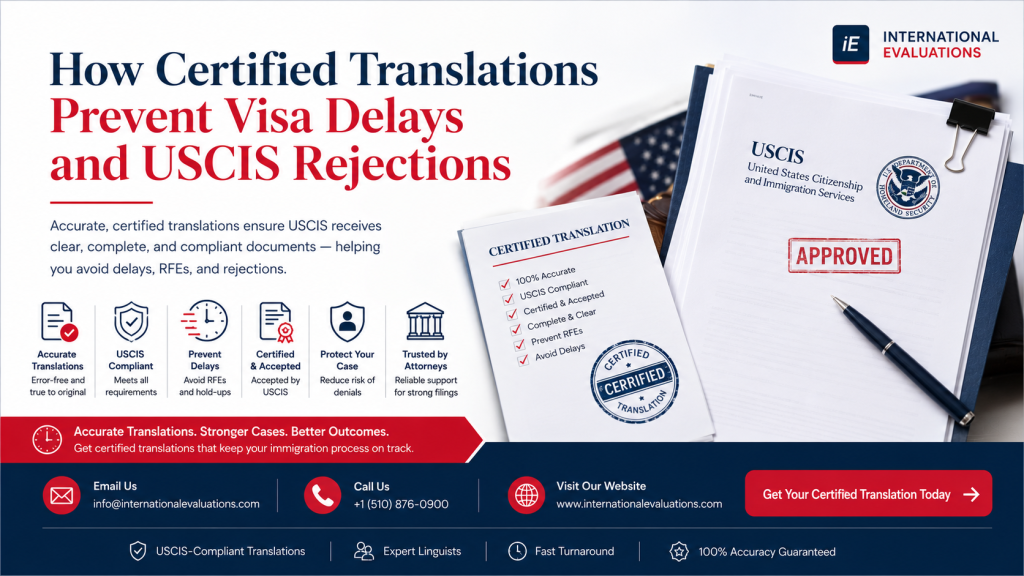
Every immigration attorney knows the pressure that comes with RFE season. As USCIS increases scrutiny on employment-based cases — especially H-1B, O-1, EB-1A, EB-2 NIW, and I-140 petitions — even the strongest filings can receive Requests for Evidence. RFEs slow down case processing, increase attorney workload, and often disrupt client timelines. The challenge isn’t the legal argument. it’s the documentation, consistency, and precision USCIS expects and the time it takes to assemble a complete, error-free response. At International Evaluations, we help attorneys navigate RFE season with confidence by preparing airtight, accurate, and fully compliant documentation so you can focus on legal strategy, not paperwork. Our team specializes in high-volume case support, rapid turnaround, and USCIS-compliant evaluations that strengthen your responses and reduce the risk of delays or denials. Why RFEs Feel Overwhelming for Attorneys RFEs demand strict accuracy — even small mistakes can trigger further RFEs or case denials. USCIS commonly issues RFEs for: Inconsistent job descriptions Missing experience or education verification Weak evidence of extraordinary ability Incorrect degree equivalency Insufficient specialty occupation justification Ambiguous job duties or employer-employee relationship issues Missing publications, citations, or expert letters Incomplete resume and employment history documentation These issues take hours to fix especially when dealing with high caseloads, tight deadlines, and urgent client needs. Instead of spending valuable attorney time chasing documents, drafting letters, and correcting inconsistencies, our team ensures your RFE responses are accurate, complete, and USCIS-ready. How International Evaluations Helps Attorneys Respond to RFEs Faster & Stronger We support the entire RFE response process, acting as your documentation partner to strengthen and streamline your filings. 1. Detailed RFE Analysis and Document Requirements Breakdown Every RFE is different — and USCIS wording can be vague. We analyze RFEs to identify:S What USCIS is really asking What evidence is missing What inconsistencies need correction What supporting documentation strengthens the case What clarifications must be drafted We provide attorneys with a clear, structured action plan for each RFE. 2. Experience & Employment Verification Letters One of the most common RFE triggers is unclear or insufficient experience evidence. We prepare: Employer verification letters Detailed job duty clarifications Missing work history documentation Letters for multi-company experience Experience+education equivalency evaluations Every document is tailored to match the roles, skills, and dates USCIS expects. 3. Degree Evaluations for RFEs (Education-Related RFEs) RFEs often question whether a foreign degree equals a U.S. bachelor’s, master’s, or doctorate. We provide: Single-degree equivalency evaluations Education+experience combined equivalency Expert opinion letters STEM field evaluations Specialized/engineering equivalency All evaluations are USCIS-compliant, professionally authored, and ready for attorney use. 4. Extraordinary Ability Evidence Strengthening for O-1 & EB-1A RFEs O-1 and EB-1A RFEs are increasing — especially around criteria such as: Media coverage Judging experience Awards and honors Original contributions Published material We prepare: Citation analyses Media evidence documentation Expert letters Article summaries Achievement portfolios Our team strengthens your case with evidence formatted the way USCIS expects. 5. Specialty Occupation Support for H-1B RFEs Specialty occupation RFEs often request additional proof of: Job complexity Degree requirements Employer-employee relationship Tools, technologies, and project descriptions Industry-specific justification We provide: Detailed job description analysis SOC/O*NET matching Industry expert letters Worksite documentation support Project descriptions & skill requirement clarifications This helps attorneys build strong H-1B responses that withstand USCIS scrutiny. 6. Consistency Check Across All Case Documents RFEs are often triggered by inconsistencies across: Forms Resumes Job duty descriptions Experience letters Degree evaluations Supporting evidence Employer memos We perform a full cross-check to ensure: Dates align Titles match Job duties flow logically Evidence supports the same narrative Employer documents correlate correctly This reduces the risk of secondary RFEs or denials. 7. Fast Turnaround for Time-Sensitive RFEs RFE deadlines are strict and USCIS rarely grants extensions. We provide: 24–48-hour expedited evaluations Rapid experience letter drafting Emergency education assessments Fast clarifications and supporting documents Your clients stay on track and your firm stays ahead of every deadline. Why Attorneys Trust International Evaluations for RFE Support Law firms rely on us because we deliver: 100% USCIS-compliant evaluations Attorney-reviewed documents Fast, reliable turnaround Deep expertise in employment-based immigration A dedicated team familiar with complex RFEs High success rate in RFE-heavy case types We act as your back-end documentation team — helping you win cases faster, stronger, and with less stress. How Our Support Helps Attorneys Focus on Strategy With our team handling the technical and documentary work, attorneys benefit from: More time for legal arguments Fewer back-and-forth document corrections Stronger, clearer RFE responses Reduced administrative workload High client satisfaction Predictable case workflows You focus on winning the case we ensure the documentation meets USCIS standards. Conclusion: Respond Faster, Respond Stronger, Stay Ahead of RFEs RFE season doesn’t have to overwhelm your law firm. With International Evaluations supporting your documentation, evidence, and evaluation needs, you stay fully prepared, compliant, and ahead of deadlines. Let us handle the paperwork while you focus on securing approvals for your clients. info@internationalevaluations.com +1 (510) 876-0900 www.internationalevaluations.com International Evaluations — Your Trusted Partner for Fast, Accurate, USCIS-Compliant RFE Support. FAQs 1.Do you assist with employment or experience-related RFEs? Yes — we prepare verification letters, job duty clarifications, and experience+education equivalency reports. 2.Can you help with O-1 or EB-1A evidence RFEs? Absolutely. We provide media documentation, citation analysis, expert letters, and original contribution support. 3.Do you offer rush deadlines? Yes — 24–48-hour expedited processing is available for RFE cases. 4.Can attorneys maintain control of strategy? Yes — attorneys handle legal arguments; we manage documentation and evidence. 5.Do you prepare degree evaluations for USCIS? Yes — we provide USCIS-compliant education and experience assessments for all visa categories.
Certified Translations: Ensuring USCIS Accepts Non-English Documents
When filing a visa petition, green card application, or any USCIS request, one critical detail often overlooked is the translation of non-English documents. Whether it’s academic transcripts, employment letters, legal documents, or certifications, USCIS requires that all foreign-language documents be accompanied by certified translations. Failing to provide accurate, certified translations can lead to delays, Requests for Evidence (RFEs), or even denials. At International Evaluations, we help applicants, employers, and immigration attorneys ensure all non-English documents meet USCIS standards through certified, accurate, and professionally formatted translations. Here’s why certified translations are essential and how they can strengthen your immigration case. Why USCIS Requires Certified Translations USCIS officers must be able to fully understand the content of every document submitted in a case. Non-English documents without proper translation can: Cause confusion or misinterpretation of credentials or qualifications Trigger Requests for Evidence (RFEs) or Notices of Intent to Deny (NOIDs) Delay processing times due to additional verification requirements Reduce the credibility of your application A certified translation ensures that USCIS can review documents accurately and efficiently, reducing the risk of errors or delays. What Is a Certified Translation? A certified translation is a document that: – Accurately converts the original text into English – Includes a signed statement from the translator attesting to its completeness and accuracy – Contains the translator’s name, signature, and date – Often includes the translator’s credentials or professional affiliation USCIS explicitly requires this certification for all foreign-language documents to ensure authenticity and prevent misunderstandings. Common Documents That Require Certified Translation Applicants and employers frequently need certified translations for: Academic transcripts and diplomas – To prove foreign educational qualifications. Employment verification letters – Especially for employment-based visas. Professional certifications and licenses – For specialized professions like healthcare, law, and engineering. Legal documents – Marriage certificates, divorce decrees, birth certificates, or adoption papers. Financial statements – Investment records, bank statements, or business financials. Each document must be translated accurately and formatted correctly to meet USCIS standards. Benefits of Using Certified Translations Certified translations offer multiple advantages for immigration applicants: 1. Compliance With USCIS Requirements Certified translations ensure that your documents meet USCIS standards, eliminating one common reason for RFEs or delays. 2. Accuracy and Clarity Professional translators accurately convey dates, titles, terminology, and legal language, ensuring no critical information is misinterpreted. 3. Consistency Across Multiple Petitions For businesses or attorneys managing multiple cases, certified translations provide a consistent format and language style across all documents, reducing errors. 4. Faster Processing Documents that are clear, complete, and certified help USCIS officers review your case quickly, speeding up approvals. 5. Credibility and Professionalism Certified translations signal professionalism and attention to detail, increasing the credibility of your submission. How to Ensure Your Translation Meets USCIS Standards To avoid complications, follow these best practices: Use a Professional Translator – Avoid online tools or informal translations. USCIS only accepts translations by qualified individuals. Include a Certification Statement – The translator must certify that the translation is complete and accurate. Maintain Original Formatting – Preserve the structure of the original document to ensure clarity. Include All Pages – Every page of the original document should be translated, including signatures, stamps, and annotations. Proofread and Verify – Double-check for consistency in dates, names, and numerical data. Following these guidelines ensures your documents are USCIS-ready and reduces the risk of RFEs. How International Evaluations Supports Certified Translation Needs At International Evaluations, we specialize in USCIS-compliant certified translations to strengthen immigration cases: Academic & Professional Documents – Translations of transcripts, diplomas, licenses, and employment verification. Legal & Government Documents – Marriage certificates, birth certificates, adoption papers, and court orders. Expert Certification – Each translation includes a signed certification from a qualified translator. Fast Turnaround – Timely delivery ensures you meet USCIS deadlines without stress. Multi-Language Support – Certified translations from dozens of languages, including Spanish, French, Mandarin, Hindi, Arabic, and more. Common Mistakes to Avoid Even minor mistakes in translations can cause delays or RFEs: Submitting translations without a certification statement Omitting stamps, signatures, or annotations from the original document Using informal translations or online tools instead of certified professionals Translating only part of the document and leaving out relevant information Failing to maintain consistent terminology across multiple documents Professional translation services eliminate these risks and ensure USCIS compliance. Real-World Impact of Certified Translations Clients who use certified translations experience: Fewer RFEs – Complete, accurate translations reduce USCIS inquiries. Faster approvals – Clear, professional translations help officers review cases efficiently. Stronger cases – Accurate translations reinforce your eligibility and qualifications. Peace of mind – Applicants and attorneys know that every document meets USCIS standards. Take Action Today Non-English documents are an essential part of many immigration petitions. Without certified translations, your case may face unnecessary delays, RFEs, or even denials. Ensure your documents meet USCIS requirements by working with International Evaluations for certified translations. Fast, reliable, and professional service keeps your immigration case on track and approval-ready. Email: info@internationalevaluations.com Phone: +1 (510) 876-0900 Website: www.internationalevaluations.com International Evaluations — Ensuring USCIS Accepts Every Non-English Document.