5 Ways to Avoid Delays with Credential Evaluation
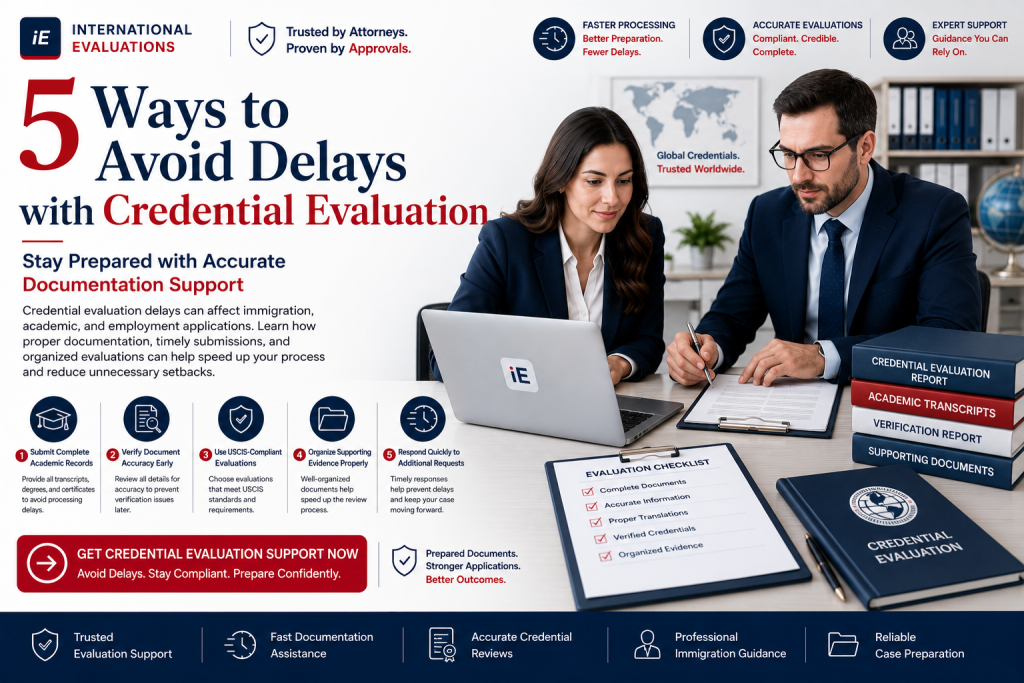
Although you can avoid delays by carefully following instructions, reviewing your required documents. But as a best credential evaluation services provider, International evaluations have underlined certain methods for you. Note Down Required Documents The first important step is understanding the required documents. You need to carefully review the document requirements based on your application or evaluation. Different types of evaluations may require different documents, so it’s crucial to understand these requirements. Each evaluation has its own specific needs. By thoroughly reading the document requirements, you can avoid sending the wrong documents, which could lead to delays. Start Early One thing you need to note is that every application, including credential evaluation, has a deadline set by the institution. It’s better to start early, as waiting until the last minute may cause you to miss the deadline. Additionally, if there’s a chance to review your documents, you’ll have time to make adjustments. This increases the chances of your application’s success. So, it’s best to send out your documents right away. “To evaluate document connect with the trustworthy Credential Evaluation service provider” The Correct Evaluation Types You must know what kind of evaluation services you need as per your academic and professional goals. You can check your requirements by going through the evaluation services because selecting a wrong evaluation can result in sending out documents all over again as different evaluations have different documents requirements. So, to sum up, you must have a clearer idea of what kind of evaluation you need. If you think you need two types of evaluation, you can have it done. The Right Order Avoid mistakes like sending out wrong documents and that too if they are right, you must confirm they are in the right order as the USCIS is strict and they might not have time to go into detail in every aspect of your application, also it’s a lengthy process. So, if your application and documents are in a certain order, then it brings out a clearer picture, thus avoiding delays. In conclusion, this approach helps identify why your application may be selected, and avoiding the need for additional documents can prevent any delays. To the Point One ore way to avoid delays in getting to the point, just to let us explain what it means. The thing is you must improvise that your documents are to the point of required outcome or goal of the application, meaning if you are going for example specialty occupation/course, you must the documents like your achievements and research publications upfront and avoid clutter, thus the examiner will know that you qualify for the certain evaluation. Thus, they won’t ask for more documents and you’ll be saved from any delays. Keep your original documents on hand, as they could be requested at any time. Attaching a copy with each application ensures you’re always prepared. This will prevent the need for additional documents and save you from delays. Contact International Evaluations One key point in avoiding delays is also choosing the right evaluation agency, we know there are numerous out there, and why we will certainly come to your mind. You need an agency that is always ready to provide backup whenever USCIS requests it. We have successfully handled many cases, such as Credential Evaluations, ensuring that your application meets the institution’s deadline and avoids delays or rejection. We will present your application in a way that eliminates the need for any additional documents.
Why Trust International Evaluations for your Credential Evaluations
Understanding Credential Evaluation: A credential evaluations is an essential process that translates your academic or work experience, including your grades and university degree, into U.S. equivalents such as GPA and credit hours. This evaluation helps U.S. universities and employers better understand your qualifications and academic background, which can significantly improve your chances of admission or career advancement. Why Do You Need a Credential Evaluations? If you’re unfamiliar with credential evaluations, the question arises: why do you need one? Grading systems differ between countries, and universities need a way to understand your scores in their context. A credential evaluation translates your grades and qualifications into a format that U.S. institutions can easily comprehend. Most U.S. institutions require this evaluation as part of your application. You may also need it to meet advisor requirements for your admission checklist. What International Evaluations Offer Acceptance When choosing a provider, it’s important to ensure that the credential evaluations is accepted by the universities or institutions you’re applying to. Our evaluations are widely recognized and accepted by most institutions. You can also check our reviews to gain confidence in our services. As a newer school, we bring fresh approaches to the evaluation process. Our methods give you an edge over traditional ones, while still aligning with accepted standards. Variety We at International evaluations offer basic evaluations to detailed (course-by-course) evaluations. For basic evaluations, we assess your overall grades, university recognition, course length, and entry requirements, providing a U.S. equivalency. For course-by-course evaluations, we convert all your transcripts, grades, and credit hours into U.S. equivalents. In some cases, grades will be converted into GPA, which is essential for those applying to graduate programs. Expertise Availability Our experts cover a wide range of fields, including arts, science, medicine, economics, nursing, and more. No matter your discipline, chances are we have an expert who can assist. Our team consists of top-level managers, professors, Ph.D. holders, Olympians, and other high-level experts who have years of experience in this field.
Why Foreign Students May Need a Credential Evaluations
The credential evaluation is a report that equates your given grades in the university to that of the U.S. equivalent. This is easily understandable by those who are familiar with the U.S. grading system. The benefit of having credentials evaluation is that the universities, colleges you are applying to the U.S. will be able to understand your given grades and thus they can evaluate your grades. Who is involved in credential evaluation? In the United States, there is no specific agency, department like the ministry of education that does it. Well, there are some colleges, universities that do them but most people rely on evaluation agencies who do these credential evaluations. Different kinds of evaluation reports There are different kinds of evaluation reports one can opt for, from basic to detailed (course by course evaluation). In the basic one, one’s overall grades the university where they have studied, its recognition, course length, entry requirement is all taken into consideration and a report equivalent to the U.S. grading system is made. Course by Course In detail, course by course, all the transcripts, grade scores, credit hours, all of them are converted to U.S. equivalents. Some of them will convert it to G.P.A which is a standard on how grades are evaluated in the U.S., which is necessary if a person is applying for a graduate degree. How are foreign credentials evaluated to U.S. equivalent? Agencies use a variety of tools and resources to determine, assess the given international institution and to evaluate the grades, academic achievements of the U.S. system, and standards of education. How are credential evaluation reports recognized? These are not recognized by every institution. Ultimately it is relied on the institution on how they wanna look at it, reports are not bound to any institution and are only advisory. The institution is not bound by any service provider and their opinions even if they recommend the service. Who needs a credential evaluation? You’ll need a credential evaluations to mostly all the institutions you are applying to in the U.S. This is because it describes your previous grades scores, credentials and helps it to understand by respective institutions and will likely be a part of your application for admission. You’ll be told by your advisor to have it done as it will be a part of the checklist of the university you are applying to. Costs and documents needed Costs depend upon the type of evaluation, basic or detailed, it differs from agency to agency like if they charge for each credential. Usually, basic evaluation costs around $150, and detailed goes from $150 to $650. It depends from organization to organization you are applying to. You can check the website for the variety of documents needed. Why International Evaluation? We have all it covered, you name it, we got it from credential evaluations, basic ones, course by course-by-course evaluations that too at a comparative price as compared in the market. We have top-level translators which will translate your documents hassle-free. We cover a wide variety of areas from science, math, medicine, nursing, and more, and our experts include high-level professors, managers, Ph.D. holders, Olympians, so basically saying we have all it covered just at the tip of your fingertips. So, what are you waiting for, call International Evaluations right now and have all your credential evaluations hassle go away?
Why Credential Evaluations are Needed for Immigration
When applying for a visa for the U.S. you must sum up the criteria for Credential evaluation to work or study in the U.S. This might need you to have a certain amount of work or educational degree to get admitted into a job and it must be claimed by the U.S. grading criteria. This needs some degree, which if you fail to present might fail your chances of working or studying in the U.S. The best way to get admitted is to have a U.S. graduation degree or its equivalent but the case rises that given your degree it must be translated into proper language. So, the best way is to get done a credential evaluation. Types and Understanding of Credential evaluation Reports Credential evaluations are done by immigration solution agencies which charge a fee for that. The reason to trust them is that they have experts who know how to sum up and present your academic and work qualification to as per U.S. equivalent degree which increases your chances up to a great extent to get a visa application accepted. The thing is that if you are looking for a report for further studies you can opt for Academic evaluation or if you want to get into a specific course you can go for the course-by-course evaluations in which all your transcripts, achievements come into place or if you are looking for work purposes you can opt for work experience evaluation in which your academic and work records comes into play. The Right Service for your Credential Evaluation The USCIS doesn’t provide a list of immigration services providers list but does provide guidelines that evaluation creating reports/agencies has to follow of U.S. National Council for the evaluation of foreign educational credentials. Since the establishment of USCIS regulations, the council dissolved in march 2006, but the principles of good practice remain in place and are championed by AACRAO IESC (American association of college registrars and admission officers International Education Standards Council) and AICE which is the first organization with published standards that oversee private credential evaluation agencies. AICE is one of those organizations which oversee these agencies by the U.S. Department of education, thus electing an agency that is endorsed by a member of AICE or NACES, the other association of evaluation agencies helps ensure that the evaluation report will be accepted by USCIS. Documents and Time Details The USCIS doesn’t set standards for the kind of documents that are required for evaluation. The documents, time vary from agency to agency and kind of evaluation. You can think of it as in your country, for educational purposes you have required the transcripts, the same will be needed for educational evaluation but it may vary from agency to agency what they need for specific evaluation. The time also differs like for physical send-off of documents and evaluation it takes around 7 days but the time is short if documents are received electronically both reducing the risk of misplacement of documents. Evaluation Report Use While filing your application, USCIS needs all your documents varying of which depend on the type of application you are applying for. So, it is advisable to present all your copies of the required documents in the first attempt. Also, it is advisable if you attach a copy of the documents to your resume/CV. Also, during the immigration interview process keep your originals with you. As to which agency you want to select the best is which can hand out the copies of your documents whenever needed which reduces the delay time and also the chances of your petition being rejected. Why Us? Good question, the thing is we have a wide variety of experts as well as topics related to academic evaluations, all covered also we have a wide variety of evaluations that best fits your requirement. Excellent translators for you’re the conversion of your transcripts. Brief We provide course by course, academic evaluation. Expert opinion letter, Beneficiary qualification letter, Work experience evaluations. Our experts consist of a Ph.D. holder, top-level managers and executives, professors, and Olympians. The academic evaluation covers topics from math, arts, science, psychology, nursing, and more, and that too at a go-get rate. So, what are you waiting for, keep the hassle aside and call International Evaluations today?
What is a Credential Evaluation for a Foreign Student?
You need to understand about Credential Evaluation for a Foreign Student. Education is the basic building block of one’s future. If your future course doesn’t retain recognition from foreign universities, then it’ll diminish your possibilities of obtaining a consecutive degree from abroad. Therefore, it’s knowing to get your degree examined by a professional organization like International Evaluations before you apply to International Universities. What is Credential Evaluation? The credential analysis is often understood because of the estimation of your current degree in a global platform. it’s principally dispensed by countries just like the USA or North American nation since their academic ministry doesn’t measure foreign degrees during which tutorial and skilled degrees attained in one country square measure compared to those attained in another university, faculties, and employers around the world The conception of international papers analysis isn’t solely restricted to effort a degree; instead, it applies to a far off worker still. Since it’s a vital method, you want to solely take into account professional bodies like International Evaluators for the duty. The international Evaluation is one of the best organizations which provide the Credential Evaluation usually and customarily. It generally offers 3 forms of evaluations: Course by Course Credential Evaluation The Course by Course Evaluation report identifies and describes every diploma/certificate and provides an equivalency for every document. It indicates an outline of periods of education, courses, credit hours, grades, and degrees, still as overall tutorial performance in terms of the tutorial system within us. The US generally uses semester credits and a mark average, or GPA, on a 4.0 scale. This sort of report is usually needed for school admissions, crucial transfer credits, or once applying for a complicated degree, still as for skilled licensing and certification matters. Documents needed during this case embody, however, don’t seem to be restricted to, originals or certified copies of college transcripts (mark sheets) showing subjects studied, grades, and credit hours attained for every course of study. Academic Credential Evaluation (document by document) The document by document Credential Evaluation analysis report describes and lists the tutorial institution(s) attended and also the education credential(s) attained during a foreign country and states their U.S. equivalence (e.g. Bachelor, Master, Doctorate, etc.). This sort of papers analysis is most typical to be used in a job, immigration matters, and university admission once transfer credit isn’t expected. Skilled Work Expertise Evaluation The skilled work expertise Credential Evaluation is provided for immigration functions most typically for those applying for H-1B visas within the US. This Credential Evaluation for Foreign Student report evaluates each Associate in Nursing individual’s skilled work history and academic credentials to determine a Bachelor’s degree equivalency. This sort of Credential Evaluation can’t be used for academic or licensure functions. How does it help? A papers analysis report will facilitate university admissions officers to create admissions choices by taking your previous education and knowledge under consideration. The time and energy invested within education are paid off once your tutorial credentials square measure understood and recognized properly.
Your Foreign Credential Evaluation- The Myths
There have been many myths about foreign credential evaluation. Here, we are talking about some common myths that people have about credential evaluation. Myth 1: The academic certificate or degree of the applicant will be equivalent in the United States. It is important to know that the academic degree obtained in another country may not be equivalent to a degree obtained in the US. For example, a 3-year honors bachelor’s degree from Australia, UK, or South Africa is equivalent to a 4-year bachelor’s degree in the US. It’s not about just the number of years the degree takes to complete. It depends upon so many other factors while we doing the evaluation. Myth2: Many think that foreign credential evaluation companies will just issue another academic transcript or certificate. This is to make clear that we do foreign transcript evaluation have no legal authority to issue any educational certificate, transcript, or diploma. Only duly the U.S. accredited educational institutions have the authority to do so. The only document we issue is the report called credential evaluation report. This report has information pertaining to the applicant’s academic degree/diploma awarded by a non-US institute. Also, has the equivalency of the credentials in the United States. Myth 3: The process is tedious and time-consuming for foreign credential evaluation. This is not true. The process is easy if we have obtained all academic documents from the applicant. The verification of education credentials might take some time but it’s definitely not tedious. So, the process can be easy if the evaluators have access to all the required documents. Myth 4: The evaluation report has no expiry date. Please note that some evaluation report has a validity of two years, while others can be valid for three years. There are credential evaluation companies that have a policy in place regarding the validity or expiration of the report. Myth 5: The evaluation report prepared by evaluators are the same format and are accepted throughout the United States. The format of the report differs just like transcripts and diplomas issued by education institutions (college and universities) are different. The format can not be the same for all the reports. For example, we follow a format that is different from another foreign evaluation company. It is always advised to check with the employer or educational institutions they are applying whether they will accept the format. Myth 6: The credential evaluation companies charge the same fees for the reports. The fees of the evaluation company can vary. At, International Evaluation, we do not charge the same fees. The fees are charged depending upon the type of credential evaluation the applicant wants to have. For example, it may vary whether Academic or Work Experience evaluation. It can be an RFE case and to evaluate that we can charge a little high. Myth 7: Foreign credential evaluation is only for educational purposes. The credential evaluations besides gaining admission into college or university can be for employment, immigration, or for professional licensure. It depends upon the purpose you are applying for coming to the US. International Evaluations, thus, can help you for your purpose of coming to the US and make your dream come true. Myth 8: Evaluation companies do not provide translation services. It is a myth that evaluation companies do not provide translation services. The majority of them are known to provide translation services. International Evaluations is one of the examples of companies that provide certified translation services. Conclusion International Evaluations is here to answer any questions you may have. We are reliable, affordable, and trusted with quick and easy application processes. Contact us today.
Why is it necessary to have your Credentials Evaluated?
Credentials Evaluated: Education is an elementary foundation stone of one’s career. We spent a considerable amount of time and energy in education to secure our future and thus invest to attain educational degrees. In case someone wants to come to the USA, these degrees can play a fundamental part. If these degrees do not get recognized by US foreign universities, then all the hard work seems a waste. It is vital to get your degrees/diplomas evaluated by experts or organizations before applying to US universities. Obtaining a credential evaluated degree is the first step for a skilled worker aspiring to work in the US. In short, your credential evaluation helps you to achieve recognition for your entire academics. International Evaluations is the trusted agency that provides an evaluation of your credentials. Before you get to know us more, let’s understand the concept and requirements of a credential evaluation. Importance of Credential Evaluation So, what exactly is a credential evaluation? In simple terms, a credential evaluation is the valuation of your degrees/diplomas through an expert. S/he analyses your national education degrees those you have attained in your native land to provide a US equivalent. It means conversion of your academic credentials to fall in line with the academic credential system of the USA. There are universities, employers, etc who expect an evaluated degree from independent credential auditors. Generally, if you are applying for US universities, you need evaluated degrees. The university can ask for your evaluated degree. Even if you apply for employment in the US, you need to submit an evaluated degree for the documentation process. It is a very critical process, only experts with knowledge of international education systems can perform a full credential evaluation document. Why do we need a credential evaluation? The necessity of a credential evaluation arises from the fact that each country has its education system. Thus, accurate and precise validation is required of a candidate’s marks/percentage & their degrees to be calculated through a proper evaluation for Credentials Evaluated. Conclusion International Evaluations is a trusted organization, where we analyze and compare your given degrees of a certain university to that of the U.S equivalent. We assess your credentials on the basis of the education system of your native country, reputation of the university you attended & curriculum of your program me. We understand your requirements and all the hard work you have put in your academics and work experience to be duly recognized, in the US.
Importance of Evaluating Educational Credentials
Today there exist numerous opportunities for the students who want to further their basic education and enter a world of knowledge that might have not been open before. There are a great number of universities that provide quality education and propel their students into the economic sector. Studying in a different country enriches your very personality and expands your perspective. Importance of Evaluating Educational Credentials is to better your chances at securing a place with one of these marvelous institutes, you must get an ECA – educational credentials assessment. International Evaluations provides on its website academic evaluations, work plans, translations, and expert opinions. We help you get to the best school for you, a school where you can prosper and grow your mind. International Evaluation is a great place to start your journey towards a magnificent future, specializes in providing highly qualified academic, work experience and professional position credential evaluations required for use in immigration, education and professional licensing. We have a broad range of experts available in various specialties, supported by comprehensive reference materials and a dynamic research system.
Choosing the Right Credential Evaluation for U.S. Immigration Success

When applying for a U.S. visa or green card, your educational qualifications play a vital role in determining eligibility. Whether you’re pursuing an H-1B, EB-2, TN, or PERM application, USCIS requires foreign degrees to be evaluated in terms of U.S. educational equivalency. Not all credential evaluations are the same. Submitting the wrong type can lead to RFEs (Requests for Evidence) or even visa denials. Choosing the right evaluation service can make the difference between smooth approval and a delayed or rejected petition. At International Evaluations, we help attorneys, employers, and applicants select and prepare the right type of credential evaluation that meets USCIS standards and supports immigration success. Why Credential Evaluations Matter in U.S. Immigration A credential evaluation translates your foreign education into its U.S. equivalent. This process helps USCIS adjudicators verify that your degree or experience meets the academic and professional requirements for your visa type. For example: H-1B applicants must show that their degree is equivalent to a U.S. bachelor’s degree or higher in a specific specialty field. EB-2 or EB-3 petitions often require proof that education and experience align with the position’s professional requirements. Submitting a general or non-USCIS compliant evaluation can result in RFEs delays, or even case denials. Types of Credential Evaluations for Immigration Purposes Not every evaluation fits every case. Depending on your visa type, background, and USCIS requirements, you’ll need one of the following: 1. Course-by-Course Evaluation Provides a detailed review of each subject, grade, and credit hour — typically used for academic admissions or PERM applications where detailed coursework comparison is required. 2. Document-by-Document Evaluation Summarizes your foreign degree, institution, and equivalent U.S. level (e.g., “Equivalent to a U.S. Bachelor’s Degree in Computer Science”). This is the most common type used for H-1B and employment-based visas. 3. Educational + Work Experience Evaluation Combines formal education and professional experience to establish equivalency — especially useful for applicants without a direct academic match but with significant professional experience. Example: If an applicant has 3 years of experience for every year of missing education, this can sometimes substitute for a degree. 4. Expert Opinion Letters When academic qualifications alone aren’t enough, expert letters written by university professors or industry specialists clarify how a candidate’s experience meets USCIS requirements. Each type of evaluation has a specific purpose — choosing the right one ensures your petition meets the exact USCIS standards for your visa category. Common Mistakes When Choosing a Credential Evaluation Even qualified applicants can face rejections if the evaluation is not USCIS-compliant. Some frequent errors include: – Submitting a general comparison report instead of a USCIS-specific evaluation – Using non-accredited or non-recognized evaluators – Ignoring work experience equivalency where applicable – Missing or inconsistent information between documents – Submitting evaluations without expert support letters when needed At International Evaluations, we’ve helped hundreds of applicants and attorneys correct these issues — often turning RFEs into approvals with properly formatted, expert-backed evaluations. How the Right Evaluation Strengthens Your Case Choosing the correct credential evaluation does more than just meet requirements — it builds credibility and clarity in your immigration petition. – Meets USCIS Compliance: Ensures your documents follow official requirements for your visa category. – Reduces RFEs and Delays: Properly formatted evaluations prevent confusion or requests for clarification. – Supports Legal Strategy: Attorneys can build stronger cases with accurate educational equivalency reports. – Boosts Approval Chances: Clear documentation helps USCIS officers verify eligibility quickly. Why Attorneys and Employers Choose International Evaluations At International Evaluations, we combine academic expertise with immigration law insight to deliver evaluations that are accurate, compliant, and ready for submission. Here’s what makes us trusted nationwide: – USCIS-Compliant Reports: Tailored for H-1B, PERM, EB-2, TN, and other visa categories. – 170+ Credentialed Experts: Covering all major academic and professional fields. – Attorney-Led Oversight: Every report reviewed for accuracy and legal relevance. – Fast Turnaround Times: Standard and expedited services for urgent filings. – Proven Success: Trusted by immigration attorneys and HR teams across the U.S. Whether you’re an attorney handling complex petitions or an applicant preparing for your dream job, the right credential evaluation can make all the difference. How to Choose the Right Evaluation for Your Case Here are simple steps to ensure your credential evaluation supports your immigration goals: Identify Your Visa Type: Different visas have different requirements. H-1B and EB-2 often require education + experience evaluations. Verify Evaluator Credentials: Always choose a recognized and USCIS-compliant evaluation agency. Confirm Experience Applicability: Combine work experience if your degree isn’t a perfect academic match. Request an Expert Letter (if needed): For borderline cases or technical fields, add an expert opinion letter to strengthen your case. Review All Details for Accuracy: Names, dates, and institutions should match across all documents. Conclusion: Your Education Deserves the Right Evaluation Every successful U.S. immigration case starts with accurate, compliant documentation — and your credential evaluation is at the heart of it. Don’t risk your approval with incomplete or incorrect evaluations. At International Evaluations, we specialize in delivering USCIS-ready credential evaluations that help attorneys, employers, and applicants achieve immigration success with confidence. info@internationalevaluations.com +1 (510) 876-0900 www.internationalevaluations.com International Evaluations — Translating Your Credentials into U.S. Immigration Success. FAQs 1. What type of credential evaluation does USCIS require? USCIS accepts evaluations that determine the U.S. equivalency of your degree and experience, typically a document-by-document or education + experience evaluation. 2. Can work experience replace missing years of education? Yes, under certain visa categories like H-1B, three years of professional experience can sometimes substitute for one year of academic study. 3. Who prepares expert opinion letters? Expert opinion letters are written by credentialed professors or industry experts qualified to evaluate specialized education or experience. 4. How long does a credential evaluation take? Standard reports are typically completed within 3–5 business days, with expedited 24–48-hour services available. 5. Are your evaluations accepted by USCIS and major law firms? Absolutely. Our