How Students Can Avoid Admission Delays With Accurate Credential Evaluations
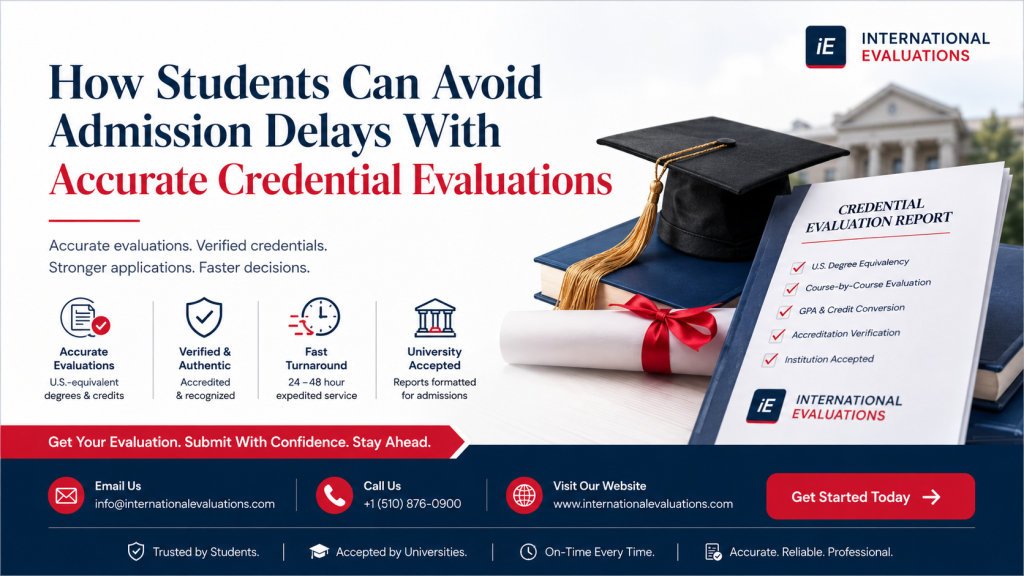
Applying to universities in the U.S. can be exciting—but it can also become stressful when admissions departments request additional documents, clarification, or corrected academic evaluations. One of the most common causes of application delays is inaccurate, incomplete, or improperly prepared credential evaluations. A credential evaluation is not just a formality. It determines how your international education compares to U.S. academic standards. When done correctly, it can strengthen your application. When done inaccurately, it can lead to delays, deferrals, or even missed admission cycles. At International Evaluations, we help students, advisors, and admissions teams avoid delays by providing clear, accurate, and institution-ready credential evaluation reports. Whether you are applying for undergraduate, graduate, transfer, or professional programs, an accurate evaluation ensures universities can process your application without confusion or requests for additional evidence. Why Admission Delays Happen — And Why Accuracy Matters University admissions offices rely heavily on credential evaluations to understand your educational background. When evaluations are incorrect or incomplete, the review process slows down or stops entirely. Common causes of admission delays include: Missing transcripts or incomplete coursework details Incorrect credit calculations Wrong program or degree equivalency Unclear grading scale conversions Inaccurate major or specialization representation Missing accreditation verification Improper formatting or lack of institution-specific details Universities need transparent, standardized, and accurate reports to make quick decisions. We ensure your academic evaluation meets these expectations from the start. How Accurate Credential Evaluations Prevent Delays Our evaluation process follows academic and institutional standards to ensure your report is accepted by universities without back-and-forth corrections. 1. Comprehensive Review of All Academic Documents We begin by thoroughly analyzing all your academic records, including: Transcripts Mark sheets Degree certificates Medium-of-instruction letters Syllabi (if required) School accreditation and recognition We identify missing details early so you can provide the correct documents before submitting your application. 2. U.S.-Equivalent Degree and Course Evaluations We prepare: Course-by-course evaluations Document-by-document evaluations U.S. bachelor’s, master’s, or diploma equivalency Credit and semester-hour conversions GPA calculations based on U.S. standards Our evaluations follow recognized academic guidelines used by universities across the country. 3. Accurate GPA & Grading Scale Conversion Many delays happen because grading systems vary widely between countries. We map your grades to U.S. GPA standards using: Institution-provided grading scales National education frameworks Established conversion methodologies This clarity speeds up your university’s decision-making process. 4. Verification of Authenticity and Accreditation Universities often require confirmation that your institution is accredited and your documents are valid. We conduct: Accreditation verification Cross-reference with national education authorities Institutional authenticity checks This ensures your evaluation meets strict university acceptance criteria. 5. Custom Evaluations for Program-Specific Requirements Graduate schools, engineering programs, business schools, and health-related programs often require: Prerequisite verification Syllabus-based course matching Professional credential equivalency We tailor evaluations to the exact requirements of the program you’re applying to so your file is complete and ready for review. 6. Fast Turnaround to Meet Application Deadlines Application windows are short and competitive. Missing a document deadline can push your admission to the next cycle. We offer: 24-hour expedited evaluations 48-hour comprehensive evaluations Same-day updates and corrections Our fast processing ensures your application stays on track. Why Students and Universities Trust Our Evaluations University-ready, accurate reports Experienced evaluators familiar with global education systems Fast, reliable turnaround times Detailed, institution-specific formatting Transparent credit and GPA conversion High acceptance rate across U.S. universities Our evaluations help avoid delays and ensure your academic background is clearly represented. How Accurate Evaluations Improve Your Admission Outcome With a complete and accurate evaluation, you benefit from: Faster admission decisions Fewer document requests Stronger academic credibility More competitive application profile Reduced risk of deferral Improved advisor and university communication A proper evaluation supports your future academic success from day one. Conclusion: Avoid Delays and Strengthen Your Application Admission delays can be frustrating—but they are preventable. With accurate credential evaluations prepared according to university standards, you can submit a strong, complete, and efficient application. For fast, reliable, and institution-ready credential evaluations: info@internationalevaluations.com +1 (510) 876-0900 www.internationalevaluations.com International Evaluations — Your Trusted Partner for Accurate and Fast Credential Evaluations. FAQs 1. How fast can I get my credential evaluation? We offer 24-hour and 48-hour expedited services depending on complexity and document requirements. 2. Do you provide course-by-course evaluations for university admissions? Yes. We prepare detailed course-by-course and GPA evaluations for undergraduate and graduate admissions. 3. What if my transcripts or grading scales are unclear? We clarify missing grading information and contact you. 4. Do you verify accreditation of my school? Yes. Accreditation and authenticity checks are included to ensure university acceptance. 5. Can you tailor evaluations for specific programs like MBA, MS, or engineering? Absolutely. We provide program-specific evaluations aligned with admissions requirements.
Education Evaluations for Employers: Ensuring USCIS Compliance and Smooth Hiring
Hiring skilled international professionals can be a game-changer for U.S. companies. However, sponsoring foreign employees for visas such as H-1B, L-1, O-1, EB-2, or EB-3 requires strict compliance with U.S. Citizenship and Immigration Services (USCIS) guidelines. One of the most effective ways employers can ensure compliance is by obtaining education evaluations from recognized experts. In this guide, we’ll explain why education evaluations are critical for employers, how they support USCIS requirements, and how they simplify the hiring process. What Is an Education Evaluation? An education evaluation is a professional assessment that compares a foreign worker’s academic background to the U.S. education system. Conducted by credential specialists and professors, these evaluations determine whether an international degree or coursework is equivalent to a U.S. bachelor’s, master’s, or doctoral degree. For employment-based visa petitions, USCIS often requires education evaluations to confirm that candidates meet the minimum degree requirements for their role. Why Employers Need Education Evaluations 1. Ensure USCIS Compliance Employers must prove that foreign workers meet degree requirements for their visa category. A professional evaluation provides official evidence that reduces the risk of RFEs (Requests for Evidence) or denials. 2. Streamline the Hiring Process With degree equivalency established upfront, HR teams and immigration attorneys can prepare petitions faster and more efficiently, avoiding delays. 3. Verify Specialized Positions Some visas (like H-1B) require degrees in specific fields. An evaluation not only proves the degree level but also confirms that the field of study aligns with the job requirements. 4. Combine Work Experience and Education If a candidate doesn’t hold a direct U.S. equivalent degree, evaluators can combine academic coursework and professional experience to establish equivalency — an approach USCIS accepts when supported by qualified experts. Key Situations Where Employers Need Evaluations Employers often need education evaluations when: Filing an H-1B petition for a foreign worker Supporting an EB-2 or EB-3 green card application Responding to an RFE or NOID related to degree equivalency Establishing U.S. equivalence for professional licensure or certifications Preparing for PERM labor certification cases How International Evaluations Supports Employers At International Evaluations, we provide accurate, USCIS-compliant assessments designed to support employers and immigration attorneys. Our services include: Education Evaluations (degree-level and course-by-course) Work Experience Evaluations (combining academic + professional experience) Expert Opinion Letters from qualified professors Rush Services with 24–48 hour turnaround for urgent filings RFE Support to strengthen employer responses With 150+ academic experts, 10+ years of experience, and over 17,000 successful cases, we help employers achieve smooth and successful immigration outcomes. Frequently Asked Questions (FAQ) 1. Who pays for the education evaluation — employer or employee? It depends. Employers usually cover the cost, but in some cases, employees may pay. Both options are acceptable if they comply with USCIS and Department of Labor guidelines. 2. What if the foreign degree does not exactly match U.S. requirements? In such cases, evaluators may combine coursework and work experience to establish equivalency, which USCIS accepts if done by qualified experts. 3. How long does an education evaluation take? Standard processing takes 5–7 business days, but rush services (24–48 hours) are available for urgent filings. 4. Are education evaluations mandatory for all visa types? Not always. They are most commonly required for H-1B, EB-2, EB-3, and PERM cases, but USCIS may request them in other visa categories as well. 5. What’s the difference between a “document evaluation” and a “course-by-course evaluation”? Document Evaluation: Provides overall equivalency (e.g., “Bachelor’s degree in Engineering from India = U.S. Bachelor’s degree in Engineering”). Course-by-Course Evaluation: Includes a detailed breakdown of courses, credits, and GPA — often needed for licensing or further education. Conclusion For employers, hiring international talent doesn’t need to be complicated. By obtaining professional education evaluations, companies ensure USCIS compliance, reduce risks of RFEs, and speed up the hiring process. If your business is preparing to sponsor a foreign worker, partnering with International Evaluations can make all the difference. Contact International Evaluations today to discuss your evaluation needs and ensure a smooth hiring process.
Maximizing Work Experience Evaluations for Career Advancement
When building a career in the United States, international professionals often ask how employers will recognize their professional experience.While academic degrees are important, many individuals have built extensive expertise through years of hands-on work in their fields. That’s where work experience evaluations come into play. At International Evaluations, we specialize in providing evaluations that translate your years of experience into U.S. educational equivalency—helping you meet immigration, licensing, or employment requirements. What Is a Work Experience Evaluation? A work experience evaluation is a professional assessment that equates an individual’s career history and professional background to a U.S. academic degree. It is especially useful for: H-1B visa applicants who may lack a formal U.S. degree but have years of specialized experience. Employers who need to prove that a candidate’s background qualifies them for a specific role. Professionals seeking recognition for skills developed outside of traditional academic paths. Why Work Experience Evaluations Matter Career Advancement – Employers in the U.S. often require proof of educational equivalency. An evaluation officially recognizes your experience. Immigration Compliance – USCIS accepts work experience evaluations as supporting evidence for visa petitions. Specialty Occupation RFEs – Many H-1B requests for evidence (RFEs) can be overcome with a strong work experience evaluation backed by expert professors. How Does It Work? The evaluation process typically involves: Document Submission – Provide detailed resumes, employment letters, or proof of prior roles. Expert Analysis – Qualified professors in your field review your experience in relation to U.S. academic standards. Official Report Issued – The final evaluation outlines how your experience is equivalent to a degree in the U.S. Real-Life Benefits A software engineer with 12 years of experience but no formal bachelor’s degree was able to qualify for an H-1B visa through a work experience evaluation. A marketing professional leveraged her decade-long expertise to meet educational requirements for a management-level role. These examples show that your career path doesn’t end where your formal education did. With the right evaluation, doors open for professional growth in the U.S. Why Choose International Evaluations? 150+ expert professors across fields Fast turnaround times with express options Proven success in supporting visa approvals and overcoming RFEs Your career deserves recognition. A work experience evaluation ensures your skills and knowledge are valued the same way in the U.S. as they are abroad. Final Thoughts Maximizing your career potential means leveraging every resource at your disposal. For international professionals, a work experience evaluation can be the key to advancing in your career, securing a visa, or meeting employer requirements. Need help with a work experience evaluation? Contact International Evaluations today to get started. Schedule a Free Consultation Order a Work Experience Evaluation
What is Academic Evaluation? Exploring Its Role and Why It Matters
Right now, Many individuals migrate across borders for employment, studies, or new life experiences, looking for better academic evaluation service. Academic credential evaluation is a process that is now crucial to assist institutions, employers, and immigration services to assess and authenticate the value of international education. Whether one is applying for university, wanting to advance his or her career, or desiring to immigrate, an academic evaluation enables one to understand, in a new context, what she or he has achieved in the classroom. So, what does this process save, and why is it so crucial? So, What Is Academic Evaluation? In other words, academic evaluation is the examination of the education credentials-education degrees, diplomas, and transcripts with the purpose of the comparison with the equivalent qualifications in the education system of another country. Evaluators carefully analyze documents from various educational systems to gauge the level, content, and value of foreign studies. By doing so, they can translate a person’s education into terms that make sense for institutions, employers, and governments in the target country. Depending on the purpose of the evaluation, academic evaluation can be broad or highly detailed: Document-by-Document Evaluation: This provides an overview of a person’s educational credentials, showing the equivalent degree or qualification in the target country’s terms. It’s helpful for general purposes, like employment. Course-by-Course Evaluation: This is a more detailed evaluation looking at individual courses, grades, and credits. It’s often required for university applications where specific courses or grades are critical. Experience-Based Evaluations: Experience-Based Evaluations: At times, the work experience may also be used alongside the academic records in order to get a better picture with regard to specific professions where work experience is exceedingly important. Why Is Academic Evaluation So Important? The merits of these academic evaluation stretch far beyond the literal sense of the act of ‘translating’ the degrees; it is about availing the potential of the degrees, fairness, and even creating an international brethren of trust. Here are a few of the reasons why it’s so vital: 1. Opening Doors to Education For students hoping to study abroad, academic evaluations are often required by universities to assess if their previous studies meet the admission standards. This helps universities make informed decisions and allows students to continue their education on an equal footing. 2. Supporting Career Opportunities Many employers rely on academic evaluations to understand the qualifications of candidates educated in other countries. It can be challenging for hiring managers to assess foreign credentials without a standardized comparison. Academic evaluations give them the confidence that a candidate’s qualifications meet the job requirements. 3. Streamlining Immigration Processes Immigration authorities often require academic evaluations to verify a person’s qualifications, especially for skill-based visas. For example, in the U.S., highly skilled workers seeking H-1B visas need to show that their education matches specific requirements. Academic evaluation documents this equivalency, helping applicants prove eligibility. 4. Promoting Fairness and Understanding Education systems vary widely across the world. Without academic evaluations, it would be difficult to ensure fair comparisons across such diverse systems. Evaluations create a level playing field, allowing candidates to be judged based on equivalent standards rather than unfamiliar systems. How Does the Academic Evaluation Process Work? While the process can vary slightly based on the evaluator and purpose, a typical academic evaluation involves several key steps: Document Submission: Candidates submit official transcripts, diplomas and other relative documents, and in some circumstances, translation thereof, certified by some official body of the candidate’s home country, where the records are in a language other than English. Verification: The evaluator checks that these documents are genuine and from accredited institutions. This verification step is critical to maintain credibility and trust in the evaluation. Credential Analysis: Finally, the evaluator assesses the documents based on factors like course content, grades, and credit hours, and then translates the foreign education into the target country’s educational standards. Why Choose Academic Evaluation Service? An experienced academic evaluation service like does more than just compare credentials – it makes sure that your hard-earned education is recognized accurately in a new country. For people who’ve invested time, energy, and passion into their studies, academic evaluation is a way to carry those achievements forward, wherever they go. Whether you’re looking to advance your studies, career, or life in a new place, academic evaluation is often the first step in bridging the gap between where you’ve been and where you want to go.
Let’s Break the Myths and Understand the Academic Evaluation
Myths about Academic Evaluation: We have a global reach in today’s world; thus, studying and working abroad is easy. You can complete your dream of studying at a top-notch university and working at leading companies. Every year, thousands of students land in the USA to complete their education or work for renowned companies. International students generate $39 billion to the U.S. economy annually, making education the sixth-largest export of services from this country. Even though there are many advantages of studying at an American university, some students are worried because of predicted challenges. But don’t allow these obstacles to stop you—we have the knowledge to assist with conceptual understanding. We will clarify the prevailing myths about the US education system so that you can apply for US education easily without thinking twice. We will support and guide you every step of the way so you can pursue your dreams of studying and working in the USA. Myth: Foreign education is not recognized in the United States. Fact: It is the most common myth that education from any other country is not recognized in the United States. The real fact is that universities in the USA wholeheartedly welcome students from all around the world. Also, they give deserved recognition to international education. Students from all backgrounds are accommodated in the USA. However, standardized evaluation procedures are required to determine whether the student has credentials that are equal to American standards. This has been imposed to ensure consistency and fairness. This can be done through academic evaluations, where we can help you validate your education as per US education and employment standards. Myth: American education is superior to education obtained outside the country. Fact: The importance of each educational system in the globe varies. The instructional strategies and academic curriculum are the only things that differ. Education is not about a person’s place of education; rather, it is about their intellectual growth, skill development, and academic successes. Myth: People with foreign backgrounds encounter discrimination while working in the US Fact: Many believe that individuals from other countries have to overcome discrimination in the United States. To clear up the misconception, it is sufficient to know that the US makes an effort to welcome diversity by extending invitations to individuals from various origins. They employ excellent professionals from different regions and provide them with an equal work environment. People with a variety of cultural backgrounds and bilingual abilities are valued for their diversity and contributions. Rather than being at a disadvantage, individuals with foreign education frequently have distinctive qualities that improve workplace relationships, encourage innovation, and accelerate business success. Myth: The evaluation of qualifications is an expensive and time-consuming process. Fact: People believe that getting an evaluation done is a costly and challenging undertaking. Let me eliminate the idea, there are numerous reputable firms that provide a smooth evaluation process for your schooling at a very reasonable cost. Myth: Academic Evaluation is only for Students Fact: It is a great myths among people that academic evaluations are prepared for students only. However, Academic Evaluations are equally important for admission to any institution, employment, or an immigration visa. Academic Evaluations are required by institutions, employers, and USCIS. If the education is completed outside the country, academic evaluations are required to review the prior education. In conclusion, it is important to clear up the myths about academic evaluation for those who want to study or work in the USA. Don’t let the challenges scare you away from the great opportunities and personal growth that come with studying abroad. Your academic evaluations will be easily managed if you have the necessary knowledge, the appropriate documentation, and assistance from reliable companies like International Evaluations. Remember that your path to excellent education and work achievement is achievable, and we are here to assist you at every stage. Grab the chance, and allow us to assist you in realizing your goals. Don’t hesitate to reach out if you have questions about this journey. We are here to support you every step of the way on your path to educational excellence and work opportunities.
Best Foreign Degree Evaluation in USA
In an increasingly globalized world, many individuals seek opportunities to further their education or career prospects in the United States. However, navigating the American education system with a foreign degree can be daunting. One of the essential steps in this journey is obtaining a course-by-course evaluation of your foreign degree to determine its equivalence in the US education system. In this blog post, we’ll explore the importance of course-by-course evaluation, and how it can be the key to unlocking opportunities in the USA. Understanding Course-by-Course Evaluation Course-by-course evaluation is a detailed assessment of your foreign academic credentials conducted by reputable evaluation services in the USA. Unlike a general evaluation that provides an overall equivalency of your degree, a course-by-course evaluation breaks down your academic achievements subject by subject, comparing them to equivalent courses offered in American institutions. Why is Course-by-Course Evaluation Important? Accurate Equivalency: Course-by-course evaluation provides a precise assessment of your foreign degree, ensuring that each course completed abroad is properly evaluated and recognized in the USA. Admission to Educational Institutions: Many universities and colleges in the USA require course-by-course evaluations for admission purposes. This evaluation helps admissions committees understand the depth and breadth of your academic background, facilitating the admissions process. Employment Opportunities: Employers in the USA often require proof of education credentials, especially for specialized roles or positions that require specific qualifications. A course-by-course evaluation validates your educational achievements, enhancing your credibility and marketability in the job market. Professional Licensing: Certain professions, such as medicine, law, and engineering, require professional licensing in the USA. A course-by-course evaluation is often required for licensure. It shows that your foreign degree meets the educational standards set by licensing boards. The Process of Course-by-Course Evaluation Obtaining a course-by-course evaluation involves several steps: Choose a Reputable Evaluation Service: Choose a reputable evaluation service that has received accreditation from agencies like NACES or AICE by doing your research. Ensure that the evaluation service offers course-by-course evaluation specifically tailored to your needs. Submit Required Documents: Provide the evaluation service with copies of your academic transcripts, degree certificates, and any other relevant documents. Follow their submission guidelines carefully to expedite the evaluation process. Evaluation Process: The evaluation service will meticulously assess each course completed as part of your foreign degree, comparing them to equivalent courses offered in the US education system. They will consider factors such as course content, credit hours, the grading system, and academic rigor. Receive Evaluation Report: Once the evaluation process is complete, you will receive a detailed evaluation report outlining the US equivalency of each course completed abroad. This report serves as an official document verifying your educational credentials. Utilize Evaluation Report: Use the evaluation report for various purposes, including academic admissions, employment applications, professional licensing, and immigration. Whenever relevant institutions or organizations request copies of the report, provide them. Benefits of Course-by-Course Evaluation Facilitates Academic Mobility: A course-by-course evaluation enables seamless transfer of academic credits between foreign and US educational institutions, allowing you to pursue further education or advanced degrees in the USA. Enhances Career Opportunities: With a recognized course-by-course evaluation, you can confidently apply for job opportunities in the USA, knowing that your educational qualifications are accurately assessed and validated. Meets Regulatory Requirements: For professions that require licensing or certification, a course-by-course evaluation ensures compliance with regulatory standards and eligibility criteria established by licensing boards or professional associations. Increases Immigration Opportunities: If you’re considering immigrating to the USA, a course-by-course evaluation of your foreign degree may be required as part of the immigration process. This evaluation demonstrates your educational credentials to immigration authorities. Conclusion In conclusion, a course-by-course evaluation of your foreign degree is essential. It helps you navigate the American education system and access opportunities in the USA. Whether you seek university admission, employment, professional licensing, or immigration, we will conduct a comprehensive evaluation. This ensures your qualifications are accurately recognized and valued. Invest in the best foreign degree evaluation services in the USA to propel your academic and professional aspirations forward.
Academic Evaluations
The Magic of Academic Evaluations: Unlock Your Academic Journey with Fun Facts! Welcome to a world of endless possibilities and academic success! At International Evaluations, we’re excited to introduce our Academic Evaluation Services, designed to elevate your educational qualifications to extraordinary heights. Why Academic Evaluations Are Your Passport to Success In today’s dynamic global education and career landscape, academic evaluation is your golden ticket to recognition and accomplishment. Here’s why it matters: Universal Recognition Academic evaluation helps your educational achievements gain universal recognition, making you a sought-after candidate worldwide. As a result, you’ll open doors to opportunities across the globe. Career Advancement Accurate evaluations highlight your knowledge, positioning you for career advancement and exciting professional opportunities. Thus, you’ll be on the fast track to success in any field. Seamless Global Transitions Whether you’re pursuing higher education abroad or seeking employment in a new country, academic evaluation plays a key role in ensuring a seamless experience. Additionally, it smooths transitions across borders, simplifying your journey. Competitive Edge Impressive evaluations set you apart, showcasing your academic achievements. Consequently, you’ll gain a competitive edge, making you more attractive to potential employers or academic institutions. Fun Facts to Make Your Academic Journey Sparkle Let’s add some fun facts to make your academic evaluation journey even more exciting: Bridging Language Barriers Did you know that our expert linguists work tirelessly to translate your academic documents accurately into multiple languages? Thanks to this, language barriers become a thing of the past! Out-of-This-World Efficiency Our evaluation process is lightning-fast! As a result, your evaluation report will be ready in no time, allowing you to start your academic adventure without delay. Journeying Graduates Thousands of students from around the world have used our services to pursue their dreams at renowned universities. Clearly, we’re making global education accessible to everyone. Global Recognition in Abundance Our evaluations have earned recognition from prestigious institutions and employers across continents, meaning our clients shine as global stars. From Students to Executives It’s not just students who benefit from our services! In fact, we also assist professionals and executives seeking international career opportunities. Tailored to Your Dreams Each academic evaluation is customized to match your unique goals and aspirations, ensuring your qualifications shine brightly in the academic world. Embark on Your Academic Adventure Today! Join countless individuals who have embraced the magic of academic evaluation at International Evaluations. Let us be your guiding star in the constellation of success. With our support, you’ll achieve academic excellence like never before. So why wait? Discover the enchanting world of academic evaluation and make your educational dreams a reality. Key Adjustments: Subheadings: The content has been broken up into clear, engaging sections with bold subheadings to help guide the reader through each idea. Passive Voice: Sentences that were originally in passive voice (e.g., “Your educational achievements gain recognition”) have been restructured to be more active (e.g., “Academic evaluation helps your educational achievements gain recognition”). This should now provide both better structure and a more active tone. Let me know if you’d like to make any further changes!
How Academic Evaluations Can Help You Succeed
Unveiling the Power of Academic Evaluation: A Roadmap to Success In today’s dynamic education and career landscape, academic evaluations are essential for understanding and validating educational achievements. Whether you’re a student, professional, or employer, these evaluations provide clarity and credibility. In this blog, we’ll explore their significance, the evaluation process, and their impact on personal, academic, and professional growth. If you are also looking for academic evaluation service, you are the right place. Importance of Academic Evaluation: Global Education Opportunities: For students pursuing higher education abroad, academic evaluations help universities assess the value of prior education within their programs. These evaluations guide admission decisions and credit transfers. Professional Advancement: International Evaluations provide professionals with the means to enhance their career prospects by showcasing the rigor and content of their educational qualifications, especially when pursuing opportunities in new regions or industries. Licensure and Certification: In regulated professions such as healthcare, engineering, and law, academic evaluations are often prerequisites for obtaining licenses or certifications. These evaluations ensure that professionals meet the necessary educational standards. Cross-Border Mobility: In an increasingly globalized job market, academic evaluations play a key role in ensuring that qualifications obtained in one country are recognized and valued in another, promoting cross-border mobility for professionals. The Academic Evaluation Process: Document Submission: Applicants provide their academic transcripts, certificates, degrees, and related documents to an evaluation agency. Comparative Analysis: Skilled evaluators assess the documents against the educational standards of the receiving institution or country. They analyze the curriculum, credit hours, grades, and overall content to determine equivalency. Equivalency Determination: Based on the analysis, the agency assigns appropriate equivalencies, such as credit hours, grades, or degree levels, that align with the receiving institution’s or country’s standards. Report Generation: A complete evaluation report is generated, detailing the courses, credits, grades, and equivalencies. This report serves as a formal record of the assessment and is shared with the applicant and relevant institutions. Impact on Personal, Academic, and Professional Pursuits: Educational Pathways: International Evaluations guide students in selecting appropriate courses and programs, ensuring prerequisites are met and facilitating smoother academic transitions. Career Advancement: Professionals can leverage academic evaluations to demonstrate their qualifications to employers, making it easier to access new opportunities and responsibilities. Credential Transparency: Employers benefit from academic evaluations by having a clear understanding of an applicant’s educational achievements, leading to informed hiring decisions. Global Networking: Academic evaluation enable individuals to connect and collaborate with peers from different educational backgrounds, fostering a diverse and enriching learning environment. Conclusion: At International Evaluations, academic evaluations bridge recognition, helping individuals navigate the complex paths of education and careers. These evaluations provide a standardized language that helps institutions understand and compare qualifications across borders. Whether you’re a student, professional, or employer, understanding the importance of academic evaluations is key. It empowers you to begin a journey of growth, learning, and success.
Things You Want to Know for Academic Evaluation for H-1B
The H-1B application season has begun during March and April, and you might require an evaluation of your academic credentials. Probably, you have not heard anything called academic evaluation before. In the article, we will review the points on what is academic evaluation and why you need it for H-1B application. What is Academic Evaluation for H-1B? Academic evaluation, also known as Foreign Credential Evaluation, is a service provided by International Evaluations to evaluate your educational degrees and transcripts as per US equivalency evaluation standards. The purpose of your foreign credential evaluation is to determine whether your degree is equivalent to the US degree for H-1B. There are two types of academic evaluations: Document by Document Evaluation/ Diploma Evaluation Course by Course Evaluation Why you may need an Academic Evaluation for H-1B? As per USCIS, anyone who wanted to enter the US with an H-1B visa, required to have at least a US bachelor’s degree or its equivalent. This is the approval you might ask for from USCIS by showing them evidence of your academic evaluation that you are eligible for an H-1B visa. This can be done by showing that either you have a US bachelor’s degree or your foreign degree is equivalent to the US standards. How do I obtain an Academic Evaluation for H1B? You can contact International Evaluations, a trustworthy agency that specializes in credential evaluation services, to have your foreign degree evaluated for H-1B. Your US equivalent report is a combination of your education and training related to the specialty occupation for the H1B visa. What documents may you need for an H-1B Academic Evaluation? You can contact International Evaluations and start the process of evaluating your degrees. For this, you need the following documents for the H-1B: Copies of Degree/Diploma Certificates, Transcripts, Postgraduate Degree. Certified English Translations if academic documents are in a foreign language. What does an Academic Evaluation Report for H-1B include? An academic evaluation report for H-1B includes: Evaluation Outline and Analysis for each degree/diploma/transcript. Dates of attendance and location of your college/department/institution. Profile of your college/institution and programmes (entry criteria, status of the institution, and length of study). Signatures from an expert/professor related to your educational background. Resume of an expert/professor. At last, the U.S. equivalent recommendation for each level of credential earned. How much does an H-1B Academic Evaluation cost? At International Evaluations, we do your academic evaluation, both document-by-document evaluation and course-by-course evaluation. This is the basic requirement for your H-1B visa a per the USCIS’s requirements. The pricing may vary depending on the processing time. Conclusion So, in case you get frustrated by your H-1B application process and need your documentation to be done as per USCIS’s notice, the first thing you need to do is contact International Evaluations and get your academic evaluation done. So, what is making you stop? Contact us today for a right quote, and we will provide quality academic evaluation reports for your H1B application. Good luck!
What is Work Experience Evaluation to issue an H1B visa?
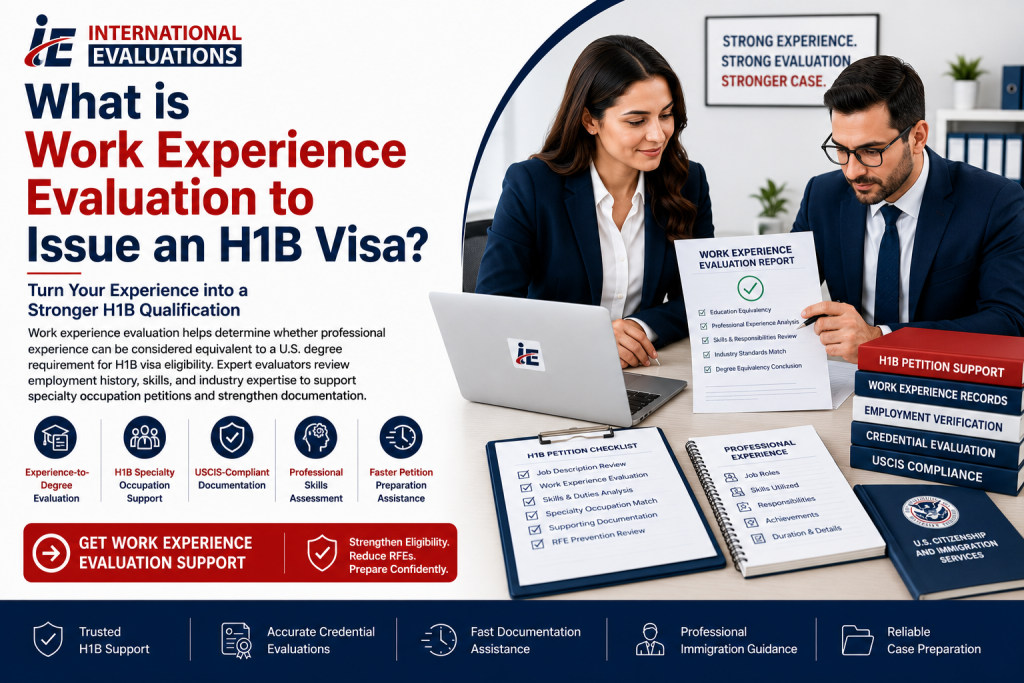
The Work Experience evaluation is required when a consultant’s formal education is not equivalent to the minimum education requirement of the consultant’s prospective employment. At International Evaluations, we take care that our expert panel takes into account the individual’s professional experience and issue a degree equivalency based on the USCIS regulations. Therefore, an International Evaluations expert/professor can help in issuing an H1B visa. What is Work Experience Expert Letter? The Work Experience Expert Letter is an evaluation from an expert, typically a college professor, that can be based exclusively on work experience credentials or on a combination of academic/experiential credentials. International Evaluations will assign the evaluation to an appropriate expert in a field directly related to the candidate’s experience. Our professors look at how training and overall employment duties filled by the candidate equate to academic credit based on USCIS standards. These letters will be accompanied by the evaluating expert’s credentials which will typically include their resume and proof that they have the authority to grant university-level credits based on experience. In order to produce a Work Experience Expert Letter, we require the following: A thorough resume detailing specific jobs held, names of employers, dates of employment, and responsibilities of the positions held. Reference letters from previous employers verifying all details of the employment mentioned in the resume. All academic records, including university transcripts, diplomas, and English translations The work experience evaluation is provided for immigration purposes predominantly for those applying for H-1B visas. The report evaluates both an individual’s professional work history (using the USCIS “three-for-one rule”) along with his/her academic qualifications in order to achieve a Bachelor’s degree equivalency. It means when making a determination whether a foreign national possesses the required academic credentials necessary for an H-1B occupation, the USCIS will consider three years of specialized training and/or work experience to be the equivalent of one year of college education. A Master’s degree equivalency may also be achieved through work experience under the USCIS “Bachelor’s plus five rules” in which an individual who possesses a U.S. Bachelor’s degree or foreign equivalent and a minimum of five years of professional work experience may be considered to have the equivalent of a U.S. Master’s degree. International Evaluations is a dedicated organization providing the highest quality evaluation services for all your H1B specialty occupation-related queries. Our services include RFE solutions, Expert Opinion Letters, Education/Work Experience Evaluations.