Work Experience vs. Degree: Which One Works Better for H-1B?
When U.S. employers sponsor foreign professionals for an H-1B visa, one of the biggest hurdles is proving that the worker is “qualified” for the specialty occupation. The law requires that the position normally calls for at least a bachelor’s degree or equivalent in a specific field. But what happens when a candidate’s background doesn’t fit neatly into the U.S. education system? Can years of professional experience substitute for a missing degree? In this blog, we’ll explore how USCIS evaluates work experience vs. degrees in H-1B petitions, and how credential evaluations can make the difference between approval and denial. Why Education Matters in H-1B Petitions The H-1B is designed for specialty occupations — jobs that require advanced knowledge in fields like IT, engineering, finance, or healthcare. Employers must prove that: The job normally requires a bachelor’s degree (or higher). The foreign worker has that degree or its equivalent. This is where credential evaluations play a key role — helping employers and attorneys document whether the candidate meets the minimum educational requirements. When a Degree Works Best A U.S. bachelor’s (or higher) degree in the required field is the cleanest way to qualify. Advantages: No questions about equivalency. Straightforward evidence for USCIS. Faster petition review. Example: An H-1B software engineer position requires a bachelor’s in computer science. If the candidate holds a U.S. computer science degree, the case is strong and simple. Can Work Experience Replace a Degree? Yes — under USCIS rules, professional experience can sometimes substitute for formal education. The standard equivalency is: 3 years of relevant work experience = 1 year of U.S. college education. That means 12 years of progressive work experience can equal a U.S. bachelor’s degree. Advantages: Opens the door for highly skilled professionals without U.S. degrees. Allows unconventional but talented workers to qualify. Challenges: USCIS requires detailed documentation of job duties, responsibilities, and progression. Must be backed by a formal work experience evaluation from a qualified professor or industry expert. Higher chance of RFEs (Requests for Evidence) if not carefully prepared. Degree + Work Experience: A Winning Combination Often, the best strategy is to combine partial education with years of experience. Example: Candidate has a 3-year foreign bachelor’s degree (common in countries like India). By itself, it may not equal a 4-year U.S. bachelor’s degree. With 3 additional years of professional experience, an evaluator can show equivalency. This combination approach is one of the most common solutions in H-1B cases. Why Employers & Attorneys Rely on Credential Evaluations A USCIS-compliant credential evaluation helps: Translate foreign degrees into U.S. standards. Combine education with professional experience. Issue expert opinion letters that strengthen complex cases. Reduce RFEs and denials by ensuring documentation meets USCIS standards. Common Pitfalls Without Proper Evaluation Employers who skip credential evaluations risk: RFEs questioning degree equivalency. Denials due to missing coursework or unclear transcripts. Delays from using non-compliant evaluators. Conclusion: Which Works Better — Work Experience or a Degree? The truth is, both can work — but the strongest H-1B cases either rely on a U.S. degree or a well-prepared combination of foreign education and work experience. For candidates without the exact U.S. degree, professional experience can bridge the gap — but only with the right documentation. At International Evaluations, we help employers and attorneys build strong H-1B petitions with: Degree Equivalency Reports Work Experience Evaluations by university professors Expert Opinion Letters Rush 48-hour processing for urgent filings Ready to file your H-1B with confidence? Order your credential evaluation with International Evaluations today.
Work Experience Evaluation for H-1B: A Solution for Candidates Without a Degree
The H-1B visa is one of the most sought-after pathways for skilled foreign professionals looking to work in the United States. However, one of its strict eligibility requirements is that applicants must hold at least a U.S. bachelor’s degree or its foreign equivalent in a field related to the job. This poses a challenge for talented candidates who may not have a formal degree but possess years of practical, hands-on experience. The good news? Work experience evaluations can bridge the gap, helping candidates qualify for the H-1B without a traditional academic credential. What is a Work Experience Evaluation? A work experience evaluation is a formal assessment performed by authorized credential evaluators, university professors, or academic experts. It converts professional experience, training, and certifications into an academic equivalency that aligns with U.S. educational standards. For H-1B purposes, three years of specialized professional experience is typically considered equivalent to one year of university-level education. This means that even without a bachelor’s degree, candidates can qualify if they have significant work experience in their field. Who Needs a Work Experience Evaluation? You may need a work experience evaluation if: You do not hold a bachelor’s degree but have years of work experience in your specialty. You have a degree that does not match your H-1B job specialty. You completed your education in a different system and need U.S. equivalency documentation. You want to strengthen your H-1B petition with expert academic and experiential credentials. How Does the Evaluation Work? Gathering Documentation Detailed resume with professional roles, skills, and achievements. Letters from past employers verifying job duties and years of service. Certifications, training records, or industry recognitions. Expert Analysis An evaluator or professor reviews your professional background to determine its academic equivalence to a U.S. degree. Issuance of Evaluation Report The evaluator provides a written report that outlines how your work experience matches the degree requirement for H-1B eligibility. Why Work Experience Evaluation Matters for H-1B Eligibility Without a Degree: Provides a pathway for skilled professionals who didn’t pursue traditional higher education. Job-Relevant Qualification: Ensures that USCIS recognizes your skills as equivalent to academic training. Stronger Petition: An expert evaluation adds credibility and reduces the chances of Requests for Evidence (RFEs). Career Growth: Opens doors to H-1B opportunities and long-term immigration benefits in the U.S. Choosing the Right Evaluation Service Not all evaluations are accepted by USCIS. To avoid delays or denials: Use evaluators authorized by U.S. universities or recognized by USCIS. Ensure the evaluation highlights both education and work experience. Work with immigration attorneys or consultants to submit the strongest possible petition. Why Choose International Evaluations? When it comes to H-1B work experience and education evaluations, the quality of your report can make or break your case. Not all evaluators are equal—choosing the wrong provider may result in RFEs, delays, or even denials. That’s why working with International Evaluations makes a real difference. 1. USCIS-Trusted Experts Our evaluations are written by university professors and credentialed professionals with deep expertise in U.S. academic equivalency standards. This ensures your report meets the highest compliance expectations. 2. Tailored to Your Case Every candidate’s background is unique. International Evaluations customizes reports—whether you need a work experience evaluation, degree equivalency, or expert opinion letter—to highlight your strengths and align with USCIS requirements. 3. Fast Turnaround Times Immigration deadlines are time-sensitive. We offer rush services within 24–48 hours, helping candidates and attorneys meet critical H-1B filing windows without compromising quality. 4. Comprehensive Services From credential evaluations and work experience equivalencies to expert opinion letters for RFEs, International Evaluations provides all the documentation support you need under one roof. 5. Proven Success with RFEs Our team has extensive experience responding to Requests for Evidence (RFEs). By providing detailed, professor-backed reports, we help strengthen petitions and improve approval chances. 6. Trusted by Attorneys and Employers Immigration attorneys and HR departments across the U.S. rely on our evaluations to hire international professionals with confidence. Final Thoughts While the H-1B visa has strict academic requirements, lack of a degree doesn’t have to end your U.S. career dreams. With the right work experience evaluation, years of professional expertise can serve as the foundation for your H-1B eligibility. At Bay Area Immigration Services, we specialize in helping candidates navigate this process with professional evaluations, strong documentation, and expert legal guidance. Schedule a Free Consultation Order a Work Experience Evaluation
No Degree? How Work Experience Can Qualify You for an H-1B Visa
Think you need a college degree to qualify for an H-1B visa? Think again. While a U.S. bachelor’s degree or its equivalent is the traditional path, there’s an alternative that many overlook: relevant work experience. If you’re an immigration attorney or an employer sponsoring international talent, it’s crucial to understand how experience-based evaluations can help meet USCIS requirements—even without a formal degree. At International Evaluations, we help attorneys and employers navigate these complex cases with detailed Work Experience Evaluations—custom-written by credentialed experts and fully compliant with USCIS standards. For individuals with extensive, progressive experience in a specialized field, this can be the key to unlocking H-1B eligibility. The H-1B Specialty Occupation Requirement To qualify for an H-1B visa, USCIS requires the job to meet the definition of a “specialty occupation”, which typically means: The position requires a bachelor’s degree or higher in a specific field. The beneficiary holds the equivalent of that U.S. bachelor’s degree. But what if the individual doesn’t have a degree—or has a degree in an unrelated field? That’s where work experience comes in. Under USCIS guidelines, three years of relevant, progressive work experience can be considered equivalent to one year of college-level education in the specialty field. This means: Evaluators can consider 12 years of experience in a relevant field equivalent to a 4-year bachelor’s degree. Who Can Benefit from a Work Experience Evaluation? This path is especially useful for: Skilled professionals who entered the workforce early without finishing formal education. Individuals with unrelated degrees (e.g., a bachelor’s in literature working as a software engineer). Self-taught professionals with certifications and years of hands-on experience. Entrepreneurs or consultants with a verifiable work history in the relevant field. We’ve helped attorneys and employers successfully file H-1B petitions for software developers, IT consultants, marketing analysts, mechanical engineers, and more—even when the candidate lacked a traditional degree. What Is a Work Experience Evaluation? A Work Experience Evaluation is a detailed report prepared by a university professor or subject matter expert. It evaluates the beneficiary’s work history to determine whether their experience is equivalent to a U.S. bachelor’s degree in a specific field. At International Evaluations, our process includes: Reviewing resume, letters of experience, and job descriptions Assessing the depth and progression of the individual’s roles Analyzing the relevance of experience to the proposed H-1B position Matching experience to academic standards based on AACRAO and USCIS guidelines Issuing a formal equivalency statement, signed by an academic expert All evaluations are USCIS-compliant, include expert credentials, and are formatted per USCIS submission standards. What Evidence Is Required? To support a work experience-based H-1B petition, USCIS expects substantial documentation. Our team will guide you or your legal counsel on what’s needed, including: Detailed employment verification letters from past employers A resume or CV outlining roles and responsibilities Project details, certifications, or work samples (if available) A clear job offer letter describing the specialty occupation All letters should be on company letterhead, signed by someone with authority, and outline job title, duties, duration of employment, and technologies/tools used. When to Use a Work Experience Evaluation Work experience evaluations are often used in: H-1B Petitions Without a Degree A candidate with 12+ years of experience and no degree can still qualify for an H-1B if the role and experience align. Degree Mismatch Cases If the beneficiary holds a degree in an unrelated field, we can combine education + experience to establish equivalency in the field of the job. RFEs or Denials If USCIS has issued an RFE or denial questioning the beneficiary’s qualifications, a properly structured expert evaluation may provide the clarity needed for approval or refiling. Why Attorneys and Employers Trust International Evaluations We specialize in helping non-traditional candidates qualify for H-1B and other employment-based visas. What sets us apart: Access to 170+ credentialed experts across STEM, business, healthcare, and social sciences who can assess and validate your experience. Fast, customized evaluations that translate your years of practical work into U.S. degree equivalency for H-1B purposes. Expertise in USCIS-compliant formatting and terminology, ensuring your case meets strict petition requirements. Proven track record of approvals, including successful conversions from Requests for Evidence (RFEs) to visa grants. Our goal is to provide documentation that not only meets requirements—but also stands up to scrutiny under today’s increasingly rigorous USCIS review standards. Final Thoughts: No Degree Doesn’t Mean No Opportunity The U.S. immigration system recognizes that real-world experience matters—especially in fast-evolving fields like IT, engineering, and business. With a professional work experience evaluation, candidates who lack formal degrees can still meet H-1B requirements and pursue their American dream. At International Evaluations, we help attorneys and employers uncover every qualifying angle for their candidates—education or experience-based. Schedule a Free Consultation Order a Work Experience Evaluation
Only 11 Days Left: Fast-Track Your H-1B Credential Evaluations Before the June 30th Filing Deadline!
The final days of June are here, and so is the last call for H-1B petition submissions. As an immigration lawyer, employer, or international candidate, you know how Precise and detail-oriented the H-1B process is—especially in the final stretch. One of the most important, deadline-driven elements is the credential evaluation, which can either make or break a petition. At International Evaluations, we excel at quick, precise, and USCIS-conformant assessments, even under pressing deadlines, assisting you in filing confidently before June 30th. Why Time Matters The H-1B process is known for its Strict and documentation-intensive nature. Although the lottery process may be long over, successfully selected applicants have until June 30th, 2025, to file their final petitions. That includes all supporting materials—most importantly, credential evaluations for foreign degrees. Why Are Credential Evaluations Crucial? One of the most common reasons USCIS sends out RFEs (Requests for Evidence) is when they are concerned that the applicant’s foreign degree is not a U.S. equivalent in the same field. If the job title doesn’t directly reflect the degree—or if the degree is from an outside United States school—USCIS demands a credential evaluation to ensure its equivalency. Such an evaluation must be: Done by an accepted academic expert or agency USCIS, AACRAO, and DOL guideline-compliant in structure Very specific in validating the field of study, degree level, and applicability to the occupation How We Help—Fast, Reliable, and USCIS-Compliant At International Evaluations, we provide expedited H-1B evaluation services with a 24–48 hour turnaround, ideal for filing on short notice. Here’s what we offer: Education-Based Credential Evaluations We evaluate foreign academic degrees to see whether they qualify as the U.S. bachelor’s or master’s degree standard in the specific field needed for the job. Best for: Candidates holding foreign degrees in STEM, business, finance, etc. Non-accredited or lesser-known degree institutions Instances where the degree major and the job title do not directly fit Work Experience + Education Evaluations If the degree is not a perfect match for the position, we blend professional experience with educational background to demonstrate eligibility. As per USCIS guidelines, 3 years of relevant work = 1 year of academic study. Ideal for: Applicants with degrees unrelated to fields but rich career backgrounds RFEs that challenge the field of study Challenging roles in tech, management, or analytics that require adaptable backgrounds Expert Opinion Letters (Specialty Occupation Justification) When USCIS questions whether the job is a “speciality occupation” (i.e., one requiring a bachelor’s degree), we offer formal expert opinion letters written by U.S. university professors that describe why the job satisfies USCIS requirements. This is particularly useful for: Marketing, business analyst, or management positions New or hybrid titles RFEs based on job complexity Rush Turnaround—Without Sacrificing Quality We understand how it feels to be racing against the clock. That’s why we provide: 24–48-hour processing (rush service available) Evaluations by credentialed professionals and PhD-level faculty 100% USCIS compliance Free consultation and review to assist in selecting the appropriate Professor Who We Work With? o Immigration Law Firms o H-1B Sponsoring Employers o Global Staffing and Recruiting Agencies o F-1 OPT/CPT Students Converting to H-1B No matter the industry — tech, finance, healthcare, or education — we provide the evaluations you need when you need them. Why Choose International Evaluations? We’ve built our reputation around speed, quality, and USCIS compliance. Here’s what sets us apart: 24–48-hour turnaround (rush services available) 100% USCIS-compliant reports reviewed by academic experts Unlimited revisions until you’re completely satisfied Dedicated case managers for each file Proven success with difficult RFEs and last-minute filings Other Services We Offer: Expert Opinion Letters (H-1B, EB1A, EB2 NIW) RFE Response Assistance PERM Filing Assistance Certified Document Translations We are your full-spectrum partner for employment-based immigration needs! Take Action Now — The H-1B Deadline Is Approaching With just 11 days remaining, the time to start your evaluation is now. Delays or errors in credential assessments can ruin your whole petition — but with International Evaluations, you can move forward with confidence, speed, and expert guidance. Email: info@internationalevaluations.com Phone: +1 (510) 876-0900 Website: com Final Thought: In the high-stakes race of H-1B petitioning, don’t let an incomplete or inaccurate credential evaluation hold you back. Rely on International Evaluations to get you to the deadline with confidence, clarity, and compliance.
What You Need to Know About H1B Visa Extension or Renewal
The H1B visa is a non-immigrant visa that allows U.S. employers to hire foreign professionals in specialty occupations, typically requiring a bachelor’s degree or higher in specific fields like IT, engineering, finance, healthcare, or education. The visa provides an initial stay of up to three years, which can be extended to a maximum of six years, and skilled workers often use it to gain valuable career experience in the United States. The visa also offers a pathway for individuals to explore permanent residency options in the future. If your H1B visa is about to expire, you’re probably asking questions like: “How do I renew my H1B visa?” “What’s the H1B visa extension processing time?” “Can I stay in the U.S. while waiting for my H1B extension?” “How much does an H1B visa extension cost?” We understand these concerns can feel overwhelming. Let’s break it down into simple steps so you can navigate this process with confidence. What is an H1B Visa Extension? The authorities generally grant this visa for an initial period of three years, and they can extend it for another three years. When the initial term period is nearing an end, individuals under H1B can apply for an extension in order to stay in the US and continue working with minimal disruption. Note that you can renew an extension provided you qualify for your initial H1B status. This means you need to be working for the same employer or start a new job as long as the proper filings are in place. H1B Renewal vs. Extension: Is There a Difference? People often use the terms interchangeably, but there is a slight difference between renewing an H1B and extending it. H1B Extension: An extension of your visa while staying within the six-year limit. H1B Renewal: A renewal involves renewal and getting beyond the six-year limit on H1B status, especially after spending at least one year outside the U.S. or when the individual starts the Green Card process. H1B Renewal and Extension Processing Time The most frequent question from applicants is regarding H1B renewal processing time or H1B extension processing time. Regular Processing: It takes 3 to 6 months in regular processing. Premium Processing: Gives the timeline a head start to 15 calendar days, but with extra fees. Other factors that might affect the processing time include USCIS workload, the accuracy of your application, and any Requests for Evidence, if necessary. You would therefore need a complete and accurate application to reduce unnecessary delays. H1B Visa Extension Fees: Expectations The cost of an H1B visa extension in the US largely depends on the employer and the type of extension you are seeking. The standard fees include: Filing Fee: $460 (Form I-129) Fraud Prevention and Detection Fee: $500 (for first-time petition and some changes/extension) Optional Premium Processing Fee: $2,500 What Documents Do You Need for an H1B Visa Extension? You will need to collect a list of important documents for filing an extension, including the following: Current H1B approval notice (Form I-797) A photocopy of your passport; making sure it is valid for the extension period requested. Recent pay stubs and tax documents. Employment verification letter mentioning your job description and salary details. Degree certificates, along with the evaluation report, if available. International workers will need their educational credentials evaluated. Helpful credential evaluation ensures that your qualifications meet all the standards needed when applying for an H1B visa. Therefore, it’s a critical part of your case. Tips for a Smooth H1B Extension Process Plan in Advance: Do not delay. It is best to start preparing your documents and application at least six months before your visa actually expires. Stay Consistent: Be consistent in your job title, salary, and responsibilities to that of your original H1B petition. Any significant alteration may necessitate an amendment. Seek Professional Guidance: Whether its credential evaluation or navigating the red tape of USCIS requirements, seek guidance on what to avoid and common pitfalls. Stay Informed: Processing times and fee structures may change, so continue to watch for updates from USCIS. What happens to my H1B status after I file an extension? If you have filed your application, you can continue working with your current H1B status for up to 240 days while awaiting a decision. This is to cause minimal interruption to employment; however, keeping your employer aware of the situation and monitoring the status of your application is key. Accrediting Your Visa Application with Credential Evaluation Through the H1B process, credential evaluation is an essential step toward validating the overall credibility of your qualification. For those earning degrees from abroad, it establishes that your acquired education meets U.S. expectations. Correct and on-time evaluations when applying for an initial H1B or an extension help build more persuasive applications while showcasing expertise in their field. When is an Evaluation Required for H1B Visa Renewal? Changes in Job Role or Employer When you must transfer within a company and your duties have changed appreciably or there is a change of employer during the H1B extension process, you may require an evaluation to verify that your education credentials meet the requirements of the new position. That way, you are still working in a “specialty occupation,” an H1B visa requirement. Your Education Was Attained at a Foreign Institution If you had earned your degree outside of the United States, you may be asked to provide a credential evaluation to prove that the foreign degree is equal to the equivalent needed U.S. degree for your specialty occupation. This ensures that your credentials meet the standard requirements of the H1B visa. Change in Educational Credentials Whether you obtained further qualifications after your initial H1B approval, updated qualifications could be necessary to show the new qualifications and their applicability to the H1B job you are engaged in currently. Renewal post multiple extensions or long gap If it has been some time since your H1B visa was renewed-for example, if there is a gap in employment—it might require an evaluation to determine whether you
Maximize Your H1B Approval: Why Credential Evaluation for H1B Matters
If you’re considering applying for an H1B visa, you’ve probably heard that it’s a popular non-immigrant visa for individuals with specialized knowledge and skills. One crucial requirement is having the right educational background. In particular, you must possess a US bachelor’s degree or its equivalent. However, what if your degree is from a different country? This is where Education Evaluation for H1b are useful. What is Credential Evaluation? An expert evaluates your credentials, including your degrees, diplomas, and transcripts from institutions outside the United States, and compares them to US education. Experts will evaluate your credentials and give you an official equivalency, which is crucial for US Citizenship and Immigration Services (USCIS) requirements. At International Evaluations, we provide the education evaluations that comply with the USCIS’s requirements. Why Do You Need an International Education Evaluation? Your foreign degree needs to be equivalent to at least a U.S. bachelor’s degree, according to USCIS. They don’t accept self-assessments; eventually, an official evaluation from an accredited service is mandatory. If your education is not properly evaluated, your H1B application could be rejected, even if you’re qualified. That is why getting your education evaluated is so important! Types of Education Evaluations for H1B General Evaluation: This basic evaluation compares your degree certificates and transcripts to see if they match up to a U.S. degree. If your degree is pretty straightforward and from a well-known university, this might be enough. Course-by-Course Evaluation: An evaluation of each course you have taken will be conducted by comparing it with courses offered in the United States. This type of evaluation is recommended for applicants with degrees from countries with different educational systems or if you wish to be extra certain. Work Experience Evaluation: If your formal education doesn’t fully meet U.S. degree requirements, relevant work experience can fill in the gaps. For every 3 years of relevant work experience, you get 1 year of college credit. If your degree falls short of U.S. Why Choose the Right Service for Your Credential Evaluation? It is important to work with an evaluation service that is trusted and accredited by USCIS. We specialize in foreign credential evaluation and make the process as seamless as possible for you at International Evaluations. Conclusion When applying for an H1B visa, be sure to have your education evaluated. A simple step can make a significant difference in the approval of your visa. The USCIS may issue an RFE if you fail to follow this step, or your visa may be rejected even if you qualify. By evaluating your educational credentials, we can assist you in obtaining a H1B visa. Let us assist you in obtaining your H1B visa by evaluating your educational credentials. Get started with International Evaluations today! We’re here to help make the process smooth and stress-free.
6 Things You Know About Request for Evidence (RFE) for H-1B
Do not know how to respond an request for evidence (RFE)? It is not difficult as in-case you don’t know, here are 6 things that can be helpful to you should know about an RFE. 1.What is an RFE? An RFE, also known as a Request for Evidence, is a request from USCIS to provide further information relating to your H1B petition or application. Basically, an H1B RFE is when your H1B visa petition must be reviewed in order to determine if you are suitable to receive the visa in the first place or not 2.Why did we receive an Request for evidence (RFE)? If you received an RFE, it is an indication that some of your documents are missing and are required to determine your eligibility for an H1B visa. USCIS no longer accepts the factual information provided by employers or other petitioners. All the facts and statements must be backed up with documentation. So, if it happens, do not be scared. At International Evaluations, we are here to help you with your H1B documentation and evidence, even though you received an RFE. 3.How long does it take to prepare the RFE response? It generally takes a few weeks to two months to prepare and submit your H1B application. In order to strategically develop a response, you must cater to all the issues raised in the request for evidence (RFE) and answer them all. Your documentation must be comprehensible and supported by strong evidence. At International Evaluation, we prepare and submit a timely response depending on the responsiveness between the petitioner, beneficiary, and attorneys. 4.What are the most common reasons cited in an H-1B RFE? Have you received an request for evidence (RFE)? These are the reasons that could be possible for the failure to establish to USCIS’ satisfaction: that the position qualifies as a specialty occupation; that the beneficiary has the required qualifications; availability of work (in-house)/ employee- employee relationship; that the beneficiary has maintained his/her immigration status; and that the prevailing wage is appropriate. 5.How do we establish that the position is a specialty occupation? Your H1B petition or application must demonstrate to USCIS satisfaction that your position requires at least a bachelor’s degree or its equivalent in a particular specialty field and not a general field of education. In recent years, USCIS has been significantly be strict in its interpretation of a specialty occupation and require evidences to proof. They required evidence between the work to be performed, the background of the employer and educational requirements for the position and if you have foreign national education translated in english language. There are four qualifying criteria to establish that the position is a specialty occupation: The position requires a Bachelor’s Degree at a minimum A Bachelor’s degree is the common entry-level requirement for the industry The employer normally requires a Bachelor’s Degree or its equivalent. The nature of the specific duties is so specialised and complex that the position requires a Bachelor’s degree. 6.How do we establish that a Bachelor’s degree is normally the minimum requirement? In order to establish that the bachelor’s degree is the minimum requirement : Evidence of the Nature and Complexity of the Employer’s Business and H-1B Position Breakdown of Duties and Educational Requirements Employer’s Hiring Practices Industry Requirements Third Party Expert Opinion Letter Conclusion At International Evaluations, we are here to help you if you do not know how an RFE works. When you submit an RFE, we guide you in the right direction so that USCIS can decide whether to approve your H1B application. We have a team of experts that will specifically focus on analysing the detailed job description to ensure that the duties are consistent with having a bachelor‘s degree in a specific field. We engage with both the employer and the employee so that we can do the documentation correctly to make your request for evidence RFE case strong. Good luck with your application!
Things You Want to Know for Academic Evaluation for H-1B
The H-1B application season has begun during March and April, and you might require an evaluation of your academic credentials. Probably, you have not heard anything called academic evaluation before. In the article, we will review the points on what is academic evaluation and why you need it for H-1B application. What is Academic Evaluation for H-1B? Academic evaluation, also known as Foreign Credential Evaluation, is a service provided by International Evaluations to evaluate your educational degrees and transcripts as per US equivalency evaluation standards. The purpose of your foreign credential evaluation is to determine whether your degree is equivalent to the US degree for H-1B. There are two types of academic evaluations: Document by Document Evaluation/ Diploma Evaluation Course by Course Evaluation Why you may need an Academic Evaluation for H-1B? As per USCIS, anyone who wanted to enter the US with an H-1B visa, required to have at least a US bachelor’s degree or its equivalent. This is the approval you might ask for from USCIS by showing them evidence of your academic evaluation that you are eligible for an H-1B visa. This can be done by showing that either you have a US bachelor’s degree or your foreign degree is equivalent to the US standards. How do I obtain an Academic Evaluation for H1B? You can contact International Evaluations, a trustworthy agency that specializes in credential evaluation services, to have your foreign degree evaluated for H-1B. Your US equivalent report is a combination of your education and training related to the specialty occupation for the H1B visa. What documents may you need for an H-1B Academic Evaluation? You can contact International Evaluations and start the process of evaluating your degrees. For this, you need the following documents for the H-1B: Copies of Degree/Diploma Certificates, Transcripts, Postgraduate Degree. Certified English Translations if academic documents are in a foreign language. What does an Academic Evaluation Report for H-1B include? An academic evaluation report for H-1B includes: Evaluation Outline and Analysis for each degree/diploma/transcript. Dates of attendance and location of your college/department/institution. Profile of your college/institution and programmes (entry criteria, status of the institution, and length of study). Signatures from an expert/professor related to your educational background. Resume of an expert/professor. At last, the U.S. equivalent recommendation for each level of credential earned. How much does an H-1B Academic Evaluation cost? At International Evaluations, we do your academic evaluation, both document-by-document evaluation and course-by-course evaluation. This is the basic requirement for your H-1B visa a per the USCIS’s requirements. The pricing may vary depending on the processing time. Conclusion So, in case you get frustrated by your H-1B application process and need your documentation to be done as per USCIS’s notice, the first thing you need to do is contact International Evaluations and get your academic evaluation done. So, what is making you stop? Contact us today for a right quote, and we will provide quality academic evaluation reports for your H1B application. Good luck!
How to Look for Jobs using an H1B database
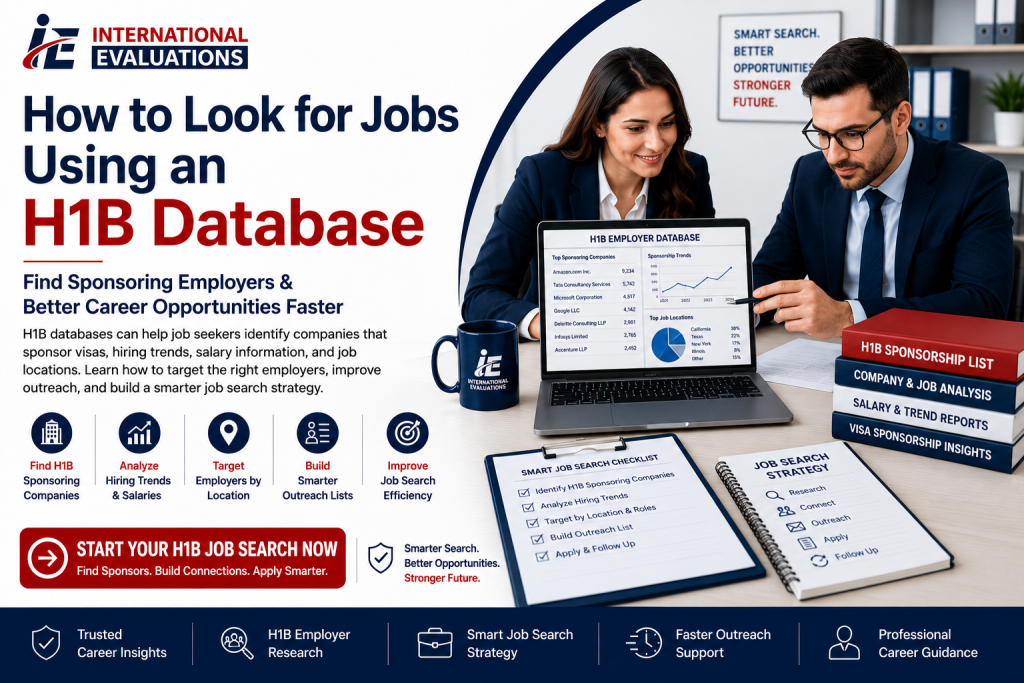
Are you looking working in the United States of America? If yes, then you should be aiming for H1B jobs. The fact is, it requires you to be qualified and skilled for the specialty occupation list. The list can be in IT sector, engineering, mathematics, science, medical and more. If you are applicable then the next step is to look for companies that sponsor H1B visas. To get the information about different sponsors, the H1B database can be the best source to obtain. Here, is the following guide that focuses on how to use database for the job search. A sponsor is mandatory for an H1B job if you are an: F1 student who is currently on Optional Practical Training (OPT) and willing to get a permanent employment option. L1 visa holder who is willing to change the status to H1B H1B visa holder who is willing to join a new employer F2, H4 visa holder or other status who is willing to change the status to H1B The data is disclosed by the Department of Labor’s Office of Foreign Labor Certification through certification of Labor Condition Applications submitted by different U.S. employers or companies. The H1B database extract information from here to help the H1B job seekers. The Department of Labor’s Employment and Training Administration (DOLETA) runs the application which maintains the Labor Certification Registry. Anyone can conduct a quick search using the records to find information about company employers those have submitted the Labor Condition Applications before filling the H1B petitions. Further, you can search the database using these criterions and filters like: Case Type: Apart from H1B visa cases, the information is also available for Green Card PERM cases, H-2A, H-2B and more State or territory of intended employment/ZIP code Employer name, if you want to search for information associated with a particular U.S. employer Certification date range to specifically search for Labor Condition Applications within a period How To Search Database for H1B Job? Following are some tips on searching for an H1B job using these databases: You can search in the H1B Labor Condition Application salary database using search filters like employer name, job title, work state and fiscal year. You may use one or a combination of these filters. Suppose, you search for the job title ‘Software Engineer’. The search results would return with H1B visa case petition number, Employer’s name, LCA status, Job title, Wage offered etc. If you click on the employer’s name, you can get the year-wise details of the number of LCAs filed, certified, denied and withdrawn. You may also obtain lists of employers or companies that filed H1B petitions. You can also find out specific job positions that are available with different employers that are currently filing H1B petitions. This would help you shortlist the employers who have job positions related to your field, skills, interest etc. The most useful way is to search by the job title only. If you are sure about the job position and a particular location you wish to join, these search results would help you target the specific employers offering these positions. Also, these databases also offer list of H1B violators, those have been found to be a defaulter. You also need to read about Position Evaluation Letter. This letter can also help you to get job in USA. Making the H1B visa job search fruitful? Finding sponsors and job positions available with them is not enough. Here is the list you must do some additional efforts to apply for the right jobs. Approach the top recruiting companies that have contracts with the employers. You may also submit your resume to these companies to broaden the job search. Research about different sponsors in the list using their websites. Consult an immigration attorney. These experts too have lists of top H1B employers or sponsors. As the H1B filing season is nearing, it is the right time to start exploring the H1B visa sponsors database of the previous seasons.
Expert Opinion letter, RFE’s, and H1-B visa
An expert opinion letter is a letter from an industry-level professional association stating that they have a Bachelor’s degree or higher in a specific specialty, a requirement for entry into the field. Or you can term it as a letter that supports your initial application or denial appeal. RFE’s RFE’s or requests for evidence come into play by the U.S. immigration department when they think they have incomplete evidence about the preferred position, completion of bachelor’s degree in a specific specialty, beneficiary status, or labor condition application. RFE’s are nothing but you can think of it as one more chance to get your petition approved. Special requests for RFE’s can include H1-B special occupation, beneficiary qualification, availability of work, and general requests. H1-B Special Occupation This nonimmigrant classification applies to people who wish to perform services in a special occupation, services of exceptional merit and ability. Specialty occupation can be termed as theoretical and practical application and highly specific knowledge, breaking it into simpler terms that one can perform a task that requires special skills which other workers don’t have relating to different departments. For a position to be termed as special occupation, the nature of specification duties should be so specific and complex that knowledge to perform such duties cab behold with a person with a minimum bachelor’s degree or the job is so complex that it can be performed by a certain individual with a degree. To Perform To perform one should be holding a U.S. bachelor or higher degree requested by a specific occupation from an accredited college or university or one should hold an unrestricted license, registration, or certification that authorizes one to fully practice the specialty occupation and be immediately engaged in that specialty in the state of intended employment. Labor Condition Application (LCA) Special occupation employers must obtain a certification from LCA and DOL. It includes that the employer will be subject to fines, bars if a violation is issued. Application Conditions The employer will pay the same amount and no less wage to the worker as compared to other workers or greater than the previous wage in the geographical area in which the employee is working. The employer will provide conditions that will not disturb other employed workers At the time of labor condition, there will be no strike at the place of employment Notice of filing of labor condition application with the DOL has been given to union bargaining representatives. Specialty Occupation and H1-B Given an overview of your position fits into a special occupation the chances of getting you an H1-B increase drastically. What’s need to be done As the denial rates are increasing thanks to COVID and much stricter norms because of previous U.S. government, you must showcase your application that it qualifies in the first attempt if not then our leading experts from various fields including professors, Ph.D. holders, managers will evaluate you both work experience as well as academic and showcases how it is equivalent to the necessary academic criteria as well as in terms of skill needed for a particular field. They have been in this field for quite some time, they know what they are doing. What’s needed Academic related documents like transcripts, mark sheets All detailed resumes specifying jobs held, job duties from previous employers specifying periods of employment. Supporting letter from previous employers specifying periods of employment, job duties. Our experts cover a wide variety of from mechanical, fashion design, medicine, nursing, construction management, finance, and more. So go ahead without a doubt and succeed in your professional working goals Trust International Evaluations. We know your goals are important. A well written Expert Opinion letter can be very helpful for work permit in usa.