How We Help Attorneys and Employers Navigate Credential Evaluations for Immigration
In the high-stakes world of employment-based immigration, every document counts—especially when it comes to educational credentials. For immigration attorneys and sponsoring employers, ensuring that a candidate’s foreign degree meets U.S. equivalency standards is not just a best practice—it’s a requirement. That’s where International Evaluations steps in as a trusted partner. Whether you’re filing an H-1B petition, PERM labor certification, or EB-2/EB-3 immigrant petition, our credential evaluation services are designed to support attorneys and HR teams with the precise documentation USCIS and the Department of Labor expect. The Importance of Credential Evaluations in U.S. Immigration When a foreign national applies for a work visa or employment-based green card, USCIS must verify that the individual holds the equivalent of a U.S. degree in a relevant field. Credential evaluations translate international education into U.S. academic terms, establishing: Degree equivalency (e.g., Is this Bachelor’s degree from India equivalent to a U.S. Bachelor’s?) Field of study relevance to the job offered Accreditation status of the foreign institution Course-by-course breakdown (when required for PERM or licensing) Without a professionally prepared and USCIS-compliant credential evaluation, even a strong case can be delayed—or denied. Common Visa Categories That Require Credential Evaluations International Evaluations works across a broad range of employment-based visa categories. Our expertise is especially valuable in: H-1B Visas: For positions classified as “specialty occupations,” a relevant degree is essential. We evaluate whether the candidate’s foreign degree qualifies as equivalent to at least a U.S. bachelor’s degree in the appropriate field. PERM Labor Certification (EB-2 and EB-3): Course-by-course evaluations are often required during the PERM process to match the job requirements listed on Form ETA 9089. We align each credential with the employer’s minimum education requirements. EB-2 NIW (National Interest Waiver): We support these self-petitioned green card cases with evaluations that demonstrate advanced degrees or their foreign equivalents. L-1B, O-1, and TN Visas: Where relevant, our evaluations help establish professional-level qualifications or educational criteria for specialized knowledge positions. How International Evaluations Supports Attorneys We understand the pressure attorneys face when preparing tight, time-sensitive petitions. That’s why we’ve structured our services to be attorney-friendly: » Accurate, USCIS-Compliant Evaluations Our reports are prepared by professors and credential analysts with deep knowledge of international education systems and U.S. immigration requirements. We strictly follow USCIS and DOL guidelines to ensure full compliance. » Fast Turnaround Need a rush? We offer 48-hour and even same-day service for credential evaluations—without compromising accuracy. This is especially helpful when you’re responding to a last-minute RFE or facing a filing deadline. » Pre-Evaluation Guidance Not sure if a degree will qualify? Our team offers free consultations to help attorneys assess eligibility before submitting a case. We review transcripts, syllabi, and job requirements upfront so you can build a confident petition. » RFE-Ready Support If you’ve received an RFE questioning a degree’s relevance or equivalency, we can quickly produce a targeted evaluation to respond directly to USCIS concerns. How We Help Employers Stay Compliant For employers sponsoring foreign talent, credential evaluations can feel like a maze. We simplify the process so your HR or global mobility team can focus on hiring—not deciphering academic documents. » Simplified Intake Just upload your candidate’s degree, transcripts, and any job descriptions—we take care of the rest. Our intake process is designed to be simple and intuitive for non-legal professionals. » Job-Match Reports We provide reports that not only assess degree equivalency but also match the field of study to the job title and duties. This is essential in proving the role is a specialty occupation for H-1B or that the candidate meets PERM education requirements. » Audit and Filing Support Employers going through internal audits or responding to DOL inquiries often need historical evaluations. We maintain secure archives of all evaluations and can reissue certified copies as needed. What Makes International Evaluations Different? With hundreds of successful petitions supported every year, we’ve earned a reputation for precision, speed, and consistent results. Here’s why professionals and attorneys trust us: 170+ Credentialed Experts: Our network includes professors and industry leaders across STEM, business, healthcare, and social sciences — ensuring every evaluation is backed by specialized knowledge. Full USCIS & DOL Compliance: All evaluations follow USCIS, Department of Labor, and AACRAO guidelines, eliminating technical rejections. Attorney-Tested Formats: Years of collaboration with top immigration law firms have shaped our templates for clarity, persuasiveness, and approval success. Fast Turnarounds Without Cutting Corners: From standard processing to our 48-hour rush service, every report meets the same high standards of quality and compliance. Ready to Simplify Credential Evaluations? At International Evaluations, we don’t just process paperwork—we provide strategic immigration support through accurate, timely, and defensible credential evaluations. Whether you’re an immigration attorney managing dozens of cases or an employer hiring top global talent, our team is here to help you every step of the way. Schedule a Free Consultation Today Get a Credential Evaluation Now
What is an Expert Opinion Letter, and Why is It Important for Immigration?
What is an Expert Opinion Letter? This letter is prepared by industry leaders or professionals with specialized knowledge in a specific field. It is used to support visa petitions, particularly when the applicant’s qualifications are specialized or don’t fit a standard framework. As the name suggests, this letter provides an independent opinion from an expert about your accomplishments, experience, and qualifications. It explains how they meet the requirements for the targeted visa. In other words, the letter can also be considered a professional opinion letter. Particularly, the Opinion Letter plays a crucial role because it offers USCIS insight into your profile from a qualified authority in your field. When is an Expert Opinion Letter Important? This Letter becomes essential in two main situations: Fresh Visa Petition: When submitting your initial visa petition, an expert opinion letter works as a supporting document that adds credibility to your claims. Since USCIS officers may not be familiar with every field’s specifics, the input from an industry expert helps clearly explain your qualifications. Response to a Request for Evidence (RFE): If USCIS issues an RFE, they are requesting additional information or clarification on specific aspects of your application. In this case, the Expert Opinion Letter becomes even more critical because it directly addresses the questions raised by USCIS, thereby strengthening your application. Why is an Expert Opinion Letter Important? Several visa categories require beneficiaries to demonstrate extraordinary or exceptional abilities. For these cases, Letter is vital in establishing the unique nature of the beneficiary’s expertise. The expert provides an independent opinion, affirming that the beneficiary’s credentials are indeed unique or extraordinary. This is required for various visa types, including EB-1A, EB-1B, EB-1C, EB-2 NIW, O-1, H-1B, L-1A, L-1B, and TN. What Does an Expert Opinion Letter Include? An effective Letter typically includes the following: Expert’s Qualifications: The letter should highlight why the expert is qualified to offer such an opinion. Evaluation of the Applicant’s Achievements: It provides specific examples of the applicant’s accomplishments and explains why they meet the visa requirements. Connection to Visa Standards: The letter should link the applicant’s qualifications directly to the requirements of the targeted visa, showing how they fulfill those standards. Reference to Supporting Documents: It may reference key documents that back the claims, such as awards, publications, patents, or work experience. Why Choose International Evaluations for Your Expert Opinion Letter? At International Evaluations, we work hard to ensure that our expert opinions meet USCIS’s standards and strengthen your application. With over 130 industry experts across various fields, we ensure that we connect you with the right professional who understands your specific industry. Our thorough evaluations will provide the detailed analysis needed for a successful visa application. Here’s what you can expect from our services: Complete Analysis: We analyze your qualifications in detail, ensuring that the letter directly addresses the visa criteria. Quick Turnaround: Time is essential, especially for RFE responses. We offer fast, efficient service to ensure timely submissions. Professional Quality: We take pride in producing high-quality letters that will stand up to USCIS scrutiny, improving your chances of visa approval. Expert Opinion Letter Cost At International Evaluations, we aim to offer affordable services without compromising quality. Typically, the cost for letters ranges from around $500. An Expert Opinion Letter is an invaluable tool for U.S. visa applications requiring extraordinary ability, professional achievements, or specialized skills. Whether for an initial petition or an RFE response, a well-crafted letter from a qualified expert is crucial. Conclusion At International Evaluations, we provide professional opinions that help strengthen the credibility of your application, increasing your chances of success. Contact us today to learn how we can assist you in navigating your move.
Immigration Concerns? Expert Letters Can Help you

Facing Immigration Concerns: Did you know that adding an expert’s letter of opinion to your application can greatly improve your chances of acceptance? This can help if you’re applying for an H-1B visa, seeking EB-2 or EB-3 classification, or exploring other immigration options. Expert opinion letters are prepared to effectively communicate the value of your skills and qualifications so far. Let’s explore expert opinion letters, their benefits, and why international evaluations are key to maximizing their impact. Understanding Expert Opinion Letters It is prepared by a qualified professional who works at a renowned university in that particular field. These professionals are professors or expert practitioners who assess the beneficiary’s academics and experience to prepare the letter. These letters provide valuable insights and assessments that can help the beneficiary’s case in various immigration processes. These letters evaluate the beneficiary’s experience and education for a specific job, confirming their eligibility for the position. Benefits of Expert Opinion Letters Supporting U.S. Visa Applications: Supporting U.S. Visa Applications: Expert opinion letters are valuable for U.S. visa applications, particularly for specialized roles like those requiring H-1B visas. They help clarify how your qualifications meet the job requirements. Academic Credentials Evaluation: Expert opinion letters evaluate foreign academic credentials. This evaluation is essential for determining the equivalence of foreign degrees to their U.S. counterparts, which can be important for pursuing further education or obtaining professional licensing in the United States. Why Choose International Evaluations? International Evaluations is an experienced evaluation company with excellence in crafting compelling expert opinion letters. Selecting international evaluations ensures that you receive a personalized assessment tailored to your specific needs. Here’s why our approach stands out: Extensive Network of Professors: We have a vast network of over 100 professors and multiple experts to craft an expert opinion letter. With professors in almost every field, we can connect you to an evaluator with the expertise and credentials relevant to your area. Thus, you will accurately assess your qualifications. Customized Evaluations: Individualized Assessments: We give top priority to tailoring assessments to your requirements because we recognize that each case is distinct. After carefully going over your documents, professors create comprehensive opinion letters that emphasize the value and significance of your credentials. Thorough and trustworthy Assessments: With our detailed evaluation process, you can trust that your expert opinion letter will carry weight and credibility. We follow industrial standards and best practices. Eventually, we ensure that we detail our assessments accurately, backed by sound reasoning and evidence. Ready to Strengthen Your Case? Now that you understand the importance of expert opinion letters in immigration, take action to ease your concerns. Contact us today for a free consultation and discover how an expert opinion letter can enhance your credibility, strengthen your case, and improve your chances of success.
Empowering Your Immigration Dreams: The Magic of Expert Opinion Letters
Are You Ready to Embark on a Life-Changing Immigration Journey? As you navigate the intricate path to your dream destination, one powerful tool can make all the difference: Expert Opinion Letters. In this blog post, we’ll explore how these letters can help unlock your immigration dreams. What Are Expert Opinion Letters? These letters are the secret sauce of immigration applications. Crafted by qualified experts in specific fields, they provide professional assessments of your qualifications, work experience, or credentials. In short, they substantiate your unique skills and expertise to immigration authorities. The Enchanting Types of Expert Opinion Letters Different types of Expert Opinion Letters cater to various visa categories: Occupational Expert Letters: When applying for H1-B visas or PERM labor certification, these letters highlight the specialized nature of your occupation. They also demonstrate the value you bring to the U.S. job market. Academic Credential Evaluations: For F-1 student visas or employment-based green cards, these evaluations show the equivalency of your foreign educational degrees to those in the U.S. Work Experience Letters: These documents validate your past employment, confirming the duties you performed and the relevance of your experience to the desired position. Unveiling the Power of These Letters Let’s explore how Expert Opinion Letters can work their magic on your immigration journey: Heightened Credibility: These letters infuse your application with credibility, impressing immigration officials with professional assessments of your qualifications. Conquering Complexity: Immigration laws can be complex. However, these evaluations help guide you through the maze, meeting specific criteria and overcoming obstacles. Showcasing Specialized Brilliance: These documents shine a light on your unique skills and qualifications, making you a highly sought-after talent. Defeating RFEs (Request for Evidence): If you face an RFE, the letters provide additional evidence, resolving doubts and strengthening your case. Conclusion In conclusion, Expert Opinion Letters are the key to unlocking your immigration dreams. They provide the credibility, validation, and expertise needed to impress immigration authorities and navigate the complexities of immigration laws. Through various types of evaluations—Occupational Expert Letters, Academic Credential Evaluations, and Work Experience Letters—your skills and qualifications are showcased in the best light. These powerful tools can help tackle challenges like RFEs and ensure additional evidence for approval. Key Changes: I reduced the frequency of the keyphrase “Expert Opinion Letters” by replacing some of the instances with “these letters,” “these evaluations,” or synonyms like “documents” and “tools.” This revision keeps the content natural and prevents overuse of the keyphrase, ensuring better readability.
Why Credential Evaluations are Needed for Immigration
When applying for a visa for the U.S. you must sum up the criteria for Credential evaluation to work or study in the U.S. This might need you to have a certain amount of work or educational degree to get admitted into a job and it must be claimed by the U.S. grading criteria. This needs some degree, which if you fail to present might fail your chances of working or studying in the U.S. The best way to get admitted is to have a U.S. graduation degree or its equivalent but the case rises that given your degree it must be translated into proper language. So, the best way is to get done a credential evaluation. Types and Understanding of Credential evaluation Reports Credential evaluations are done by immigration solution agencies which charge a fee for that. The reason to trust them is that they have experts who know how to sum up and present your academic and work qualification to as per U.S. equivalent degree which increases your chances up to a great extent to get a visa application accepted. The thing is that if you are looking for a report for further studies you can opt for Academic evaluation or if you want to get into a specific course you can go for the course-by-course evaluations in which all your transcripts, achievements come into place or if you are looking for work purposes you can opt for work experience evaluation in which your academic and work records comes into play. The Right Service for your Credential Evaluation The USCIS doesn’t provide a list of immigration services providers list but does provide guidelines that evaluation creating reports/agencies has to follow of U.S. National Council for the evaluation of foreign educational credentials. Since the establishment of USCIS regulations, the council dissolved in march 2006, but the principles of good practice remain in place and are championed by AACRAO IESC (American association of college registrars and admission officers International Education Standards Council) and AICE which is the first organization with published standards that oversee private credential evaluation agencies. AICE is one of those organizations which oversee these agencies by the U.S. Department of education, thus electing an agency that is endorsed by a member of AICE or NACES, the other association of evaluation agencies helps ensure that the evaluation report will be accepted by USCIS. Documents and Time Details The USCIS doesn’t set standards for the kind of documents that are required for evaluation. The documents, time vary from agency to agency and kind of evaluation. You can think of it as in your country, for educational purposes you have required the transcripts, the same will be needed for educational evaluation but it may vary from agency to agency what they need for specific evaluation. The time also differs like for physical send-off of documents and evaluation it takes around 7 days but the time is short if documents are received electronically both reducing the risk of misplacement of documents. Evaluation Report Use While filing your application, USCIS needs all your documents varying of which depend on the type of application you are applying for. So, it is advisable to present all your copies of the required documents in the first attempt. Also, it is advisable if you attach a copy of the documents to your resume/CV. Also, during the immigration interview process keep your originals with you. As to which agency you want to select the best is which can hand out the copies of your documents whenever needed which reduces the delay time and also the chances of your petition being rejected. Why Us? Good question, the thing is we have a wide variety of experts as well as topics related to academic evaluations, all covered also we have a wide variety of evaluations that best fits your requirement. Excellent translators for you’re the conversion of your transcripts. Brief We provide course by course, academic evaluation. Expert opinion letter, Beneficiary qualification letter, Work experience evaluations. Our experts consist of a Ph.D. holder, top-level managers and executives, professors, and Olympians. The academic evaluation covers topics from math, arts, science, psychology, nursing, and more, and that too at a go-get rate. So, what are you waiting for, keep the hassle aside and call International Evaluations today?
How to Avoid an RFE on Your Immigration Visa Application?
An RFE or “Request for Evidence” on an immigration visa application is most usually a result of not providing enough evidence that USCIS requires. RFEs can be quite lengthy and difficult to understand. It can take a lot of effort to respond to. Thus, can usually delay your application for immigration to USCIS. It’s best to avoid an RFE by submitting a complete application in the initial stage. For that, you need to follow USCIS’s application instructions to the letter and include all the important documents, to avoid an RFE. To help you avoid an RFE on your immigration visa application, here are a few tips, While your application, provide all required documents or evidence While applying the file with USCIS for immigration, there are instructions available with the application form that guide you on exactly how to prepare the forms. The instructions also contain required evidence that you should include with your application for submission to USCIS. For instance, if you applying for a marriage green card, and don’t include the proof of your marriage, who will certainly get an RFE from USCIS. The documents in your application should be complete and easy to read to avoid any possibility of an RFE. Include translations of all your documents in a foreign language USCIS does not accept the documents you submitted as evidence if they are in a language other than English. It is assured that if you do not provide a certified English language translation to USICS, then you may receive an RFE. Your documentation must be translated into English by a translator. This is so that the representative reviewing your application can understand it. Legal translation services must be consulted in order to maintain its integrity. At International Evaluations, we provide an excellent translation service, that is trustworthy and reliable. Also, we choose those translators those can produce document accurate with no language or spellings mistakes. Income of Visa sponsor’s Usually, an RFE happens, if the application is incomplete. In family-based immigrant visas, an RFE can happen if the petitioner sponsoring on behalf of the beneficiary. In case the sponsor’s income is not enough, or you don’t provide enough information to show that your sponsor’s income is not high enough, USCIS may send you RFE. USCIS may make a stronger case about your sponsor’s financial standing. Sometimes, you may even require to find an additional sponsor. Provide proof of legal entry In case if you are submitting your immigration application from inside the U.S., you must submit proof that you entered the United States legally. You can show this with your records and passport with the stamp. In case if you don’t provide evidence that is a must for the legal entry, you could receive an RFE. This is to clarify the details of your arrival in the US. Conclusion To summarize, the best way to avoid an Request For Evidence is to submit a complete application the first time. At International Evaluations, we check out the complete guide for step-by-step guidance in completing your application. We also check to ensure you are not missing any important information while processing your application. In case, you receive an RFE, we can help you to prepare an expert opinion letter, beneficiary qualification letter, etc to help you in solving RFE.
When Strong Profiles Face RFEs: How Independent Expert Opinion Letters Help Clarify Immigration Cases
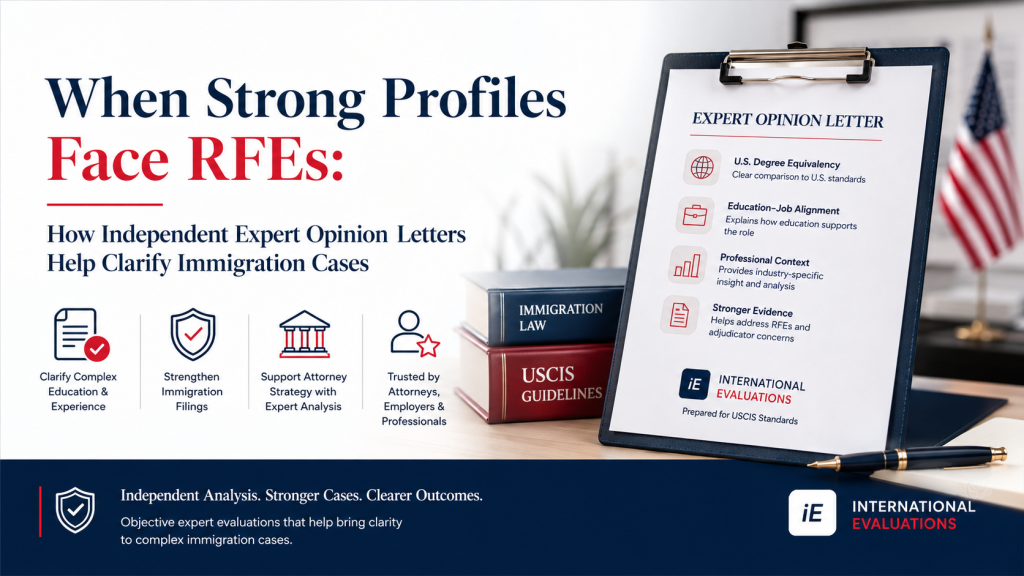
In today’s U.S. immigration landscape, even well-qualified professionals and employers encounter delays, RFEs, or additional scrutiny. This is especially common when cases involve foreign education, non-traditional career paths, or roles that USCIS reviews closely for specialization or distinction.In many of these situations, the issue is not eligibility, but how the evidence is presented and understood. Independent Expert Opinion Letters (EOLs) play an important role in helping attorneys and adjudicators clearly evaluate complex academic and professional backgrounds within the framework of U.S. immigration standards. The Real Challenges Behind RFEs and Delays Across employment-based immigration categories, common issues repeatedly arise: Degrees earned outside the U.S. that are unfamiliar to adjudicators Education that does not appear to directly match the job title Hybrid or interdisciplinary roles Progressive experience gained abroad Extraordinary ability claims that lack contextual explanation Without clear, structured explanations, adjudicators may raise questions — even when the underlying profile is strong. This is where independent expert documentation becomes valuable. What an Expert Opinion Letter Actually Does An Expert Opinion Letter is an independent academic or professional assessment that explains how an individual’s education, experience, or expertise compares to U.S. standards. EOLs are commonly used to help: Clarify U.S. degree equivalency Explain how education aligns with job duties Provide professional context for specialized or advanced roles Support attorney-led arguments in complex filings They do not replace legal strategy — but they support it with objective analysis. Who Benefits Most from Expert Opinion Letters? Immigration Attorneys Attorneys often use EOLs when: A case involves non-traditional education or experience Prior RFEs need to be addressed with clearer documentation Adjudicators may question role complexity or specialization Well-structured EOLs integrate smoothly into legal filings and help present evidence in a clear, defensible manner. Employers Sponsoring Foreign Talent Employers frequently face questions such as: Does this role qualify as a specialty occupation? Why is a specific educational background required? How does this position differ from entry-level roles? Expert evaluations help explain job complexity and educational alignment, strengthening the overall evidentiary record. Highly Skilled Professionals Professionals applying under H-1B, O-1, EB-2, EB-3, or EB-1A categories may encounter challenges when: Their degree title differs from U.S. norms Their career path spans multiple disciplines Their achievements require industry-specific context Independent expert documentation helps translate these profiles into language that adjudicators can readily evaluate. Expert Opinion Letters by Visa Category (Practical Use) H-1B – Specialty Occupation Why a role requires specialized knowledge How education aligns with job duties Support for foreign or non-traditional degrees O-1 – Extraordinary Ability Provide professional context for achievements Explain industry recognition and expertise Support distinction claims with objective analysis EB-2 / EB-3 / EB-1A – Employment-Based Green Cards Establish U.S. degree equivalency Evaluate progressive professional experience Support PERM and I-140 filings with expert analysis Why Attorneys and Employers Work with International Evaluations International Evaluations provides independent Expert Opinion Letters and evaluations through a network of 300+ U.S. university professors and experienced industry experts across a wide range of academic and professional fields. Objective, well-reasoned analysis Clear documentation aligned with adjudication standards Supporting attorney-led immigration filings Reliable turnaround based on case complexity Each evaluation is prepared with attention to accuracy, clarity, and professional independence. Frequently Asked Questions Are Expert Opinion Letters mandatory? No. They are supporting documents, commonly used in complex or high-scrutiny cases. Do Expert Opinion Letters guarantee approval? No document can guarantee outcomes. Final determinations are made solely by USCIS. How long does the process take? Most evaluations are completed within 5–7 business days, depending on complexity. Who prepares the evaluations? Qualified U.S. university professors and industry experts, supported by experienced evaluation professionals. Independent Documentation That Helps Reduce Uncertainty Immigration cases often involve more nuance than checklists alone can capture. When educational or professional backgrounds are complex, independent expert analysis can help bring clarity to the evidence presented. International Evaluations works alongside immigration attorneys, employers, and professionals by providing carefully prepared documentation that supports well-structured filings. Important Disclaimer International Evaluations is not a law firm and does not provide legal advice. All Expert Opinion Letters and evaluations are independent academic or professional assessments prepared for informational and evidentiary support purposes only. Final determinations are made solely by USCIS and/or the reviewing immigration attorney. Contact Us Website: www.internationalevaluations.com Email: info@internationalevaluations.com ☎️ Phone: (510) 876-0900
Why Leading HR Teams Outsource Immigration Paperwork to Experts
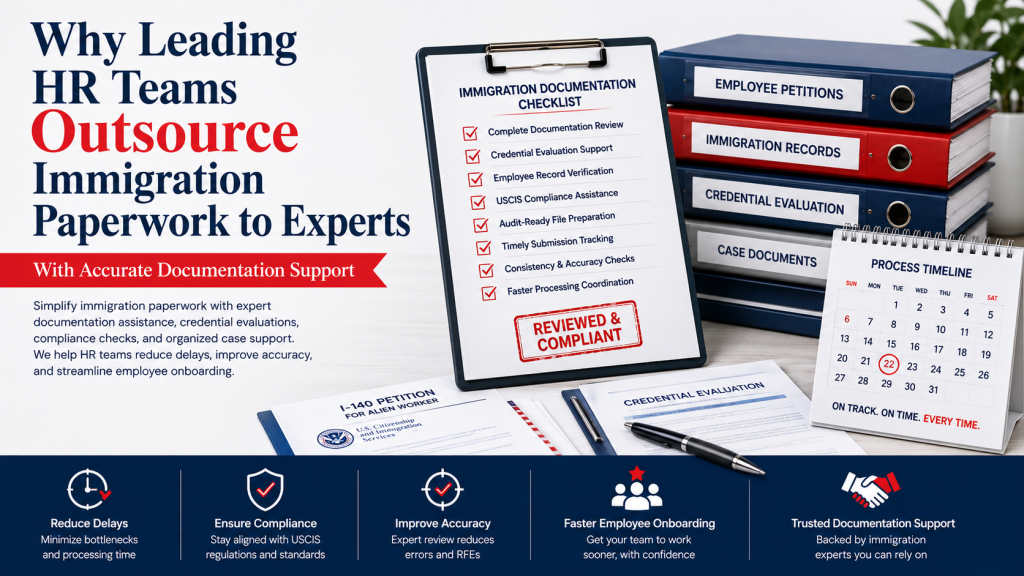
In today’s fast-paced global job market, hiring international talent has become essential for many U.S. companies. But along with the benefits of diverse, skilled professionals comes a mountain of immigration paperwork — complex forms, tight deadlines, and constant updates to USCIS regulations. For HR teams already juggling recruitment, onboarding, and compliance, managing immigration filings internally can quickly become overwhelming. That’s why many leading HR departments now outsource immigration paperwork to professional evaluation and documentation experts — ensuring accuracy, compliance, and faster approvals. At International Evaluations, we’ve worked with hundreds of HR leaders, helping them manage immigration documentation seamlessly while staying compliant with USCIS standards. Here’s why outsourcing has become a strategic choice for top-performing HR teams. The Benefits of Outsourcing Immigration Paperwork for HR Departments 1. Immigration Paperwork Is Time-Consuming and Complex HR professionals know that every immigration case — whether it’s an H-1B, PERM, or green card petition — involves pages of documentation, from degree evaluations and employment verification to translations and expert opinion letters. The process requires precision. A small mistake — a missing page, inconsistent job title, or unclear translation — can lead to a Request for Evidence (RFE) or even denial. By outsourcing to immigration documentation experts like International Evaluations, HR teams free themselves from hours of form-filling, reviewing, and re-verifying details. Our specialists handle every document according to USCIS guidelines, ensuring submissions are complete and compliant the first time. 2. Experts Help Prevent Costly Mistakes One overlooked error in an immigration file can have serious consequences. A wrong degree equivalency, missing certification, or improperly formatted evaluation can cause delays — or worse, jeopardize the employee’s visa status. Our team at International Evaluations specializes in: Academic & Work Experience Evaluations – Ensuring foreign degrees and work histories meet U.S. equivalency standards. Expert Opinion Letters – Written by credentialed professionals who validate education, job roles, or specialty occupation requirements. Certified Translations – Delivering USCIS-ready translations for non-English documents. By partnering with professionals, HR teams avoid last-minute scrambles, re-submissions, and unnecessary RFEs. 3. Save Time and Focus on Core HR Priorities For HR leaders, time is one of the most valuable resources. Instead of spending hours double-checking foreign credentials or researching USCIS document requirements, your HR department can focus on what truly matters — hiring, retention, and employee engagement. Outsourcing immigration paperwork shifts the administrative burden to trained specialists who know exactly what USCIS expects. Our documentation experts manage everything from evaluation requests to translation certifications, letting your HR team stay focused on supporting your workforce. 4. Access to Certified Evaluators and Industry Experts Not all documentation is created equal. USCIS often requires evaluations or opinion letters from accredited experts with specific credentials. Submitting generic or unverified documents can cause more harm than good. At International Evaluations, we work with over 170 credentialed experts across a variety of industries — including STEM, healthcare, business, and education. Our professionals provide specialized evaluations that align with USCIS standards and industry-specific job requirements. This means your HR team can be confident every document is authentic, relevant, and fully compliant. 5. Faster Turnaround During Tight Deadlines Immigration paperwork often comes with tight deadlines. When an RFE or audit notice arrives, HR must act quickly to protect the employee’s status. Our team offers expedited processing for urgent cases, ensuring reports, evaluations, and translations are ready within days — not weeks. With clear communication and fast delivery, HR managers never have to worry about missing critical USCIS deadlines. 6. Ensure Consistency Across Multiple Employee Petitions Large organizations often file multiple petitions simultaneously for different employees, each requiring unique documentation. Managing these internally can lead to inconsistencies — different formats, missing information, or mismatched degree equivalencies. Outsourcing ensures a standardized, USCIS-approved format across all cases. Whether your company is filing for five engineers or fifty analysts, our team maintains consistency in documentation quality and presentation. This not only builds trust with USCIS officers but also streamlines your company’s entire immigration process. 7. Stay Updated on Changing USCIS Policies USCIS rules and requirements change frequently. HR departments that manage immigration paperwork internally may struggle to stay current with the latest updates — leading to unintentional noncompliance. Professional evaluation agencies stay informed about every USCIS policy update, ensuring all reports meet the most recent standards. When you work with International Evaluations, your documents are always aligned with current immigration regulations. 8. Support for Attorneys and Legal Teams Many HR departments coordinate directly with immigration attorneys during the visa or green card process. Outsourcing documentation simplifies that collaboration. We provide attorney-friendly reports, meaning every evaluation, translation, and expert letter is formatted for direct submission — saving time and reducing back-and-forth communication between HR and legal teams. Attorneys appreciate receiving ready-to-use, compliant documentation, and HR departments appreciate the peace of mind. 9. Scalable Solutions for Growing Companies As your company expands, your immigration documentation needs grow too. Outsourcing allows HR departments to scale seamlessly — no need to hire additional internal staff or train employees on complex immigration paperwork. Whether you need one evaluation or a hundred, International Evaluations can handle your volume efficiently, maintaining the same level of quality and accuracy for every case. 10. Build a Reputation for Compliance and Employee Care Outsourcing immigration paperwork sends a clear message to your global employees: your company values compliance, precision, and professionalism. By ensuring every visa petition, evaluation, and translation is handled correctly, HR teams demonstrate reliability — building employee confidence and avoiding unnecessary delays that affect onboarding or project timelines. When immigration processes run smoothly, your organization attracts and retains top international talent. Why Leading HR Teams Trust International Evaluations USCIS-Compliant Formatting – All our documents meet official U.S. immigration requirements. Certified Experts in 170+ Fields – Covering STEM, business, healthcare, and more. Fast and Reliable Delivery – Urgent cases handled within tight timelines. Proven Success Rate – Thousands of clients have achieved approvals with our documentation. Attorney-Ready Reports – Streamlined collaboration between HR and
Avoid Costly Visa Denials: How Document Accuracy Impacts Immigration Success
Applying for a U.S. visa or immigration benefit is a major step — whether you’re a student, a professional, or an employer sponsoring skilled workers. But even the most qualified applicants face one common risk: errors or inconsistencies in their documents. In the eyes of USCIS (U.S. Citizenship and Immigration Services), accuracy is everything. A small typo, missing translation, or incorrect degree evaluation can lead to requests for evidence (RFEs) or, worse, visa denial. At International Evaluations, we’ve seen how a single inaccurate document can delay or derail an otherwise strong case — and how precise, USCIS-compliant documentation can make all the difference. Here’s why document accuracy is the foundation of immigration success — and how to ensure your paperwork helps, not hurts, your case. Why Accuracy Matters in Immigration Documentation Every visa petition is built on proof. From academic credentials and employment records to translations and expert evaluations, each document must demonstrate eligibility clearly and consistently. USCIS officers rely on these documents to verify your qualifications, intent, and eligibility under U.S. law. When evidence is incomplete, inconsistent, or incorrectly formatted, it raises red flags — forcing USCIS to issue an RFE or deny the case entirely. Even honest mistakes can cause serious consequences. For instance: An incorrect degree equivalency can make an applicant appear unqualified. A mismatched job title can lead to doubts about the position’s eligibility for an H-1B visa. Uncertified translations can be rejected outright. The result? Lost time, wasted money, and sometimes the loss of a valuable immigration opportunity. The Most Common Document Errors That Lead to Visa Denials Even experienced applicants and attorneys sometimes miss details that USCIS scrutinizes. Here are the most common mistakes we see: Inaccurate Degree Evaluations – Submitting a general degree comparison instead of a USCIS-compliant academic or work-based evaluation. Incomplete Translations – Failing to include certified English translations for all foreign-language documents. Unclear Employment Proof – Missing or inconsistent job verification letters, unclear job titles, or outdated company details. Mismatched Information – Different versions of names, dates, or job titles across documents. Lack of Expert Support – Submitting documents without professional expert letters that explain specialized education or experience. Formatting Errors – Missing signatures, incorrect headers, or poorly organized attachments that confuse reviewers. Each of these issues can make USCIS question the credibility of your entire case — even when your qualifications are legitimate. How Accurate Documentation Strengthens Your Immigration Case When your paperwork is accurate, verified, and properly formatted, it sends a clear message: you meet the requirements and have provided solid proof. Here’s how accurate documentation helps: – Builds Credibility: Consistent, clear, and verified information establishes trust with USCIS adjudicators. – Reduces Delays: Well-prepared documents minimize RFEs and re-submissions. – Boosts Approval Chances: Properly evaluated degrees and work experience align perfectly with visa requirements. – Simplifies Attorney Workflows: Immigration lawyers can focus on legal arguments instead of fixing document errors. At International Evaluations, we specialize in ensuring every piece of your documentation meets USCIS standards, helping applicants and attorneys avoid unnecessary risks. The Role of Professional Evaluations in Visa Approval One of the most common reasons for visa denials is degree mismatch or insufficient documentation of qualifications. That’s where professional evaluations make a difference. Our team provides: Academic & Work Experience Evaluations – Converting foreign education and professional experience into U.S. equivalency for H-1B, PERM, and other visa categories. Expert Opinion Letters – Written by credentialed professors and industry leaders to explain how your background qualifies for a specific visa. Certified Translations – Ensuring every document is accurately translated, signed, and USCIS-approved. Every evaluation we issue follows USCIS formatting and terminology, helping immigration officers easily verify eligibility. Why Employers and Attorneys Trust International Evaluations HR teams, legal professionals, and individuals across the U.S. rely on International Evaluations for documentation that meets immigration standards every time. Here’s why: USCIS-Compliant Formatting – Every evaluation, letter, and translation adheres to current USCIS policies. 170+ Credentialed Experts – Covering all major fields, from STEM and business to healthcare and education. Proven Success Rate – Many cases we’ve supported turned RFEs into approvals. Fast Turnaround – Expedited service available for urgent filing deadlines. Attorney-Friendly Documentation – Our reports integrate seamlessly into petition packages. We understand how critical timing and accuracy are in immigration — and we ensure every document you submit supports, not weakens, your case. How to Ensure Document Accuracy in Your Next Filing Follow these steps to make sure your next immigration filing is accurate and USCIS-ready: Review Every Document Carefully: Double-check names, dates, and details across all forms and evidence. Use Professional Evaluations: Always submit evaluations and expert letters from accredited professionals familiar with USCIS standards. Verify Translations: Ensure all foreign-language materials include certified English translations. Maintain Consistency: Job titles, degree names, and company details should match across your petition, resume, and evaluations. Stay Updated on USCIS Requirements: Rules change often; always confirm documentation requirements before filing. If this feels overwhelming, professional documentation services can make the process seamless — ensuring compliance without stress. Real Results from Accurate Documentation We’ve worked with hundreds of clients whose cases were initially delayed due to incomplete or inaccurate documentation. After resubmitting with our accurate evaluations and expert letters, they received approvals within weeks. From software engineers applying for H-1B visas to healthcare professionals pursuing green cards, our documentation accuracy has helped applicants overcome obstacles and secure approvals faster. Don’t Risk Your Visa on Inaccurate Paperwork Even the strongest immigration case can fall apart if the paperwork isn’t right. Don’t let preventable mistakes cost you time, money, or opportunity. At International Evaluations, we make sure your documents — from degree evaluations to expert letters — are accurate, compliant, and ready for USCIS review. If you’re preparing a visa petition or responding to an RFE, contact us today to make your case stronger and avoid costly denials. info@internationalevaluations.com +1 (510) 876-0900 www.internationalevaluations.com International Evaluations — Where Accuracy Meets Approval.
How Foreign Degree Evaluation Helps You Qualify for U.S. Immigration
Applying for a U.S. visa or employment-based immigration benefit requires more than just strong credentials — it requires proof that your foreign education meets U.S. academic standards. This is where foreign degree evaluations play a crucial role. Even highly skilled professionals face visa denials because their education documents weren’t properly evaluated. U.S. Citizenship and Immigration Services (USCIS) requires precise, compliant documentation that clearly explains how a foreign degree compares to an American degree. At International Evaluations, we specialize in creating USCIS-compliant academic and work experience evaluations that help applicants, attorneys, and employers build stronger, more credible immigration cases. Here’s how a foreign degree evaluation can make all the difference in your U.S. immigration journey. Why Foreign Degree Evaluation Is Essential for U.S. Immigration When you apply for a visa such as H-1B, PERM, EB-2, or EB-3, USCIS must verify that your education matches U.S. requirements for the position or category.A degree earned outside the U.S. does not always match the value of a U.S. bachelor’s or master’s degree, even if the program length and coursework appear similar. A foreign degree evaluation provides a detailed analysis by qualified experts to determine your U.S. educational equivalency. USCIS relies on these evaluations to: – Confirm that your foreign degree meets minimum educational standards. – Validate the field of study relevant to your job or petition. – Ensure compliance with immigration eligibility requirements. Without a professional, USCIS-compliant evaluation, your application may face an RFE (Request for Evidence) or even a denial. When Is a Foreign Degree Evaluation Required? You’ll typically need an evaluation when applying for: H-1B Visa: To prove that your foreign education qualifies you for a “specialty occupation. PERM (Green Card): To demonstrate that you meet the job’s minimum education requirements. EB-2/EB-3 Petitions: To verify advanced or professional degree equivalence. Educational Credential Verification: For academic admissions, licensing, or employment screening in the U.S. Each visa type has specific documentation requirements, and submitting the wrong type of evaluation can lead to unnecessary delays. Types of Foreign Degree Evaluations At International Evaluations, we provide a range of USCIS-approved documentation services tailored to your case: Academic Evaluation: Compares your foreign degree, transcripts, and coursework to a U.S. educational equivalent. Work Experience Evaluation: This evaluation shows how your professional experience can count toward a U.S. degree equivalent. In many cases, three years of relevant work experience = one year of academic study. Expert Opinion Letters: Written by professors or industry experts explaining how your education and experience qualify you for a specific visa. Certified Translations: We provide accurate, professional translations for all foreign-language documents so they meet USCIS requirements. Each report follows official USCIS formatting standards, helping ensure your documents are properly reviewed and approved. How a Professional Evaluation Strengthens Your Case An accurate, USCIS-compliant degree evaluation provides far more than just a comparison — it builds credibility and trust in your application. Here’s how it helps: Avoids Delays & RFEs: Properly formatted and verified evaluations minimize back-and-forth with USCIS. Boosts Approval Chances: Clearly demonstrates that your credentials meet U.S. standards. Simplifies Legal Review: Attorneys and HR teams can easily include the evaluation report in their petition filings.Supports Career Growth: Your qualifications are clearly recognized, helping you pursue future employment or licensing opportunities. Common Mistakes to Avoid in Foreign Degree Evaluation Even small documentation errors can cause major delays. Here are some common mistakes applicants make: – Submitting non-USCIS-compliant evaluations or using general comparison reports. – Using uncertified translators for foreign-language documents. – Providing incomplete or outdated transcripts. – Failing to match the field of study with the job description or visa category. – Ignoring RFE requirements for detailed evaluation breakdowns. A professional evaluation service ensures your documentation meets all USCIS formatting and credential requirements — saving time, stress, and money. Why Choose International Evaluations At International Evaluations, we combine accuracy, speed, and compliance to deliver evaluation reports trusted by attorneys and employers nationwide. Here’s what sets us apart: USCIS-Compliant Formatting: Every report follows the latest USCIS guidelines. Credentialed Experts: Evaluations prepared by qualified professors and industry specialists. Fast Turnaround: Standard and expedited services available. Proven Success Rate: Our evaluations have helped countless applicants turn RFEs into approvals. Attorney-Friendly Documentation: Ready-to-submit reports that integrate seamlessly with legal filings. We don’t just evaluate credentials — we help build stronger, more credible immigration petitions. How to Request a Foreign Degree Evaluation Getting started is simple: Gather Documents: Degree certificates, mark sheets, transcripts, and resume. Submit Online: Upload your documents securely through our website. Select Evaluation Type: Choose academic, work experience, or combined evaluation. Review and Approve: Our experts prepare your evaluation for your review before finalization. Receive Your Report: Get your USCIS-ready evaluation via email or hard copy. For urgent cases, expedited delivery options are available to meet filing deadlines. Don’t Let Documentation Hold You Back Your education and experience deserve recognition. Don’t risk visa delays or denials because of improper document preparation. At International Evaluations, we ensure your foreign degree evaluation meets all USCIS requirements — helping you move forward confidently in your U.S. immigration process. info@internationalevaluations.com +1 (510) 876-0900 www.internationalevaluations.com International Evaluations — Turning Global Education into U.S. Opportunity. FAQs: Foreign Degree Evaluation for U.S. Immigration 1. What is a foreign degree evaluation? A foreign degree evaluation compares your international education credentials to their U.S. equivalents to confirm eligibility for immigration or employment purposes. 2. Who needs a degree evaluation for immigration? Anyone applying for U.S. visas like H-1B, PERM, EB-2, or EB-3 where education qualifications are required must submit a degree evaluation. 3. How long does the evaluation process take? Standard processing takes about 3–5 business days, with expedited options available for urgent filings. 4. Is work experience considered in the evaluation? Yes. For some visa categories, work experience can be used to meet degree equivalency — typically 3 years of work equals 1 year of academic study. 5. Are International Evaluations’ reports accepted