The Fastest Way to Validate Your Foreign Education for U.S. Immigration
When it comes to U.S. immigration, validating your foreign education isn’t just a formality it’s a critical step that can determine whether your visa, green card, or employment petition gets approved. USCIS reviews educational credentials closely for eligibility, specialty occupation requirements, and degree equivalency. For thousands of applicants each year, delays happen not because they don’t qualify but because their educational documents are evaluated incorrectly, inconsistently, or too slowly. At International Evaluations, we help attorneys and applicants validate foreign degrees accurately and quickly so immigration filings stay on schedule and compliant with USCIS standards. Whether you are filing for H-1B, EB-2 NIW, EB-3, O-1, PERM, or I-140, a properly prepared education evaluation can make or break your case. Why Education Validation Is So Important for Immigration USCIS relies on credential evaluations to determine if a foreign degree is equal to a U.S. bachelor’s, master’s, or doctorate. When documentation is incomplete or unclear, USCIS can issue delays or Requests for Evidence (RFEs). Common issues include: Missing transcripts or mark sheets Incorrect degree equivalency Unrecognized institutions Inconsistent major or specialization Confusion between 3-year degrees vs. U.S. 4-year degrees Lack of professor or expert analysis for specialized fields No experience-based equivalency where required Even a small inconsistency can disrupt processing timelines. Our team ensures your education evaluation meets USCIS expectations — the first time. How International Evaluations Provides the Fastest and Most Reliable Education Validation We streamline the evaluation process using a structured, USCIS-compliant methodology tailored for immigration filings. 1. Rapid Evaluation Intake & Document Review We begin by reviewing all educational documents, including: Degree certificates Transcripts/mark sheets Course lists Professional certifications Diploma supplements We determine what’s missing, what needs correction, and which evaluation type will meet USCIS requirements. You get a clear, step-by-step roadmap before we begin the evaluation. 2. Accurate U.S. Degree Equivalency Reports Our evaluations clearly establish whether your foreign qualification equals: U.S. Bachelor’s degree U.S. Master’s degree U.S. Doctorate Specialized or professional degree Every report references accredited universities, academic standards, and comparative systems recognized by USCIS and major institutions. 3. Education + Experience (Work-Based) Evaluations Some immigration categories — especially H-1B, I-140, and EB-2/EB-3 — allow professional experience to count toward degree equivalency. We prepare: Bachelor’s equivalency from education + experience Specialized field equivalency Experience-heavy assessments for technical roles Senior-level expertise evaluations These are authored by qualified experts and structured for USCIS acceptance. 4. Expert Opinion Letters for Highly Specialized Cases For STEM, engineering, research, and advanced fields, USCIS may require expert analysis. Our experts provide: Professional opinion letters Industry-specific equivalency justification Clarification of technical coursework or specializations Letters tailored for H-1B, O-1, and EB-1/EB-2 filings These letters strengthen complex immigration petitions. 5. Full Consistency Check for All Supporting Documents USCIS frequently rejects evaluations due to inconsistencies, such as: Different graduation dates Conflicting major or specialization names Incorrect institution names Mismatch between transcripts and degree certificates We perform a complete cross-document review to ensure everything aligns perfectly. 6. The Fastest Turnaround Times in the Industry Deadlines matter and immigration filings often can’t wait. We offer: 24-hour expedited evaluations 48-hour comprehensive evaluations Same-day corrections and clarifications Emergency expert opinion letters Your application stays on track, no matter how tight the timeline. Why Attorneys and Applicants Trust International Evaluations 100% USCIS-compliant reports Fast response times Expert-authored evaluations Deep experience across all visa categories Accurate, detailed, and professionally formatted documents High acceptance rate across immigration filings We help applicants avoid delays and help attorneys build strong, clean, consistent petitions. How Fast, Accurate Evaluations Improve Immigration Success With our support, you benefit from: Faster filing times Fewer RFEs Stronger documentation for attorneys A smooth, predictable immigration process Clear and credible academic analysis Peace of mind knowing your degree meets USCIS expectations You focus on your immigration goals we make sure your education is validated correctly. Conclusion: Validate Your Education Quickly & Confidently A properly prepared educational evaluation is one of the most important steps in your immigration journey. With International Evaluations, you get fast, accurate, and USCIS-compliant validation that keeps your case moving forward. info@internationalevaluations.com +1 (510) 876-0900 www.internationalevaluations.com International Evaluations — Your Trusted Partner for Fast, Accurate, and USCIS-Approved Education Validation. FAQs 1.How fast can you provide an evaluation? We offer 24-hour and 48-hour expedited services depending on the evaluation type. 2.Do you provide education + experience equivalency? Yes — we specialize in combining academic credentials with professional experience for USCIS. 3.Are your evaluations USCIS-compliant? Absolutely. All reports meet strict USCIS requirements for immigration filings. 4.Can you help if I have missing transcripts? Yes — we can guide you on alternatives and documentation needed for evaluation. 5.Do you provide expert opinion letters? Yes — especially for engineering, IT, STEM, and highly specialized fields.
Got a Visa RFE? Here’s How to Fix It Right and Fast
Receiving a Request for Evidence (RFE) from USCIS can feel overwhelming, especially when your immigration status, job offer, or green card depends on timely approval. But an RFE is not a denial. It’s an opportunity to strengthen your petition and fix documentation gaps before a final decision is made. Most RFEs happen not because applicants lack qualifications but because evidence is incomplete, unclear, or not presented according to USCIS requirements. A strong and rapid response can protect your timeline and significantly improve your chances of approval. At International Evaluations, we assist attorneys and applicants in addressing RFEs quickly, accurately, and strategically so immigration cases move forward without delays. Whether your case involves H-1B, I-140, EB-1, EB-2, EB-3, O-1, or PERM, a well-prepared RFE response can be the turning point in getting your petition approved. Why RFEs Happen and Why Responding Correctly Matters USCIS issues RFEs when documentation does not fully satisfy eligibility criteria. Even small inconsistencies can lead to additional scrutiny, delayed processing, or potential denials. Common triggers include: Missing academic or employment evidence Incorrect degree equivalency Inconsistent job descriptions or duties Questions about specialty occupation requirements Missing expert analysis Unclear experience qualifications Incomplete employer information USCIS expects clear, consistent, and properly structured evidence. We ensure your RFE response addresses every concern thoroughly and professionally. How We Help You Fix an RFE Quickly and Correctly We follow a structured, USCIS-compliant process that resolves deficiencies and provides a strong evidence package tailored to the specific RFE issued. 1. Complete RFE Review and Evidence Assessment We start by examining the RFE in detail, including all USCIS questions and required clarifications.We review your existing filing, including: Petition forms Employer letters Education credentials Experience records Job descriptions Supporting documents We identify what is missing, conflicting, or unclear and provide a clear action plan for what needs to be added or corrected. 2. Accurate and USCIS-Ready Credential Evaluations If your RFE involves education or degree equivalency concerns, we prepare: U.S. bachelor’s, master’s, or doctorate equivalency Field-specific evaluations Specialty occupation justification Our reports reference accredited academic standards and recognized comparative systems so your degree meets USCIS expectations. 3. Work-Experience-Based Evaluations for H-1B and I-140 Many RFEs request proof that experience can be counted toward degree equivalency. We prepare: Education plus experience equivalency Expert analysis for technical roles Senior-level specialty evaluations Evaluations tailored to USCIS RFE language These evaluations directly respond to USCIS concerns and strengthen eligibility claims. 4. Expert Opinion Letters for Complex or High-Level RFEs When USCIS questions job duties, specialty occupation requirements, or advanced qualifications, expert letters can resolve concerns quickly. We provide: Professional industry opinion letters USCIS-aligned analyses of specialized roles Job duty clarification and justification Letters tailored for H-1B, O-1, EB-1, EB-2, and PERM RFEs These letters add authority and credibility to your response. 5. Consistency and Accuracy Check Across All Evidence Many RFEs arise due to simple inconsistencies across documents. We conduct a detailed review of: Dates Job titles Degree names Institution details Transcripts and certificates Employer descriptions We ensure every document aligns perfectly before submission so no new issues arise. 6. Fast Turnaround for Urgent RFE Deadlines USCIS RFE deadlines are strict. Missing the deadline can result in denial. We offer: Twenty-four-hour expedited evaluations Forty-eight-hour comprehensive evaluations Same-day corrections and updates Rapid expert opinion letters Your RFE response stays fully on schedule. Why Attorneys and Applicants Trust Our RFE Services USCIS-compliant evaluations Fast and reliable processing Expert-authored documentation Experience with complex RFEs Clear and detailed reporting High approval rates for RFE responses We help eliminate uncertainty and build a response package that addresses USCIS concerns head-on. How a Strong RFE Response Improves Your Case Outcome A complete and well-prepared RFE response leads to: Higher approval chances Stronger documentation for attorneys Clear and credible evidence Reduced chances of further review Faster final decisions Improved confidence in meeting USCIS criteria We help you transform an RFE into an opportunity to strengthen your case. Conclusion: Fix Your RFE Correctly and Without Delays An RFE doesn’t have to derail your immigration plans. With the right documentation, expert evaluation, and quick processing, you can resolve USCIS concerns and move forward confidently. For fast, accurate, and USCIS-compliant RFE support: info@internationalevaluations.com +1 (510) 876-0900 www.internationalevaluations.com International Evaluations — Your Trusted Partner for Strong, Fast, and Effective RFE Responses. FAQs 1.How quickly can you help with an RFE? We provide twenty-four-hour and forty-eight-hour expedited services depending on the complexity of the RFE. 2.Can you help with RFEs related to degree equivalency? Yes. We specialize in providing USCIS-compliant academic and experience-based evaluations for RFE responses. 3.Do you assist with job duty or specialty occupation RFEs? Yes. We offer expert opinion letters and detailed analyses tailored for H-1B, I-140, O-1, and other categories. 4.What if my documents have inconsistencies? We identify and correct inconsistencies so your response package is clean and fully aligned. 5.Do you provide expert opinion letters? Yes. Our experts prepare letters for STEM, engineering, IT, research, and other specialized fields.
How Students Can Avoid Admission Delays With Accurate Credential Evaluations

Applying to universities in the U.S. can be exciting—but it can also become stressful when admissions departments request additional documents, clarification, or corrected academic evaluations. One of the most common causes of application delays is inaccurate, incomplete, or improperly prepared credential evaluations. A credential evaluation is not just a formality. It determines how your international education compares to U.S. academic standards. When done correctly, it can strengthen your application. When done inaccurately, it can lead to delays, deferrals, or even missed admission cycles. At International Evaluations, we help students, advisors, and admissions teams avoid delays by providing clear, accurate, and institution-ready credential evaluation reports. Whether you are applying for undergraduate, graduate, transfer, or professional programs, an accurate evaluation ensures universities can process your application without confusion or requests for additional evidence. Why Admission Delays Happen — And Why Accuracy Matters University admissions offices rely heavily on credential evaluations to understand your educational background. When evaluations are incorrect or incomplete, the review process slows down or stops entirely. Common causes of admission delays include: Missing transcripts or incomplete coursework details Incorrect credit calculations Wrong program or degree equivalency Unclear grading scale conversions Inaccurate major or specialization representation Missing accreditation verification Improper formatting or lack of institution-specific details Universities need transparent, standardized, and accurate reports to make quick decisions. We ensure your academic evaluation meets these expectations from the start. How Accurate Credential Evaluations Prevent Delays Our evaluation process follows academic and institutional standards to ensure your report is accepted by universities without back-and-forth corrections. 1. Comprehensive Review of All Academic Documents We begin by thoroughly analyzing all your academic records, including: Transcripts Mark sheets Degree certificates Medium-of-instruction letters Syllabi (if required) School accreditation and recognition We identify missing details early so you can provide the correct documents before submitting your application. 2. U.S.-Equivalent Degree and Course Evaluations We prepare: Course-by-course evaluations Document-by-document evaluations U.S. bachelor’s, master’s, or diploma equivalency Credit and semester-hour conversions GPA calculations based on U.S. standards Our evaluations follow recognized academic guidelines used by universities across the country. 3. Accurate GPA & Grading Scale Conversion Many delays happen because grading systems vary widely between countries. We map your grades to U.S. GPA standards using: Institution-provided grading scales National education frameworks Established conversion methodologies This clarity speeds up your university’s decision-making process. 4. Verification of Authenticity and Accreditation Universities often require confirmation that your institution is accredited and your documents are valid. We conduct: Accreditation verification Cross-reference with national education authorities Institutional authenticity checks This ensures your evaluation meets strict university acceptance criteria. 5. Custom Evaluations for Program-Specific Requirements Graduate schools, engineering programs, business schools, and health-related programs often require: Prerequisite verification Syllabus-based course matching Professional credential equivalency We tailor evaluations to the exact requirements of the program you’re applying to so your file is complete and ready for review. 6. Fast Turnaround to Meet Application Deadlines Application windows are short and competitive. Missing a document deadline can push your admission to the next cycle. We offer: 24-hour expedited evaluations 48-hour comprehensive evaluations Same-day updates and corrections Our fast processing ensures your application stays on track. Why Students and Universities Trust Our Evaluations University-ready, accurate reports Experienced evaluators familiar with global education systems Fast, reliable turnaround times Detailed, institution-specific formatting Transparent credit and GPA conversion High acceptance rate across U.S. universities Our evaluations help avoid delays and ensure your academic background is clearly represented. How Accurate Evaluations Improve Your Admission Outcome With a complete and accurate evaluation, you benefit from: Faster admission decisions Fewer document requests Stronger academic credibility More competitive application profile Reduced risk of deferral Improved advisor and university communication A proper evaluation supports your future academic success from day one. Conclusion: Avoid Delays and Strengthen Your Application Admission delays can be frustrating—but they are preventable. With accurate credential evaluations prepared according to university standards, you can submit a strong, complete, and efficient application. For fast, reliable, and institution-ready credential evaluations: info@internationalevaluations.com +1 (510) 876-0900 www.internationalevaluations.com International Evaluations — Your Trusted Partner for Accurate and Fast Credential Evaluations. FAQs 1. How fast can I get my credential evaluation? We offer 24-hour and 48-hour expedited services depending on complexity and document requirements. 2. Do you provide course-by-course evaluations for university admissions? Yes. We prepare detailed course-by-course and GPA evaluations for undergraduate and graduate admissions. 3. What if my transcripts or grading scales are unclear? We clarify missing grading information and contact you. 4. Do you verify accreditation of my school? Yes. Accreditation and authenticity checks are included to ensure university acceptance. 5. Can you tailor evaluations for specific programs like MBA, MS, or engineering? Absolutely. We provide program-specific evaluations aligned with admissions requirements.
When Strong Profiles Face RFEs: How Independent Expert Opinion Letters Help Clarify Immigration Cases
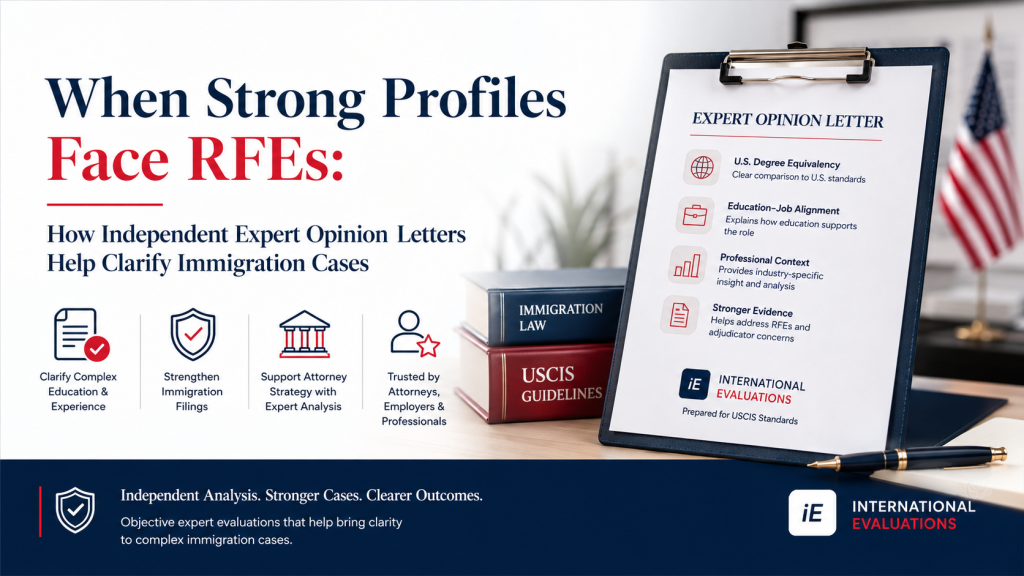
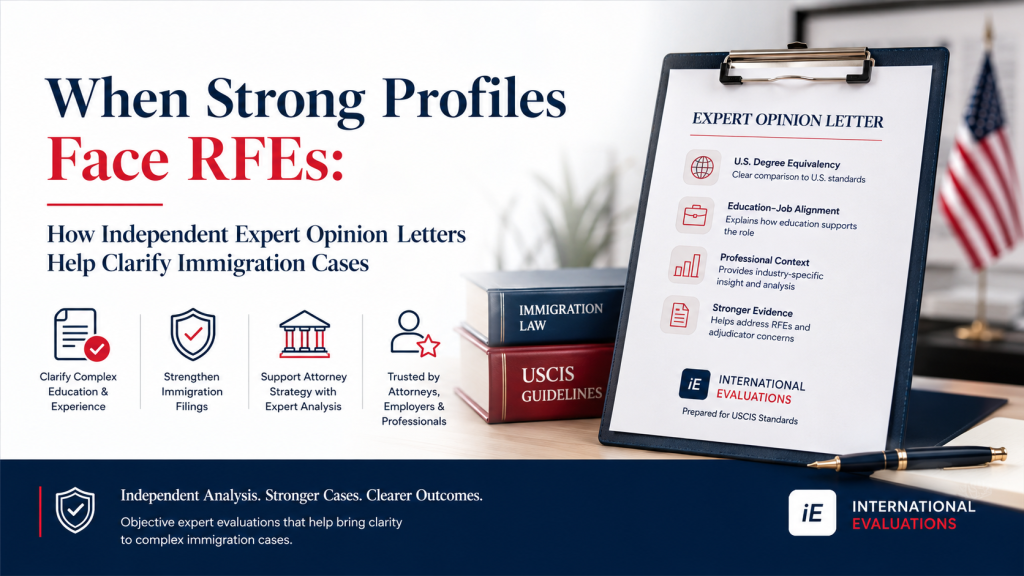
In today’s U.S. immigration landscape, even well-qualified professionals and employers encounter delays, RFEs, or additional scrutiny. This is especially common when cases involve foreign education, non-traditional career paths, or roles that USCIS reviews closely for specialization or distinction.In many of these situations, the issue is not eligibility, but how the evidence is presented and understood. Independent Expert Opinion Letters (EOLs) play an important role in helping attorneys and adjudicators clearly evaluate complex academic and professional backgrounds within the framework of U.S. immigration standards. The Real Challenges Behind RFEs and Delays Across employment-based immigration categories, common issues repeatedly arise: Degrees earned outside the U.S. that are unfamiliar to adjudicators Education that does not appear to directly match the job title Hybrid or interdisciplinary roles Progressive experience gained abroad Extraordinary ability claims that lack contextual explanation Without clear, structured explanations, adjudicators may raise questions — even when the underlying profile is strong. This is where independent expert documentation becomes valuable. What an Expert Opinion Letter Actually Does An Expert Opinion Letter is an independent academic or professional assessment that explains how an individual’s education, experience, or expertise compares to U.S. standards. EOLs are commonly used to help: Clarify U.S. degree equivalency Explain how education aligns with job duties Provide professional context for specialized or advanced roles Support attorney-led arguments in complex filings They do not replace legal strategy — but they support it with objective analysis. Who Benefits Most from Expert Opinion Letters? Immigration Attorneys Attorneys often use EOLs when: A case involves non-traditional education or experience Prior RFEs need to be addressed with clearer documentation Adjudicators may question role complexity or specialization Well-structured EOLs integrate smoothly into legal filings and help present evidence in a clear, defensible manner. Employers Sponsoring Foreign Talent Employers frequently face questions such as: Does this role qualify as a specialty occupation? Why is a specific educational background required? How does this position differ from entry-level roles? Expert evaluations help explain job complexity and educational alignment, strengthening the overall evidentiary record. Highly Skilled Professionals Professionals applying under H-1B, O-1, EB-2, EB-3, or EB-1A categories may encounter challenges when: Their degree title differs from U.S. norms Their career path spans multiple disciplines Their achievements require industry-specific context Independent expert documentation helps translate these profiles into language that adjudicators can readily evaluate. Expert Opinion Letters by Visa Category (Practical Use) H-1B – Specialty Occupation Why a role requires specialized knowledge How education aligns with job duties Support for foreign or non-traditional degrees O-1 – Extraordinary Ability Provide professional context for achievements Explain industry recognition and expertise Support distinction claims with objective analysis EB-2 / EB-3 / EB-1A – Employment-Based Green Cards Establish U.S. degree equivalency Evaluate progressive professional experience Support PERM and I-140 filings with expert analysis Why Attorneys and Employers Work with International Evaluations International Evaluations provides independent Expert Opinion Letters and evaluations through a network of 300+ U.S. university professors and experienced industry experts across a wide range of academic and professional fields. Objective, well-reasoned analysis Clear documentation aligned with adjudication standards Supporting attorney-led immigration filings Reliable turnaround based on case complexity Each evaluation is prepared with attention to accuracy, clarity, and professional independence. Frequently Asked Questions Are Expert Opinion Letters mandatory? No. They are supporting documents, commonly used in complex or high-scrutiny cases. Do Expert Opinion Letters guarantee approval? No document can guarantee outcomes. Final determinations are made solely by USCIS. How long does the process take? Most evaluations are completed within 5–7 business days, depending on complexity. Who prepares the evaluations? Qualified U.S. university professors and industry experts, supported by experienced evaluation professionals. Independent Documentation That Helps Reduce Uncertainty Immigration cases often involve more nuance than checklists alone can capture. When educational or professional backgrounds are complex, independent expert analysis can help bring clarity to the evidence presented. International Evaluations works alongside immigration attorneys, employers, and professionals by providing carefully prepared documentation that supports well-structured filings. Important Disclaimer International Evaluations is not a law firm and does not provide legal advice. All Expert Opinion Letters and evaluations are independent academic or professional assessments prepared for informational and evidentiary support purposes only. Final determinations are made solely by USCIS and/or the reviewing immigration attorney. Contact Us Website: www.internationalevaluations.com Email: info@internationalevaluations.com ☎️ Phone: (510) 876-0900
Understanding Recommendation Letters vs Expert Opinion Letters in EB-1A and EB-2 NIW Cases
In EB-1A Extraordinary Ability and EB-2 National Interest Waiver (NIW) petitions, supporting letters play a critical role. However, one of the most common and costly mistakes applicants make is assuming that all letters carry the same evidentiary weight in the USCIS evaluation process. They don’t. Recommendation Letters and Expert Opinion Letters are reviewed differently by USCIS, serve different evidentiary purposes, and are most effective when used together and correctly. Understanding this distinction can materially affect how clearly an applicant’s qualifications are evaluated and whether an RFE is issued. This article explains: Who writes each type of letter What each letter is meant to establish Why EB-1A and NIW petitions are strongest when both are used strategically How independent expert evaluations help reduce RFEs Why USCIS Treats Letters Differently USCIS does not simply count the number of letters submitted. Officers assess: Who authored the letter Whether the author is independent of the beneficiary What type of analysis the letter provides How closely the content aligns with regulatory evidentiary standards In high-skilled and self-petitioned categories such as EB-1A and EB-2 NIW, USCIS often looks beyond personal praise and focuses on objective, field-level impact. This is where understanding the difference between recommendation letters and expert opinion letters becomes essential. Recommendation Letters: Purpose and Limitations Who Writes Recommendation Letters Recommendation letters are typically written by: Employers Supervisors Mentors Colleagues Professional collaborators What Recommendation Letters Establish These letters usually address: Professional reputation Work performance Character and ethics Contributions within an organization or project They provide useful background and credibility, but USCIS often views them as inherently subjective, particularly when the author has a direct professional relationship with the applicant. Role in EB-1A and EB-2 NIW Cases Recommendation letters can: Validate professional standing Support narrative consistency Demonstrate peer recognition However, on their own, they are often insufficient to establish: Claims of extraordinary ability under the regulatory criteria National or international impact Objective significance within the broader field This limitation is a common reason USCIS issues RFEs requesting further clarification or independent analysis. Expert Opinion Letters: Why Objective Analysis Matters Who Writes Expert Opinion Letters Expert Opinion Letters are prepared by: Independent, recognized authorities U.S. university professors Senior researchers Experienced industry experts Importantly, these experts have no direct professional dependency on the applicant. What Expert Opinion Letters Address These letters focus on: Field-level significance of the applicant’s work Objective evaluation of contributions Extraordinary ability or national importance, as applicable How the work compares to others in the field Unlike recommendation letters, expert opinion letters evaluate impact beyond a single employer or organization. Role in USCIS Review When properly prepared, expert opinion letters can carry significant evidentiary value because they help USCIS: Interpret complex or technical achievements Understand academic or industry-specific contributions Evaluate whether the work rises above the norm Assess national interest relevance in NIW cases This is why EB-1A expert opinion letters and EB-2 NIW expert opinion letters are frequently relied upon in both initial filings and RFE responses. How USCIS Focus Differs Between EB-1A and EB-2 NIW Although both categories rely on expert analysis, USCIS evaluates them under different legal frameworks. EB-1A Extraordinary Ability USCIS focuses on: Sustained national or international acclaim Comparison to top individuals in the field Evidence that the beneficiary is among a small percentage at the very top Expert Opinion Letters help contextualize achievements within the field and explain why they exceed ordinary professional success. EB-2 National Interest Waiver (NIW) USCIS evaluates: The national importance of the proposed endeavor Whether the applicant is well positioned to advance that endeavor Whether waiving the labor certification benefits the United States Expert letters are often critical to explaining why the work matters at a national level and how the applicant’s background supports that impact. Why Strong Petitions Use Both Types of Letters The strongest EB-1A and EB-2 NIW petitions use both letter types for their intended purposes: Recommendation Letters → Personal credibility and professional reputation Expert Opinion Letters → Independent, objective field-level analysis When only recommendation letters are submitted, USCIS may question: Whether the evidence is sufficiently independent Whether achievements are evaluated objectively How the work compares to others in the field These concerns frequently trigger RFEs requesting expert-level clarification. RFEs and Letter Quality A Request for Evidence (RFE) is not a denial. It usually signals that USCIS needs clearer or better-aligned documentation. In EB-1A and NIW cases, RFEs commonly request: Clarification of extraordinary ability claims Explanation of national interest impact Independent assessment of field significance Better alignment between evidence and regulatory criteria Well-prepared expert opinion letters, combined with strong recommendation letters, often directly address these concerns by providing structured, USCIS-aligned explanations. How International Evaluations Supports EB-1A and NIW Cases At International Evaluations, we provide independent expert opinion letters and credential evaluations designed to support attorney-led immigration strategies. What Sets Our Support Apart Access to a curated network of 300+ U.S. university professors and senior industry experts, selected based on field relevance and independence Independent, objective evaluations not advocacy letters Documentation prepared with USCIS evidentiary expectations in mind 48-hour expedited options available for time-sensitive filings and RFEs How Our Evaluations Help Clarify education and professional experience Explain field-level impact in clear, structured terms Support extraordinary ability and national interest arguments Integrate seamlessly into attorney-prepared petitions Reduce back-and-forth during tight filing timelines Our role is not legal advice. We support documentation clarity so USCIS can accurately evaluate qualifications. Why Independent Expert Letters Matter More Than Ever As USCIS review practices evolve, officers are applying increasingly detailed scrutiny to high-skilled and self-petitioned cases. Clear, well-structured documentation has become essential. Independent expert letters help bridge the gap between: Technical achievements and legal standards Complex credentials and adjudicator understanding Strong profiles and clear evidence presentation Frequently Asked Questions (FAQ) Why did I receive an RFE despite strong letters? RFEs often occur when evidence is descriptive, not analytical. USCIS may request clearer evaluation against EB-1A or EB-2 NIW standards. What does USCIS expect in an expert opinion letter? An expert letter should provide independent analysis, explain extraordinary
Certified Translations: Ensuring USCIS Accepts Non-English Documents
When filing a visa petition, green card application, or any USCIS request, one critical detail often overlooked is the translation of non-English documents. Whether it’s academic transcripts, employment letters, legal documents, or certifications, USCIS requires that all foreign-language documents be accompanied by certified translations. Failing to provide accurate, certified translations can lead to delays, Requests for Evidence (RFEs), or even denials. At International Evaluations, we help applicants, employers, and immigration attorneys ensure all non-English documents meet USCIS standards through certified, accurate, and professionally formatted translations. Here’s why certified translations are essential and how they can strengthen your immigration case. Why USCIS Requires Certified Translations USCIS officers must be able to fully understand the content of every document submitted in a case. Non-English documents without proper translation can: Cause confusion or misinterpretation of credentials or qualifications Trigger Requests for Evidence (RFEs) or Notices of Intent to Deny (NOIDs) Delay processing times due to additional verification requirements Reduce the credibility of your application A certified translation ensures that USCIS can review documents accurately and efficiently, reducing the risk of errors or delays. What Is a Certified Translation? A certified translation is a document that: – Accurately converts the original text into English – Includes a signed statement from the translator attesting to its completeness and accuracy – Contains the translator’s name, signature, and date – Often includes the translator’s credentials or professional affiliation USCIS explicitly requires this certification for all foreign-language documents to ensure authenticity and prevent misunderstandings. Common Documents That Require Certified Translation Applicants and employers frequently need certified translations for: Academic transcripts and diplomas – To prove foreign educational qualifications. Employment verification letters – Especially for employment-based visas. Professional certifications and licenses – For specialized professions like healthcare, law, and engineering. Legal documents – Marriage certificates, divorce decrees, birth certificates, or adoption papers. Financial statements – Investment records, bank statements, or business financials. Each document must be translated accurately and formatted correctly to meet USCIS standards. Benefits of Using Certified Translations Certified translations offer multiple advantages for immigration applicants: 1. Compliance With USCIS Requirements Certified translations ensure that your documents meet USCIS standards, eliminating one common reason for RFEs or delays. 2. Accuracy and Clarity Professional translators accurately convey dates, titles, terminology, and legal language, ensuring no critical information is misinterpreted. 3. Consistency Across Multiple Petitions For businesses or attorneys managing multiple cases, certified translations provide a consistent format and language style across all documents, reducing errors. 4. Faster Processing Documents that are clear, complete, and certified help USCIS officers review your case quickly, speeding up approvals. 5. Credibility and Professionalism Certified translations signal professionalism and attention to detail, increasing the credibility of your submission. How to Ensure Your Translation Meets USCIS Standards To avoid complications, follow these best practices: Use a Professional Translator – Avoid online tools or informal translations. USCIS only accepts translations by qualified individuals. Include a Certification Statement – The translator must certify that the translation is complete and accurate. Maintain Original Formatting – Preserve the structure of the original document to ensure clarity. Include All Pages – Every page of the original document should be translated, including signatures, stamps, and annotations. Proofread and Verify – Double-check for consistency in dates, names, and numerical data. Following these guidelines ensures your documents are USCIS-ready and reduces the risk of RFEs. How International Evaluations Supports Certified Translation Needs At International Evaluations, we specialize in USCIS-compliant certified translations to strengthen immigration cases: Academic & Professional Documents – Translations of transcripts, diplomas, licenses, and employment verification. Legal & Government Documents – Marriage certificates, birth certificates, adoption papers, and court orders. Expert Certification – Each translation includes a signed certification from a qualified translator. Fast Turnaround – Timely delivery ensures you meet USCIS deadlines without stress. Multi-Language Support – Certified translations from dozens of languages, including Spanish, French, Mandarin, Hindi, Arabic, and more. Common Mistakes to Avoid Even minor mistakes in translations can cause delays or RFEs: Submitting translations without a certification statement Omitting stamps, signatures, or annotations from the original document Using informal translations or online tools instead of certified professionals Translating only part of the document and leaving out relevant information Failing to maintain consistent terminology across multiple documents Professional translation services eliminate these risks and ensure USCIS compliance. Real-World Impact of Certified Translations Clients who use certified translations experience: Fewer RFEs – Complete, accurate translations reduce USCIS inquiries. Faster approvals – Clear, professional translations help officers review cases efficiently. Stronger cases – Accurate translations reinforce your eligibility and qualifications. Peace of mind – Applicants and attorneys know that every document meets USCIS standards. Take Action Today Non-English documents are an essential part of many immigration petitions. Without certified translations, your case may face unnecessary delays, RFEs, or even denials. Ensure your documents meet USCIS requirements by working with International Evaluations for certified translations. Fast, reliable, and professional service keeps your immigration case on track and approval-ready. Email: info@internationalevaluations.com Phone: +1 (510) 876-0900 Website: www.internationalevaluations.com International Evaluations — Ensuring USCIS Accepts Every Non-English Document.
How to Ensure Your Degree is Recognized by U.S. Universities
For students and professionals who want to pursue higher education or career opportunities in the U.S., it is essential to verify that their foreign degree meets U.S. academic standards. Proper evaluation ensures schools, licensing boards, and employers can clearly understand your academic background. With the right credential evaluation, you can move forward confidently with admissions, advanced study, or professional licensing. At International Evaluations, we help students, graduates, and institutions evaluate foreign degrees to determine U.S. equivalency. This not only prevents delays and rejections but also strengthens your academic and career prospects. Here’s how to ensure your degree is recognized by U.S. universities. Why Degree Recognition Matters U.S. universities rely on standardized criteria to assess foreign academic qualifications. Recognition of your degree ensures that: Your application meets admission requirements – Universities can compare your academic background with U.S. standards. You qualify for scholarships or funding – Many scholarships require degree equivalency. Your professional credentials are valid – Some licenses and certifications depend on recognized academic qualifications. You avoid delays or rejections – Admissions offices may issue conditional acceptance or reject applications if your degree cannot be evaluated. Degree recognition is often the first step toward academic and professional success in the U.S. Key Steps to Ensure Your Degree is Recognized 1. Obtain Official Academic Transcripts US universities require official transcripts directly from your institution: Include course names, grades, and degree awarded Ensure transcripts are sealed and signed by the issuing institution Provide translations if the transcripts are in a non-English language Official documents form the foundation of any evaluation or recognition process. 2. Get a Credential Evaluation Credential evaluations compare foreign degrees to U.S. educational standards. There are two main types: Course-by-Course Evaluation – Breaks down each course, credits, and grades for U.S. equivalency Document-by-Document Evaluation – Confirms the degree and institution without detailed course analysis Credential evaluations: – Ensure your degree aligns with U.S. academic requirements – Help universities assess credit transfer and program eligibility – Are often required for admissions, employment, and licensing 3. Verify Accreditation Accreditation matters when evaluating degree recognition: Degrees from recognized, accredited foreign institutions are more likely to be accepted Check if your institution is listed in official educational directories or recognized by your country’s education ministry Universities may refuse degrees from unaccredited or unrecognized institutions 4. Provide Certified Translations Foreign-language transcripts and diplomas must have USCIS-compliant certified translations for evaluation: Ensure translations are accurate, complete, and certified Include all pages, stamps, and signatures Maintain consistent terminology and formatting Certified translations prevent misunderstandings and speed up the recognition process. 5. Include Detailed Course Descriptions U.S. universities may require course descriptions to understand your curriculum: Outline subjects, credit hours, and content covered Include syllabi, textbooks, or program outlines if available Helps universities determine equivalency and transfer credits Providing detailed information increases the likelihood that your degree will be recognized. 6. Consult with Experts Working with credential evaluation experts ensures your documents are reviewed accurately and professionally: Experts verify course content, degree levels, and grades against U.S. standards They produce evaluations accepted by most universities and licensing boards Professionals anticipate potential questions or gaps USCIS or universities might identify International Evaluations has a team of experts across multiple fields to guide you through this process. Benefits of Ensuring Degree Recognition Ensuring your degree is recognized by U.S. universities provides several advantages: Smooth Admission Process – Avoid delays, conditional acceptances, or rejections. Eligibility for Advanced Degrees – Demonstrate qualification for master’s, PhD, or professional programs. Professional Licensing – Meet requirements for regulated fields such as engineering, nursing, or law. Scholarships and Funding – Access financial aid and grant opportunities. Career Opportunities – U.S. employers value verified academic credentials. How International Evaluations Helps At International Evaluations, we help students and professionals ensure their foreign degrees are properly recognized by U.S. universities, employers, and licensing boards. Credential Evaluations – Course-by-course and document-by-document evaluations accepted by universities. Certified Translations – Accurate, USCIS-compliant translations of transcripts and diplomas. Expert Guidance – Advice on course descriptions, credit transfers, and admission requirements. Fast Turnaround – Timely evaluations to meet university deadlines. Multi-Field Expertise – STEM, business, healthcare, law, and more. Common Mistakes to Avoid Even minor oversights can delay degree recognition: Submitting unofficial transcripts or incomplete documents Using non-certified translations for foreign-language documents Failing to provide course descriptions or syllabi Overlooking accreditation verification Ignoring credential evaluation requirements for admissions or licensing Avoiding these mistakes ensures a smooth, efficient process. Real-World Impact Students and professionals who ensure their degrees are recognized experience: Faster University Admission – Evaluations streamline the application process. Better Academic Planning – Universities can advise on credit transfer and program eligibility. Higher Scholarship Opportunities – Verified credentials improve eligibility for funding. Career Advancement – Recognized degrees open doors to U.S. employment and licensing. Take Action Today Your foreign degree can unlock opportunities in U.S. education and careers—but only if it is recognized. By obtaining credential evaluations, certified translations, and expert guidance, you can confidently apply to universities and advance professionally. Contact International Evaluations today to ensure your degree is recognized by U.S. universities. Fast, reliable, and professional services keep your academic journey on track. Email: info@internationalevaluations.com Phone: +1 (510) 876-0900 Website: www.internationalevaluations.com International Evaluations — Ensuring Your Foreign Degree is Recognized in the U.S.
Prevent F-1 Visa Rejection by Preparing the Right Documents
Applying for an F-1 student visa is an exciting step toward studying in the U.S., but it can also be stressful. USCIS carefully reviews every application to ensure eligibility, and even minor mistakes or missing documents can result in delays, RFEs (Requests for Evidence), or outright visa denials. The key to preventing F-1 visa rejection is preparing the right documents in a clear, complete, and USCIS-compliant manner. At International Evaluations, we help students, parents, and educational institutions ensure every document meets U.S. requirements—minimizing risks and maximizing approval chances. Why Proper Documentation Is Crucial for F-1 Visas USCIS requires evidence that the student: Is admitted to a U.S. SEVP-certified institution Has sufficient financial resources to cover tuition and living expenses Intends to return home after completing studies
General vs Course-by-Course Evaluation: Which One Should You Choose?

For students, professionals, and immigrants seeking to use their foreign degrees in the U.S., credential evaluations are essential. They help U.S. universities, employers, and licensing boards understand how a foreign education compares to U.S. standards. However, there are different types oFor students, professionals, and immigrants seeking to use their foreign degrees in the U.S., credential evaluations are essential. They help U.S. universities, employers, and licensing boards understand how a foreign education compares to U.S. standards. However, there are different types of evaluations, and choosing the right one is critical for your academic or professional goals. Two of the most common evaluations are General (Document-by-Document) Evaluations and Course-by-Course Evaluations. Understanding the differences, applications, and benefits of each can save you time, money, and unnecessary complications. At International Evaluations, we help applicants determine which type of evaluation best suits their goals and ensure USCIS-compliant, accurate assessments. What Is a General (Document-by-Document) Evaluation? A General or Document-by-Document Evaluation provides an overall assessment of a foreign degree without breaking down individual courses. It confirms: The equivalent U.S. degree level (e.g., Bachelor’s, Master’s, Doctorate) The institution’s accreditation and credibility The dates of attendance and degree completion General evaluations are often sufficient when: You only need to verify degree level for employment Applying to licensing boards that require overall degree recognition Universities do not require detailed course equivalency for admissions Pros: Faster and less expensive than course-by-course evaluations. Cons: Does not provide detailed course credits, GPA equivalency, or transferable credit information. What Is a Course-by-Course Evaluation? A Course-by-Course Evaluation is more detailed and breaks down each course you completed in your foreign program. It provides: U.S. equivalent credits and grades for each course Overall GPA conversion Degree level and field of study assessment Analysis of course content in comparison to U.S. standards Course-by-course evaluations are essential when: Applying to U.S. universities for undergraduate or graduate programs Seeking credit transfer or advanced placement Licensing boards require detailed verification of coursework Immigration petitions require precise educational documentation for RFEs Pros: Detailed, supports credit transfers, GPA conversion, and academic planning. Cons: Slightly more time-consuming and expensive than general evaluations. Key Differences Between General and Course-by-Course Evaluations Feature General Evaluation Course-by-Course Evaluation Degree Level Yes Yes Course Details No Yes Credit Hours / GPA No Yes Cost Lower Higher Processing Time Faster Longer Best For Employment, licensing, visa submissions University admissions, credit transfer, detailed immigration documentation How to Choose the Right Evaluation 1. Consider Your Purpose Employment or Visa Submission: General evaluation is usually sufficient for U.S. employers, USCIS, or licensing boards that only need proof of degree level. University Admission or Credit Transfer: Course-by-course evaluation is typically required by universities to determine course equivalency and transferable credits. 2. Check Institutional Requirements Many U.S. universities clearly state which type of evaluation they accept. Licensing boards may also specify requirements for professional recognition. 3. Evaluate Your Timeline and Budget General evaluations are faster and cost-effective. Course-by-course evaluations take longer but provide detailed academic information that can prevent RFEs or additional requests from universities or USCIS. 4. Consider Immigration or Visa Needs USCIS may request detailed course equivalency for employment-based visas or F-1 visa petitions, especially if your experience is evaluated as a substitute for a U.S. degree. In these cases, a course-by-course evaluation strengthens your petition and reduces the risk of RFEs. How International Evaluations Helps At International Evaluations, we guide applicants in choosing and completing the right type of credential evaluation: Accurate General Evaluations – Verifying degree levels for employment, licensing, and basic immigration needs. Detailed Course-by-Course Evaluations – U.S. credit equivalency, GPA conversion, and course content verification for universities, licensing boards, and immigration cases. Certified Translations – Ensuring foreign-language transcripts are USCIS-compliant. Expert Guidance – Advising on which evaluation best suits your academic, professional, or immigration goals. Fast Turnaround – Timely delivery to meet admission deadlines, visa filings, or professional applications. Benefits of Choosing the Right Evaluation Prevents Delays and RFEs – USCIS, universities, and licensing boards receive the correct documentation upfront. Supports Academic Planning – Universities can assess transfer credits accurately. Strengthens Visa Applications – Detailed course evaluations support employment-based and student visa petitions. Ensures Professional Recognition – Licensing boards receive credible, thorough documentation for credential verification. Saves Time and Money – Avoid repeating evaluations or correcting incomplete submissions. Common Mistakes to Avoid Submitting a general evaluation when a course-by-course is required – Can lead to RFEs or admission delays. Using unverified evaluators – Only recognized credential evaluation agencies are accepted by universities and USCIS. Failing to include certified translations – Non-English transcripts must be translated accurately and certified. Not checking institution-specific requirements – Always confirm which evaluation type is mandatory before submission. Real-World Impact Students and professionals who choose the right evaluation experience: Faster university admissions – Clear, recognized documentation simplifies the review process. Smooth immigration filings – USCIS-approved evaluations reduce RFEs. Accurate credit transfers – Ensures that prior coursework is recognized appropriately. Peace of mind – Applicants can focus on academic, professional, or immigration goals without worrying about documentation issues. Take Action Today Choosing the right credential evaluation—general or course-by-course—is critical to achieving your U.S. academic, professional, or immigration goals. With professional guidance, certified translations, and USCIS-compliant evaluations, you can confidently submit your documents and minimize delays or rejections. Contact International Evaluations today to determine the best type of evaluation for your goals and receive accurate, reliable, and timely credential assessments. Email: info@internationalevaluations.com Phone: +1 (510) 876-0900 Website:www.internationalevaluations.com
How to Prevent PERM Delays and Keep Top Foreign Talent
For employers hiring foreign professionals, the PERM Labor Certification process is often the first — and most critical — step toward securing permanent residency for skilled employees. But while it’s a necessary part of the green card process, it can also become a major roadblock if not handled properly. Delays, audits, or denials in PERM processing can cause serious setbacks — from losing valuable talent to halting ongoing projects. In today’s competitive labor market, those delays aren’t just inconvenient; they can cost your business time, money, and top-tier employees. At International Evaluations, we’ve helped employers and attorneys streamline documentation, avoid costly PERM errors, and keep cases on schedule. Here’s how you can prevent PERM delays — and retain your best foreign talent with confidence. Understanding PERM: The Foundation of Employment-Based Green Cards PERM (Program Electronic Review Management) is the U.S. Department of Labor’s (DOL) system for ensuring that hiring a foreign worker will not negatively impact the U.S. labor market. Before sponsoring a foreign employee for a green card, employers must prove: There are no qualified U.S. workers available for the position. The foreign employee is being paid a fair wage according to DOL standards. The job opportunity meets regulatory and recruitment requirements. The process involves multiple stages — including prevailing wage determination, recruitment, and PERM filing — each with its own compliance standards and strict timelines. Even a small oversight can lead to months of delay or, worse, a complete reset of the process. Common Causes of PERM Delays Before you can prevent delays, it’s important to understand where most employers go wrong. Here are the most common culprits behind slow or failed PERM applications: Incomplete or inaccurate job descriptions – Missing duties, unclear requirements, or unrealistic qualifications can trigger audits. Prevailing wage delays – Errors in requesting the prevailing wage or incorrect job classifications can cause processing backlogs. Recruitment documentation issues – Missing ads, inconsistent job postings, or improper recruitment steps lead to denials. Poor case coordination – Miscommunication between HR, attorneys, and employees slows everything down. Weak or inconsistent supporting documentation – DOL often requests evidence that the recruitment process was genuine and compliant. These are avoidable — but only with the right preparation and expert guidance. How to Prevent PERM Delays Every day counts when you’re sponsoring a key employee. Below are actionable steps to keep your PERM process efficient, compliant, and audit-ready. 1. Start Early and Plan Strategically PERM is a time-sensitive, multi-stage process, and rushing any part of it invites risk. Employers should begin months in advance — ideally before the employee’s visa status is near expiration. Create a timeline for each phase: Prevailing wage request Recruitment campaign PERM submission window This helps ensure there’s enough buffer time for DOL processing and any unexpected review. 2. Ensure Accurate Job Descriptions and Classifications Job descriptions are the backbone of the PERM process. They determine the prevailing wage level and whether your recruitment ads attract the right candidates. A strong job description should include: – Clear and realistic job duties – Required education and experience – Special skills or tools used – Work location and remote work details Avoid exaggerating job qualifications — DOL may flag that as an attempt to exclude U.S. workers. Our team can review your job description to ensure it’s both accurate and compliant with DOL standards. 3. Get the Prevailing Wage Right the First Time The prevailing wage determination sets the minimum salary you must offer. Requesting it with incorrect details can delay your case by months. Before submitting your Form ETA-9141, double-check: Job title and SOC code match Location is correct (especially for remote/hybrid positions) Education and experience requirements are realistic Our experts help verify every detail so you don’t face avoidable rejections or re-submissions. 4. Follow DOL Recruitment Steps Precisely Recruitment is where many PERM applications fail. DOL requires that employers actively recruit U.S. workers before sponsoring a foreign employee. To stay compliant, make sure you: Post ads in two Sunday newspapers in the job area List the job with the state workforce agency Post an internal company notice Use three additional recruitment methods (e.g., job fairs, websites, radio, trade journals) Every ad must include consistent job details — and all recruitment documentation should be saved for at least five years. 5. Document Everything Properly A missing or incomplete recruitment report is one of the fastest ways to trigger an audit. Maintain a complete record of: Ad placements and screenshots Applicant resumes and rejection reasons Copies of all job postings and proof of publication When DOL audits your case, you’ll be ready to respond immediately with organized, credible documentation. 6. Coordinate Closely with Your Attorney and Evaluation Partner Communication gaps are a major source of delay. Employers, attorneys, and evaluators should stay aligned at every step — especially when degree equivalency or foreign education verification is needed. At International Evaluations, we provide USCIS- and DOL-compliant education and work experience evaluations that strengthen your PERM case and prevent requests for additional evidence. 7. Prepare for Possible Audits Before They Happen Even perfectly filed cases can be audited. The best way to minimize the impact is to be audit-ready from day one. We help employers: Cross-check documentation for consistency Validate that job requirements are reasonable Review educational and experience evidence for compliance By anticipating DOL scrutiny, you can respond quickly — avoiding weeks or months of processing delays. How International Evaluations Helps Employers Prevent PERM Delays Our team specializes in helping businesses and attorneys build complete, compliant PERM filings that withstand DOL and USCIS scrutiny. Here’s how we support your case: Education & Experience Evaluations – Ensuring every foreign qualification meets U.S. standards. Expert Opinion Letters – From industry specialists confirming the employee’s role and expertise. Business Documentation Support – Verifying company data aligns with DOL requirements. Fast Turnaround – When timelines are tight, we deliver accurate documentation quickly. By addressing potential issues before filing, we help employers keep