How Expert Opinion Letters Can Strengthen Weak Immigration Cases
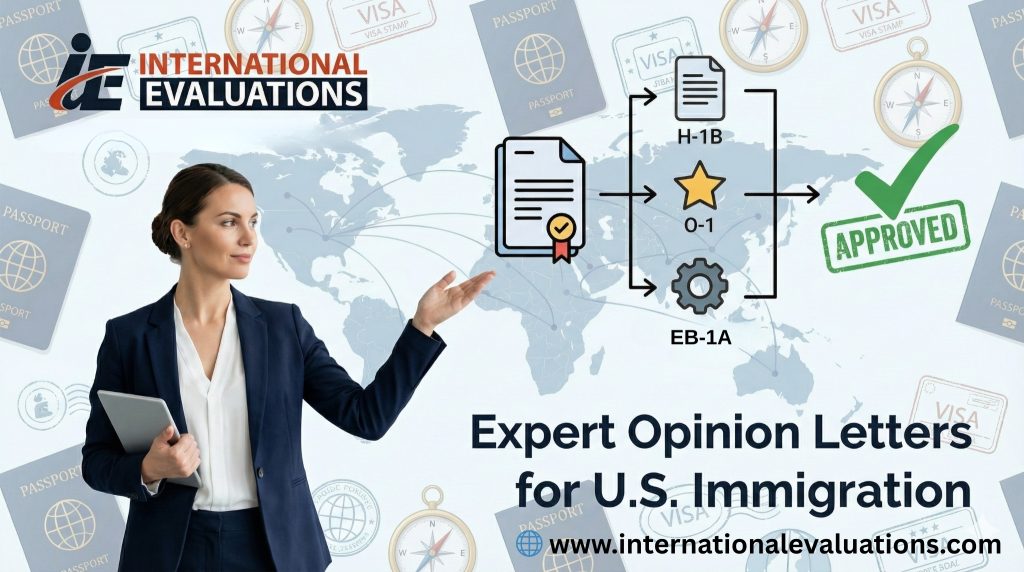
Not every immigration case begins with perfect documentation, clear qualifications, or a straightforward educational background. Many applicants have gaps in education, unconventional experience, foreign degrees that don’t clearly align with U.S. standards, or job roles that USCIS may view as “borderline.” This is where Expert Opinion Letters can transform a weak or questionable immigration case into a strong, well-supported petition. At International Evaluations, we work closely with professors, industry authorities, employers, and attorneys to craft Expert Opinion Letters that clarify complex qualifications, address USCIS concerns, and significantly increase approval success. Why Weak Immigration Cases Need Expert Support USCIS officers rely heavily on documentation to confirm eligibility. When a case includes unusual circumstances, ambiguous credentials, or insufficient evidence, it creates uncertainty—and uncertainty often results in: RFEs (Requests for Evidence) NOIDs (Notices of Intent to Deny) Lengthy delays Denials Expert Opinion Letters provide clarity, context, and authoritative validation that otherwise may not appear in standard documentation. What Is an Expert Opinion Letter? An Expert Opinion Letter is a formal evaluation prepared by a qualified: University professor Industry specialist Subject matter expert Academic authority These letters explain, justify, and verify an applicant’s skills, experience, education, or job duties using expert analysis recognized by USCIS. How Expert Opinion Letters Strengthen Weak Cases Below are the powerful ways expert letters transform weak or complex cases into strong, approvable ones. 1. Clarify Educational Equivalency for Foreign Degrees Some foreign degrees do not directly match U.S. degree structures. This often causes issues in: H-1B petitions EB-2 and EB-3 cases PERM labor certifications Expert letters can explain: – How a foreign degree aligns with U.S. education – Why a degree meets “specialty occupation” requirements – How academic rigor compares across international institutions This eliminates confusion for USCIS officers reviewing the petition. 2. Validate Work Experience as a Degree Equivalent Many applicants lack the exact academic degree USCIS requires but have substantial professional experience. Expert letters can show: 3 years of relevant experience = 1 year of U.S. academic study Equivalent mastery gained through hands-on work Industry-recognized competencies This is critical for H-1B and EB-2 cases where education-experience combinations are permitted. 3. Strengthen Technical or Specialized Occupations Positions in IT, engineering, biotech, finance, research, or niche technical fields may be difficult for USCIS adjudicators to interpret. Experts can: – Break down advanced job duties – Explain technical requirements – Clarify why a role meets “specialty occupation” criteria – Demonstrate advanced industry knowledge This is especially valuable in H-1B and O-1 petitions. 4. Address RFEs or NOIDs Quickly and Effectively If your case already received an RFE or NOID, an Expert Opinion Letter can directly respond to USCIS concerns. Common RFE issues solved by expert letters: “Degree is not related to the job.” “Experience is insufficient for specialty occupation.” “Job duties do not meet the required complexity.” “Insufficient evidence of extraordinary ability.” A well-crafted expert letter targets the exact objections and supports your legal argument. 5. Support O-1, EB-1, and Extraordinary Ability Cases Extraordinary ability cases depend on achievements, reputation, and industry impact. Expert letters can verify: – Award significance – Research influence – Leadership value – Original contributions – Professional acclaim These letters help USCIS understand why an applicant’s accomplishments meet extraordinary standards. 6. Validate Industry Standards for Emerging Occupations Some modern occupations (AI, cloud engineering, cybersecurity, UX architecture) didn’t exist in traditional academic systems. Experts can explain: Why the role requires advanced knowledge How industry norms qualify the applicant Why traditional degree classifications may not apply This reduces confusion and strengthens eligibility arguments. What Makes a Strong Expert Opinion Letter? A powerful letter includes: – Detailed explanation of qualifications – Specific references to USCIS requirements – Clear academic/industry justification – Author’s full credentials and authority – Direct response to any RFE or concern – Precise evaluation of experience or education A vague or generic expert letter will not help—and may weaken your case. Why Attorneys Depend on Expert Opinion Letters Immigration attorneys frequently request these letters because: They provide authoritative validation They help align complex evidence They reduce RFEs They build stronger legal strategy They clarify technical descriptions The right expert can quickly shift the outcome in your favor. Why Choose International Evaluations for Expert Letters At International Evaluations, we provide expert letters that are: – USCIS-Recognized – Professionally Authored by Credentialed Experts – Tailored to Visa-Specific Requirements – Reviewed for Legal Accuracy – Delivered Quickly (24–48-hour expedited options available) – Trusted by Immigration Attorneys Nationwide We have experts across: Engineering IT & Software Business & Finance Healthcare & Life Sciences Education & Research Emerging Technologies Whether you’re preparing a new filing or responding to an RFE, our expert letters provide the clarity USCIS needs. Conclusion: Expert Letters Turn Weak Cases Into Strong Approvals Immigration cases succeed when documentation is clear, credible, and compliant. For applicants with unconventional backgrounds, foreign credentials, or technical job roles, Expert Opinion Letters provide the missing clarity that strengthens the entire petition. At International Evaluations, we help applicants and attorneys resolve weaknesses, address USCIS concerns, and achieve faster approvals through expert-backed, USCIS-ready letters. info@internationalevaluations.com +1 (510) 876-0900 www.internationalevaluations.com International Evaluations — Turning Uncertainty Into Approval Success. FAQs 1. Who writes Expert Opinion Letters? University professors, industry specialists, and academic authorities with recognized credentials. 2. Are expert letters required by USCIS? Not always, but they are strongly recommended for complex, technical, or weak cases. 3. Can expert letters help respond to an RFE? Yes — they directly address USCIS objections and strengthen your response. 4. What visa categories benefit from expert letters? H-1B, O-1, EB-1, EB-2, EB-3, and PERM labor certification. 5. How fast can I get an expert letter? Most are completed within 3–5 business days, with expedited 24–48-hour options.
Fast and Reliable Business Plan Delivery for E-2 Visa Filings
For entrepreneurs seeking an E-2 Investor Visa, a strong business plan is essential. USCIS requires that applicants demonstrate not only their qualifications and investment capability but also that the business is viable, profitable, and able to create a positive economic impact in the U.S. Delays or errors in submitting your business plan can result in RFEs (Requests for Evidence), prolonged processing times, or even visa denials. That’s why fast and reliable business plan delivery is critical for E-2 visa success. At International Evaluations, we help investors, attorneys, and business owners craft and deliver USCIS-compliant business plans quickly without compromising quality. Here’s how speed, accuracy, and expertise work together to improve your E-2 visa approval chances. Why Timely Business Plan Delivery Matters USCIS filings are time-sensitive. Missing deadlines or submitting incomplete plans can lead to: RFEs or Requests for Additional Documentation – USCIS often asks for clarification if your business plan lacks detail. Delays in Visa Processing – Late or incomplete submissions can prolong review times. Increased Stress and Uncertainty – Entrepreneurs and attorneys face avoidable anxiety. Potential Denials – Inadequate documentation can result in outright rejection. A fast and reliable business plan ensures your application is complete, professional, and compliant from the start. Key Components of a USCIS-Compliant E-2 Business Plan A business plan for an E-2 visa must clearly demonstrate that the business is viable, substantial, and beneficial to the U.S. economy. Core components include: 1. Executive Summary Clearly outlines the business, investor role, and visa eligibility. Summarizes investment amount, business objectives, and projected economic impact. Provides a snapshot for USCIS to understand the venture at a glance. 2. Company Description Legal structure (LLC, Corporation, Partnership). Products or services offered. Market opportunity and business objectives. Background of the business owner and their qualifications. 3. Market Analysis Target audience and customer demographics. Competitor analysis and positioning. Industry trends and potential growth in the U.S. market. Clear explanation of how the business addresses market needs. 4. Organizational Structure Key roles and responsibilities within the business. Investor’s managerial or operational role. Demonstrates how your role aligns with E-2 visa requirements. 5. Financial Plan Start-up costs and capital investment details. Projected revenue, profit and loss statements, and cash flow analysis. Break-even calculations and long-term sustainability plan. Evidence that the business is not marginal and can support more than just the investor. 6. Job Creation Strategy Projected number of employees over time. Job descriptions and qualifications required. Timeline for hiring and training employees. Contribution to the U.S. economy through job creation. 7. Risk Assessment and Contingency Plans Potential challenges and market risks. Strategies for mitigating operational, financial, or competitive risks. Shows USCIS that the business is prepared and professionally managed. How Fast Business Plan Delivery Helps E-2 Visa Applicants Quick, reliable delivery of a USCIS-ready business plan provides several advantages: Reduces Risk of RFEs – A complete, detailed plan leaves little room for questions. Supports Timely Filing – Meet strict E-2 visa submission deadlines. Demonstrates Professionalism – Shows USCIS that your business is well-organized and credible. Minimizes Stress – Applicants and attorneys can focus on other aspects of visa preparation. Improves Approval Chances – Well-structured, compliant plans strengthen the overall application. How International Evaluations Ensures Fast and Reliable Delivery At International Evaluations, we specialize in producing USCIS-compliant business plans for E-2 visa applicants with speed and precision: Tailored Business Plans – Customized for each investor’s business, investment amount, and industry. Credential & Experience Verification – Validates the investor’s qualifications and professional experience to support visa eligibility. Expert Financial Planning – Accurate revenue projections, investment summaries, and sustainability plans. Rapid Turnaround – Fast, reliable delivery without compromising compliance or quality. RFE Prevention Guidance – Ensures the business plan anticipates USCIS questions and preempts requests for additional evidence. Common Mistakes to Avoid in E-2 Business Plans Even minor oversights can jeopardize your E-2 visa approval: Submitting a vague or generic plan without industry-specific detail. Missing or inaccurate financial projections. Failing to demonstrate substantial investment or economic impact. Overlooking job creation or hiring plans. Ignoring risk assessment or contingency planning. Working with professionals ensures these mistakes are avoided. Benefits of Partnering with Experts USCIS-Compliant Plans – Every business plan meets government standards. Faster Submission – Avoid delays and meet strict filing deadlines. Increased Approval Odds – Detailed, credible documentation strengthens your case. Peace of Mind – Investors and attorneys can focus on operations and strategy. Custom Solutions – Each plan is tailored for your business, investment, and visa category. Take Action Today A strong E-2 business plan delivered quickly and reliably is your ticket to a smoother visa process. Don’t risk delays, RFEs, or denials with incomplete or poorly structured documentation. Contact International Evaluations today for professional, USCIS-compliant business plan services tailored to E-2 visa filings. Email: info@internationalevaluations.com Phone: +1 (510) 876-0900 Website: www.internationalevaluations.com
Work Experience vs. Degree: Which One Works Better for H-1B?

When U.S. employers sponsor foreign professionals for an H-1B visa, one of the biggest hurdles is proving that the worker is “qualified” for the specialty occupation. The law requires that the position normally calls for at least a bachelor’s degree or equivalent in a specific field. But what happens when a candidate’s background doesn’t fit neatly into the U.S. education system? Can years of professional experience substitute for a missing degree? In this blog, we’ll explore how USCIS evaluates work experience vs. degrees in H-1B petitions, and how credential evaluations can make the difference between approval and denial. Why Education Matters in H-1B Petitions The H-1B is designed for specialty occupations — jobs that require advanced knowledge in fields like IT, engineering, finance, or healthcare. Employers must prove that: The job normally requires a bachelor’s degree (or higher). The foreign worker has that degree or its equivalent. This is where credential evaluations play a key role — helping employers and attorneys document whether the candidate meets the minimum educational requirements. When a Degree Works Best A U.S. bachelor’s (or higher) degree in the required field is the cleanest way to qualify. Advantages: No questions about equivalency. Straightforward evidence for USCIS. Faster petition review. Example: An H-1B software engineer position requires a bachelor’s in computer science. If the candidate holds a U.S. computer science degree, the case is strong and simple. Can Work Experience Replace a Degree? Yes — under USCIS rules, professional experience can sometimes substitute for formal education. The standard equivalency is: 3 years of relevant work experience = 1 year of U.S. college education. That means 12 years of progressive work experience can equal a U.S. bachelor’s degree. Advantages: Opens the door for highly skilled professionals without U.S. degrees. Allows unconventional but talented workers to qualify. Challenges: USCIS requires detailed documentation of job duties, responsibilities, and progression. Must be backed by a formal work experience evaluation from a qualified professor or industry expert. Higher chance of RFEs (Requests for Evidence) if not carefully prepared. Degree + Work Experience: A Winning Combination Often, the best strategy is to combine partial education with years of experience. Example: Candidate has a 3-year foreign bachelor’s degree (common in countries like India). By itself, it may not equal a 4-year U.S. bachelor’s degree. With 3 additional years of professional experience, an evaluator can show equivalency. This combination approach is one of the most common solutions in H-1B cases. Why Employers & Attorneys Rely on Credential Evaluations A USCIS-compliant credential evaluation helps: Translate foreign degrees into U.S. standards. Combine education with professional experience. Issue expert opinion letters that strengthen complex cases. Reduce RFEs and denials by ensuring documentation meets USCIS standards. Common Pitfalls Without Proper Evaluation Employers who skip credential evaluations risk: RFEs questioning degree equivalency. Denials due to missing coursework or unclear transcripts. Delays from using non-compliant evaluators. Conclusion: Which Works Better — Work Experience or a Degree? The truth is, both can work — but the strongest H-1B cases either rely on a U.S. degree or a well-prepared combination of foreign education and work experience. For candidates without the exact U.S. degree, professional experience can bridge the gap — but only with the right documentation. At International Evaluations, we help employers and attorneys build strong H-1B petitions with: Degree Equivalency Reports Work Experience Evaluations by university professors Expert Opinion Letters Rush 48-hour processing for urgent filings Ready to file your H-1B with confidence? Order your credential evaluation with International Evaluations today.
RFE Survival Guide: Why Expert Opinion Letters Are the Game-Changer
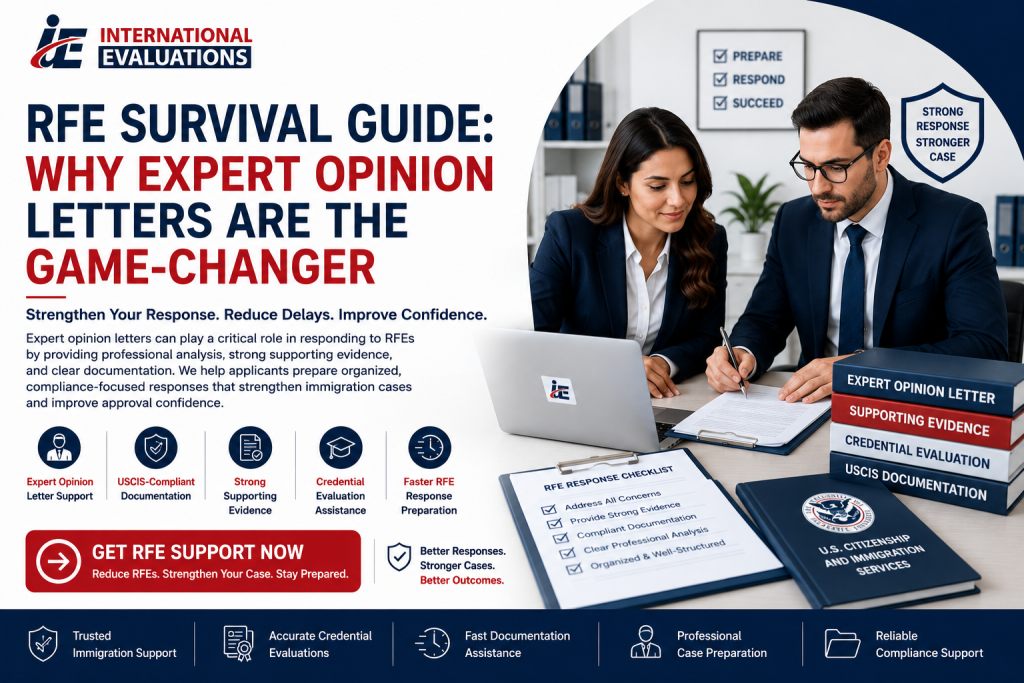
Receiving an RFE (Request for Evidence) from USCIS can feel like hitting a roadblock in your immigration journey. For employers, attorneys, and foreign professionals, an RFE often means additional costs, delays, and uncertainty. The good news? Expert opinion letters have become a crucial tool in turning these challenges into approvals. In this guide, we’ll explain why expert letters matter, how they resolve the most common RFE issues, and share examples of how they’ve saved applications at the last moment. What Is an Expert Opinion Letter? An expert opinion letter is a professional assessment written by a recognized authority in a particular academic or professional field. In immigration cases, these letters serve to: Validate foreign degrees or experience against U.S. standards. Confirm specialized knowledge or skills required for a job. Provide independent, credible evidence that USCIS or DOL officers can rely on. These letters are widely used in H-1B petitions, PERM labor certifications, I-140 filings, and RFE responses. Why RFEs Happen — And How Expert Letters Fix Them USCIS issues RFEs when it needs additional proof of an applicant’s qualifications. Common RFE triggers include: 1. Education Equivalency Confusion Problem: USCIS may question whether a foreign degree meets U.S. standards. Solution: An expert letter confirms equivalency, showing that the coursework and content satisfy U.S. academic requirements. 2. Specialized Field of Study Doubts Problem: Officers may doubt if the applicant’s major qualifies them for the position. Solution: An expert explains how the coursework or experience directly applies to the job. 3. Insufficient Work Experience Documentation Problem: Some applicants substitute years of professional experience for missing academic qualifications. Solution: Experts validate the experience and translate it into U.S.-recognized terms. 4. Complex or Unique Job Roles Problem: Niche industries or emerging roles may confuse officers unfamiliar with the field. Solution: An expert letter provides context, bridging the gap between industry standards and USCIS requirements. 5. Misinterpreted Foreign Credentials Problem: USCIS may undervalue foreign certifications, licenses, or professional designations. Solution: Experts provide authoritative validation, explaining equivalency to U.S. credentials. Real-Life Examples: Expert Letters That Made the Difference Case 1: Degree Gap Turned Approval A tech worker with a Mathematics degree faced an RFE for a Computer Science role. An expert analyzed coursework and confirmed equivalency. Result: Petition approved. Case 2: Experience Over Education A foreign worker lacked the final year of a bachelor’s degree but had 12 years of industry experience. A professor equated the experience to the missing academic year. Result: Green card process moved forward. Case 3: Clarifying a Specialized Job Role A cybersecurity specialist faced an RFE questioning degree relevance. An expert in cybersecurity explained industry practices and degree applicability. Result: RFE overturned, application approved. Why Employers and Attorneys Rely on Expert Letters Credibility: Written by professors or recognized industry authorities. Compliance: Tailored to USCIS and DOL standards. Flexibility: Suitable for H-1B, PERM, I-140, and complex RFE cases. Speed: Rush processing ensures deadlines are met. How International Evaluations Supports RFE Responses At International Evaluations, we provide expert letters trusted nationwide: Expert Opinion Letters for H-1B, PERM, and I-140 filings. Work Experience Evaluations translating professional years into academic equivalents. Rush Delivery (48 hours) for urgent RFE deadlines. USCIS-Compliant Reports backed by university professors and field specialists. Conclusion: The Game-Changer in RFE Responses Facing an RFE doesn’t have to delay your case. An expert opinion letter provides clarity, credibility, and compliance — often turning a potential denial into an approval. Don’t risk delays or denials. Order your expert opinion letter with International Evaluations today and turn your RFE into a success story.
Top 5 USCIS RFE Mistakes — And How Expert Letters Fix Them Fast
Receiving an RFE (Request for Evidence) from USCIS can be stressful for employers, attorneys, and foreign workers. Even the strongest petitions can face delays or denials if key documentation is missing or unclear. Understanding the most common mistakes USCIS makes — and how expert opinion letters can quickly address them — is essential for a smooth immigration process. What Is an Expert Opinion Letter? An expert opinion letter is a professional evaluation written by a recognized authority in a specific academic or professional field. In immigration cases, these letters help: Confirm foreign education or experience aligns with U.S. standards. Validate specialized knowledge or skills required for a specific job. Provide independent, credible evidence USCIS can rely on. Expert letters are commonly used in H-1B petitions, PERM labor certifications, I-140 filings, and RFE responses. Top 5 USCIS RFE Mistakes 1. Misunderstanding Education Equivalency The Mistake: USCIS often questions whether a foreign degree matches U.S. standards, especially for STEM or specialized fields. How Expert Letters Help: A qualified professor or industry expert analyzes the coursework and confirms equivalency, translating international education into U.S.-recognized terms. Real Example: A foreign hire had a Mathematics degree, while the H-1B job required Computer Science. An expert letter clarified that the degree covered the necessary technical coursework, and USCIS approved the petition. 2. Questioning Specialized Fields of Study The Mistake: Officers sometimes doubt whether a candidate’s major qualifies them for a specific role, especially in niche industries. How Expert Letters Help: An expert explains how the applicant’s education or work experience aligns with the position and industry standards. Real Example: A cybersecurity specialist faced an RFE questioning degree relevance. A cybersecurity industry expert detailed typical hiring practices and degree applicability, resulting in USCIS approval. 3. Insufficient Documentation of Work Experience The Mistake: Many petitions lack clear evidence when professional experience is used to substitute for a degree or to show advanced expertise. How Expert Letters Help: An expert validates years of professional experience, showing equivalence to missing academic qualifications. Real Example: A worker missing the final year of a bachelor’s degree had 12 years of industry experience. An expert letter equated this experience to the missing academic requirement, moving the green card process forward. 4. Confusing or Unique Job Roles The Mistake: USCIS may struggle to understand highly specialized or emerging roles, such as AI engineers, data scientists, or blockchain developers. How Expert Letters Help: Experts explain job functions, industry practices, and required qualifications, bridging the knowledge gap for officers. Real Example: An AI startup faced an RFE for a machine learning engineer. An expert letter clarified role responsibilities and the necessity of specific qualifications, leading to petition approval. 5. Misinterpreting Foreign Credentials or Licenses The Mistake: USCIS sometimes undervalues foreign certifications, licensures, or professional designations. How Expert Letters Help: Experts provide authoritative validation, explaining equivalency to U.S. certifications or professional standards. Real Example: A medical technologist with a foreign license faced an RFE questioning credentials. An expert letter confirmed the license’s U.S. equivalency, and USCIS approved the application. Why Expert Letters Are a Game-Changer Credibility: Authored by professors or recognized industry leaders. Compliance: Tailored to USCIS and DOL standards. Versatility: Suitable for H-1B, PERM, I-140, and complex RFE cases. Speed: Rush options ensure tight deadlines are met. How International Evaluations Supports RFE Responses At International Evaluations, we provide expert letters trusted nationwide. Our services include: Expert Opinion Letters for H-1B, PERM, and I-140 filings. Work Experience Evaluations translating professional experience into academic terms. Rush Delivery (48 hours) for urgent RFE deadlines. USCIS-Compliant Reports backed by university professors and field specialists. Conclusion: Fix RFEs Fast With Expert Letters An RFE doesn’t have to delay or derail your immigration case. Expert opinion letters provide the credibility and clarity USCIS needs to approve petitions quickly. Facing an RFE? Protect your case and save time. Order your expert opinion letter with International Evaluations today.
The Hidden Power of Expert Letters: Real Stories of RFE Turnarounds
When it comes to U.S. immigration, RFEs (Requests for Evidence) can derail even the strongest applications. Employers, attorneys, and foreign workers know that an RFE means additional costs, delays, and the risk of denial. One powerful tool that often turns the tide in these cases is the Expert Opinion Letter. In this blog, we’ll explore why expert letters matter, how they resolve complex RFEs, and share real examples of how they’ve saved applications at the last moment. What Is an Expert Opinion Letter? An expert opinion letter is a professional assessment written by a recognized authority in a specific academic or professional field. In the immigration context, it’s used to: Clarify whether a foreign degree or experience matches U.S. standards. Validate specialized knowledge or skills required for a job. Provide independent, credible evidence that USCIS or DOL officers can rely on. These letters are commonly used in PERM labor certifications, H-1B petitions, I-140 filings, and RFE responses. Why RFEs Happen—and How Expert Letters Help RFEs are issued when USCIS or DOL needs more proof to verify an applicant’s qualifications. Common reasons include: Unclear Education Equivalency Foreign degrees don’t always align with U.S. standards. Solution: An expert letter from a qualified professor confirms equivalency. Specialized Field of Study Questions USCIS may question whether a worker’s major truly qualifies them for the position. Solution: An expert explains how coursework or experience aligns with the job. Insufficient Work Experience Documentation Sometimes years of professional experience are needed to substitute for education. Solution: An expert verifies and translates that experience into USCIS-recognized terms. Complex or Unique Job Roles Niche industries often confuse officers unfamiliar with the field. Solution: An expert letter provides context, bridging the gap between industry standards and USCIS requirements. Real Stories: Expert Letters That Made the Difference Case 1: Turning a Degree Gap into Approval A tech employer received an RFE because their foreign hire’s degree was in Mathematics, while the job description required Computer Science. With an expert letter analyzing coursework and industry practices, USCIS accepted the degree as equivalent. Result: Petition approved. Case 2: Experience Over Education A worker lacked the final year of a bachelor’s degree but had 12 years of progressive industry experience. A professor’s expert evaluation equated the work experience to the missing academic year. Result: Green card process moved forward. Case 3: Clarifying a Specialized Job Role An employer sponsoring a cybersecurity specialist faced an RFE because the officer questioned whether the applicant’s degree aligned with the role. An expert in cybersecurity explained industry hiring practices and degree relevance. Result: RFE overturned, application approved. Why Employers and Attorneys Rely on Expert Letters Credibility: Written by university professors and industry leaders. Compliance: Tailored to USCIS and DOL standards. Flexibility: Used in H-1B, PERM, I-140, and complex RFE cases. Speed: Available with rush processing to meet deadlines. How International Evaluations Supports RFE Responses At International Evaluations, we provide expert letters that are trusted by employers and immigration attorneys nationwide. Our services include: Expert Opinion Letters for PERM, H-1B, and I-140 filings. Work Experience Evaluations equating professional years to academic study. Rush Delivery (48 hours) for urgent RFE deadlines. USCIS-Compliant Reports backed by university professors and field specialists. Conclusion: The Game-Changer in RFE Responses When facing an RFE, every piece of evidence matters. An expert opinion letter can be the difference between a denial and an approval. It provides the clarity, credibility, and compliance USCIS officers require. At International Evaluations, we’ve helped countless employers and attorneys turn RFEs into approvals with carefully prepared expert letters. Facing an RFE? Don’t risk delays or denials. Order your expert opinion letter with International Evaluations today.
Work Experience Evaluation for H-1B: A Solution for Candidates Without a Degree
The H-1B visa is one of the most sought-after pathways for skilled foreign professionals looking to work in the United States. However, one of its strict eligibility requirements is that applicants must hold at least a U.S. bachelor’s degree or its foreign equivalent in a field related to the job. This poses a challenge for talented candidates who may not have a formal degree but possess years of practical, hands-on experience. The good news? Work experience evaluations can bridge the gap, helping candidates qualify for the H-1B without a traditional academic credential. What is a Work Experience Evaluation? A work experience evaluation is a formal assessment performed by authorized credential evaluators, university professors, or academic experts. It converts professional experience, training, and certifications into an academic equivalency that aligns with U.S. educational standards. For H-1B purposes, three years of specialized professional experience is typically considered equivalent to one year of university-level education. This means that even without a bachelor’s degree, candidates can qualify if they have significant work experience in their field. Who Needs a Work Experience Evaluation? You may need a work experience evaluation if: You do not hold a bachelor’s degree but have years of work experience in your specialty. You have a degree that does not match your H-1B job specialty. You completed your education in a different system and need U.S. equivalency documentation. You want to strengthen your H-1B petition with expert academic and experiential credentials. How Does the Evaluation Work? Gathering Documentation Detailed resume with professional roles, skills, and achievements. Letters from past employers verifying job duties and years of service. Certifications, training records, or industry recognitions. Expert Analysis An evaluator or professor reviews your professional background to determine its academic equivalence to a U.S. degree. Issuance of Evaluation Report The evaluator provides a written report that outlines how your work experience matches the degree requirement for H-1B eligibility. Why Work Experience Evaluation Matters for H-1B Eligibility Without a Degree: Provides a pathway for skilled professionals who didn’t pursue traditional higher education. Job-Relevant Qualification: Ensures that USCIS recognizes your skills as equivalent to academic training. Stronger Petition: An expert evaluation adds credibility and reduces the chances of Requests for Evidence (RFEs). Career Growth: Opens doors to H-1B opportunities and long-term immigration benefits in the U.S. Choosing the Right Evaluation Service Not all evaluations are accepted by USCIS. To avoid delays or denials: Use evaluators authorized by U.S. universities or recognized by USCIS. Ensure the evaluation highlights both education and work experience. Work with immigration attorneys or consultants to submit the strongest possible petition. Why Choose International Evaluations? When it comes to H-1B work experience and education evaluations, the quality of your report can make or break your case. Not all evaluators are equal—choosing the wrong provider may result in RFEs, delays, or even denials. That’s why working with International Evaluations makes a real difference. 1. USCIS-Trusted Experts Our evaluations are written by university professors and credentialed professionals with deep expertise in U.S. academic equivalency standards. This ensures your report meets the highest compliance expectations. 2. Tailored to Your Case Every candidate’s background is unique. International Evaluations customizes reports—whether you need a work experience evaluation, degree equivalency, or expert opinion letter—to highlight your strengths and align with USCIS requirements. 3. Fast Turnaround Times Immigration deadlines are time-sensitive. We offer rush services within 24–48 hours, helping candidates and attorneys meet critical H-1B filing windows without compromising quality. 4. Comprehensive Services From credential evaluations and work experience equivalencies to expert opinion letters for RFEs, International Evaluations provides all the documentation support you need under one roof. 5. Proven Success with RFEs Our team has extensive experience responding to Requests for Evidence (RFEs). By providing detailed, professor-backed reports, we help strengthen petitions and improve approval chances. 6. Trusted by Attorneys and Employers Immigration attorneys and HR departments across the U.S. rely on our evaluations to hire international professionals with confidence. Final Thoughts While the H-1B visa has strict academic requirements, lack of a degree doesn’t have to end your U.S. career dreams. With the right work experience evaluation, years of professional expertise can serve as the foundation for your H-1B eligibility. At Bay Area Immigration Services, we specialize in helping candidates navigate this process with professional evaluations, strong documentation, and expert legal guidance. Schedule a Free Consultation Order a Work Experience Evaluation
Faster H-1B Approvals: How Specialty Occupation Expert Letters Can Help
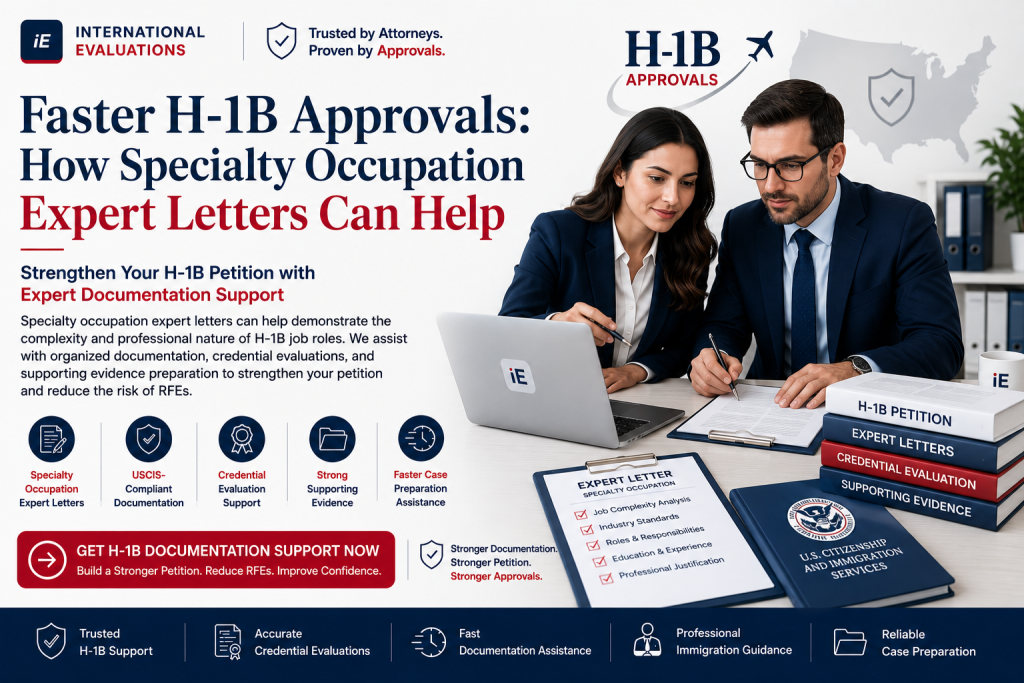
Navigating the H-1B visa process can be daunting—especially when USCIS requests proof that your role qualifies as a “specialty occupation.” This is where a Specialty Occupation Expert Letter can become a powerful ally, bridging the gap between your job duties and immigration requirements. With the right guidance and documentation, what once felt like an uphill battle can transform into a confident, well-supported application that moves swiftly through adjudication. Initial Case Review & Eligibility Assessment Our H-1B specialists begin with a comprehensive review of your position, educational background, and employer details. We evaluate job descriptions, industry norms, and SOC codes to determine if your role meets USCIS’s specialty occupation criteria. This proactive analysis ensures that your petition is built on a solid foundation before moving forward. Crafting a Tailored Specialty Occupation Expert Letter Strategy Once the eligibility is confirmed, we design a customized plan for obtaining an expert letter that aligns perfectly with your position. Whether your field is engineering, IT, finance, or healthcare, we identify a highly qualified industry expert whose credentials meet USCIS standards. This ensures the letter carries the professional weight needed to influence adjudication positively. Selecting the Right Expert Witness Not all experts are created equal. We vet specialists with advanced degrees, relevant industry publications, and real-world experience. The chosen expert carefully analyzes your role, required qualifications, and industry norms to produce an authoritative statement demonstrating why your position demands specialized knowledge and a bachelor’s degree or higher in a specific field. Drafting & Refining the Expert Letter Our team collaborates closely with the expert to ensure the letter is comprehensive, precise, and USCIS-compliant. It details: The complexity of your job duties Industry standards for similar roles Why your educational background is essential to the role How your position meets specialty occupation regulations This attention to detail minimizes the risk of Requests for Evidence (RFEs) and accelerates processing. Responding to RFEs with Confidence If USCIS issues an RFE questioning the specialty nature of your occupation, a strong expert letter can be the difference between approval and denial. We prepare targeted, persuasive responses that address each USCIS concern head-on—supplemented with additional evidence such as industry data, peer job postings, and employer attestations. Supporting Cap-Exempt and Cap-Subject Cases Whether your petition is cap-subject or filed under a cap-exempt employer (such as universities or research institutions), specialty occupation expert letters play a vital role in substantiating eligibility. We tailor the content to match the filing category and processing route for optimal results. Guiding Employers Through Compliance Beyond the letter itself, we advise employers on aligning job postings, LCA requirements, and internal records to avoid discrepancies that could raise USCIS concerns. This holistic approach safeguards both the petition and future compliance. Why Choose Us for Specialty Occupation Expert Letters? With decades of combined immigration experience, we’ve cultivated a network of over 170 credentialed specialists across STEM, finance, business, and healthcare. Our proven track record in securing H-1B approvals—often after complex RFEs—demonstrates the power of pairing legal strategy with authoritative expert testimony. Conclusion In the fast-moving world of H-1B adjudications, speed and precision matter. A well-crafted Specialty Occupation Expert Letter doesn’t just defend your case—it accelerates it. By combining deep immigration knowledge with access to top-tier industry experts, we help ensure your petition clears USCIS scrutiny and reaches approval faster, with fewer roadblocks. FAQs What is a Specialty Occupation Expert Letter? It’s a professional statement from a qualified industry expert explaining why your role requires specialized knowledge and a specific degree, as defined by USCIS. When should I get one? Ideally before filing, but it can also be obtained to respond to a USCIS RFE. Can an expert letter guarantee H-1B approval? No letter can guarantee approval, but a strong one can significantly strengthen your case. Who can write such a letter? Experts with advanced credentials, substantial industry experience, and professional credibility in your field. Does premium processing help with H-1B speed? Yes. When paired with a strong petition and expert letter, premium processing can deliver decisions in as little as 15 days. Schedule a Free Consultation Order a Work Experience Evaluation
Converting from H-1B to Green Card: Choosing Between PERM and EB2-NIW
For many skilled professionals on an H-1B visa, the ultimate goal is U.S. permanent residency — the coveted green card. However, the path to getting there isn’t one-size-fits-all. Two of the most common routes are PERM Labor Certification and EB2-NIW (National Interest Waiver). Both can lead to a green card, but they differ significantly in process, requirements, and flexibility. In this article, we’ll break down each option, highlight the pros and cons, and help you determine which pathway might suit your career and immigration goals. Understanding the Two Pathways 1. PERM Labor Certification The PERM process requires your employer to obtain a labor certification from the U.S. Department of Labor (DOL). This certification verifies that: There are no qualified U.S. workers available for your position. Hiring you will not adversely affect U.S. workers’ wages and working conditions. Once the PERM is approved, your employer can file an I-140 Immigrant Petition on your behalf. Key Features of PERM: Employer sponsorship is mandatory. Strict recruitment process to test the U.S. labor market. Dependent on employer’s commitment to support your green card. 2. EB2-NIW (National Interest Waiver) The EB2-NIW route allows you to self-petition without an employer sponsor if you can prove that your work is in the “national interest” of the United States. This means you must demonstrate: Your work has substantial merit and national importance. You are well-positioned to advance your proposed endeavor. Waiving the job offer requirement benefits the U.S. Key Features of EB2-NIW: No employer sponsorship required. Greater flexibility to change jobs, industries, or even start your own business. Focuses on your contributions and future potential rather than the job market test. Pros and Cons of Each Route Criteria PERM Labor Certification EB2-NIW Employer Sponsorship Required Not required Job Flexibility Tied to employer until GC approval Flexible after filing Processing Time Can be longer due to recruitment process Often faster if well-documented Evidence Focus Employer’s need for your role Your achievements & national impact Risk of RFE Related to recruitment results & compliance Related to evidence of national importance When to Choose PERM Your employer is supportive and willing to sponsor your green card. Your career path is stable, and you plan to stay with the same employer until green card approval. You do not have strong evidence to prove national importance under EB2-NIW. When to Choose EB2-NIW You want to self-petition without relying on an employer. Your work impacts a national-level priority (STEM research, public health, infrastructure, etc.). You anticipate changing jobs, starting a business, or pursuing independent projects before green card approval. Can You Pursue Both? Yes. Some professionals file both PERM and EB2-NIW concurrently to increase their chances and speed up the process. This dual approach provides a safety net in case one pathway faces delays or RFEs (Requests for Evidence). How Expert Opinion Letters Can Strengthen Either Path Whether you choose PERM or EB2-NIW, a well-crafted expert opinion letter can be the difference between an approval and an RFE. These letters: Validate your qualifications and achievements. Provide third-party evidence of your contributions. Address USCIS criteria in language that officers recognize and respect. Why Legal Professionals and Petitioners Trust Our Expertise Our clients — from leading immigration attorneys to self-petitioners — choose us because we offer unmatched precision and credibility in the field. Here’s what sets us apart: Extensive Professional Network – Access to over 170 credentialed experts across STEM, business, healthcare, and social sciences. Fast, Tailored Turnaround – Customized letters delivered quickly without compromising quality. Mastery of USCIS Standards – We specialize in precise formatting, language, and evidentiary requirements that USCIS looks for. Proven Approval Outcomes – Consistent success in turning RFEs into green card approvals. Whether you’re navigating the process with an attorney or filing on your own, we provide the specialized insight that moves petitions forward — faster and stronger. Final Thoughts Transitioning from an H-1B visa to a green card is a major milestone, and choosing the right pathway — PERM or EB2-NIW — depends on your career goals, evidence strength, and flexibility needs. Whichever route you choose, building a solid case with clear, well-documented evidence is key to success. If you’re ready to take the next step, our team of credentialed experts is here to prepare the persuasive documentation USCIS wants to see. Schedule a Free Consultation Order a Work Experience Evaluation
Insider Tips: Structuring a Winning EB2-NIW Expert Opinion Letter

When it comes to the EB2-NIW (Employment-Based Second Preference – National Interest Waiver) petition, an expert opinion letter can be the deciding factor between an approval and a denial. This letter serves as a credible, third-party validation of your qualifications, contributions, and the national importance of your work. But not all opinion letters are created equal—small mistakes in tone, structure, or USCIS compliance can lead to costly delays or denials. In this guide, we’ll cover insider strategies to craft an EB2-NIW expert opinion letter that captures USCIS attention for the right reasons. Tips: 1. Start with a Strong Introduction That Establishes Authority The opening paragraph should immediately tell USCIS who the expert is and why their opinion matters. This isn’t just a formal introduction—it’s a credibility statement. Include: Expert’s Academic Credentials Professional Affiliations Years of Relevant Experience Notable Publications, Patents, or Contributions The goal is to make the adjudicator feel that they are reading the words of someone whose judgment is beyond question. Avoid generic titles; instead, use precise descriptors (e.g., “Professor of Mechanical Engineering with 25 years of aerospace research experience”). 2. Align with USCIS Criteria Early On The EB2-NIW approval hinges on proving three key elements under the Matter of Dhanasar framework: Substantial Merit and National Importance Positioning to Advance the Endeavor Benefit to the United States An effective letter addresses these criteria explicitly. The earlier in the letter this alignment is established, the more weight it carries throughout the review process. 3. Focus on Evidence, Not Flattery USCIS officers are trained to identify vague praise without substance. Replace subjective adjectives (“brilliant,” “highly talented”) with objective evidence: Metrics (citations, impact factor, patents granted) Specific projects and their measurable outcomes Recognition by authoritative organizations Tangible societal or industry benefits 4. Use a Logical Structure That Flows Naturally A well-structured EB2-NIW expert opinion letter generally follows this outline: Expert’s credentials and authority Relationship to the petitioner (if any, disclose clearly) Overview of the petitioner’s work and contributions Evidence that aligns with USCIS criteria Conclusion with strong endorsement Each section should transition smoothly into the next. Choppy or unorganized letters can diminish credibility, even if the content is strong. 5. Maintain USCIS-Approved Language and Formatting Certain phrases, formats, and word choices are known to resonate with USCIS. These include: Claims are not substantiated with verifiable data The expert’s authority is unclear There is no explicit link between the petitioner’s work and U.S. national interest Remember: presentation impacts perception. A sloppy or unprofessional format can cast doubt on the legitimacy of the content. 6. Anticipate and Preempt RFE Triggers An RFE (Request for Evidence) often arises when: Verifiable Data for Claims Clear Expert Authority Explicit Link to U.S. National Interest To prevent RFEs, ensure that every claim in the letter is backed by specific, credible evidence and directly tied to the EB2-NIW criteria. Why Legal Professionals Trust Our Expertise Extensive Expert Network: We collaborate with over 170 highly qualified specialists across STEM, business, healthcare, and social science fields. Fast, Customized Delivery: Tailored opinion letters prepared with speed—without compromising precision or quality USCIS-Compliant Precision: Every document is crafted to meet the exact formatting and linguistic standards recognized by USCIS. Proven RFE Turnaround Success: A consistent record of converting Requests for Evidence into successful case approvals Whether you’re representing a distinguished client or navigating the process as a self-petitioner, our team provides the strategic insights and documentation support that can make the difference between approval and denial. 7. Close with a Powerful Endorsement Statement The conclusion is your final chance to influence USCIS. A strong ending should: Reaffirm the petitioner’s national importance Summarize their qualifications in one impactful sentence State unequivocally that approval would be in the United States’ best interest Final Thoughts A well-crafted EB2-NIW expert opinion letter is not just a formality—it’s a strategic document that can tip the scales toward approval. By selecting the right expert, aligning content with USCIS criteria, and avoiding vague or unsupported claims, petitioners can significantly strengthen their case. If you’re facing tight deadlines, a complex RFE, or simply want to ensure your letter meets the highest standards, working with experienced evaluation professionals can save time, reduce risk, and improve approval odds. Schedule a Free Consultation Order a Work Experience Evaluation