No Degree? How Work Experience Can Qualify You for an H-1B Visa

Think you need a college degree to qualify for an H-1B visa? Think again. While a U.S. bachelor’s degree or its equivalent is the traditional path, there’s an alternative that many overlook: relevant work experience. If you’re an immigration attorney or an employer sponsoring international talent, it’s crucial to understand how experience-based evaluations can help meet USCIS requirements—even without a formal degree. At International Evaluations, we help attorneys and employers navigate these complex cases with detailed Work Experience Evaluations—custom-written by credentialed experts and fully compliant with USCIS standards. For individuals with extensive, progressive experience in a specialized field, this can be the key to unlocking H-1B eligibility. The H-1B Specialty Occupation Requirement To qualify for an H-1B visa, USCIS requires the job to meet the definition of a “specialty occupation”, which typically means: The position requires a bachelor’s degree or higher in a specific field. The beneficiary holds the equivalent of that U.S. bachelor’s degree. But what if the individual doesn’t have a degree—or has a degree in an unrelated field? That’s where work experience comes in. Under USCIS guidelines, three years of relevant, progressive work experience can be considered equivalent to one year of college-level education in the specialty field. This means: Evaluators can consider 12 years of experience in a relevant field equivalent to a 4-year bachelor’s degree. Who Can Benefit from a Work Experience Evaluation? This path is especially useful for: Skilled professionals who entered the workforce early without finishing formal education. Individuals with unrelated degrees (e.g., a bachelor’s in literature working as a software engineer). Self-taught professionals with certifications and years of hands-on experience. Entrepreneurs or consultants with a verifiable work history in the relevant field. We’ve helped attorneys and employers successfully file H-1B petitions for software developers, IT consultants, marketing analysts, mechanical engineers, and more—even when the candidate lacked a traditional degree. What Is a Work Experience Evaluation? A Work Experience Evaluation is a detailed report prepared by a university professor or subject matter expert. It evaluates the beneficiary’s work history to determine whether their experience is equivalent to a U.S. bachelor’s degree in a specific field. At International Evaluations, our process includes: Reviewing resume, letters of experience, and job descriptions Assessing the depth and progression of the individual’s roles Analyzing the relevance of experience to the proposed H-1B position Matching experience to academic standards based on AACRAO and USCIS guidelines Issuing a formal equivalency statement, signed by an academic expert All evaluations are USCIS-compliant, include expert credentials, and are formatted per USCIS submission standards. What Evidence Is Required? To support a work experience-based H-1B petition, USCIS expects substantial documentation. Our team will guide you or your legal counsel on what’s needed, including: Detailed employment verification letters from past employers A resume or CV outlining roles and responsibilities Project details, certifications, or work samples (if available) A clear job offer letter describing the specialty occupation All letters should be on company letterhead, signed by someone with authority, and outline job title, duties, duration of employment, and technologies/tools used. When to Use a Work Experience Evaluation Work experience evaluations are often used in: H-1B Petitions Without a Degree A candidate with 12+ years of experience and no degree can still qualify for an H-1B if the role and experience align. Degree Mismatch Cases If the beneficiary holds a degree in an unrelated field, we can combine education + experience to establish equivalency in the field of the job. RFEs or Denials If USCIS has issued an RFE or denial questioning the beneficiary’s qualifications, a properly structured expert evaluation may provide the clarity needed for approval or refiling. Why Attorneys and Employers Trust International Evaluations We specialize in helping non-traditional candidates qualify for H-1B and other employment-based visas. What sets us apart: Access to 170+ credentialed experts across STEM, business, healthcare, and social sciences who can assess and validate your experience. Fast, customized evaluations that translate your years of practical work into U.S. degree equivalency for H-1B purposes. Expertise in USCIS-compliant formatting and terminology, ensuring your case meets strict petition requirements. Proven track record of approvals, including successful conversions from Requests for Evidence (RFEs) to visa grants. Our goal is to provide documentation that not only meets requirements—but also stands up to scrutiny under today’s increasingly rigorous USCIS review standards. Final Thoughts: No Degree Doesn’t Mean No Opportunity The U.S. immigration system recognizes that real-world experience matters—especially in fast-evolving fields like IT, engineering, and business. With a professional work experience evaluation, candidates who lack formal degrees can still meet H-1B requirements and pursue their American dream. At International Evaluations, we help attorneys and employers uncover every qualifying angle for their candidates—education or experience-based. Schedule a Free Consultation Order a Work Experience Evaluation
How Our Expert Opinion Letters Turn RFEs into Approvals

Getting closer to your dream of working or living in the U.S. is an exciting journey—but even strong visa petitions can sometimes hit unexpected hurdles. One such hurdle is a Request for Evidence (RFE) from USCIS. While it may seem discouraging, it doesn’t have to mean denial. For hundreds of attorneys, employers, and foreign professionals nationwide, International Evaluations has provided the critical support needed to transform RFEs into approvals through USCIS-compliant Expert Opinion Letters. Whether the petition is for an H-1B, EB1-A, EB2-NIW, or O-1 visa, RFEs are commonly issued when USCIS is not convinced the role qualifies as a specialty occupation or when there is insufficient evidence that the beneficiary meets the required academic and professional standards. This is where International Evaluations’ expert-backed documentation makes all the difference. What Is an RFE—and Why Is It So Common? A A Request for Evidence is issued when USCIS believes the initial petition lacks sufficient documentation to support its claims. In employment-based petitions, the most common RFE triggers include: Failure to prove the specialty occupation requirement (H-1B) Lack of clear evidence that the beneficiary qualifies for the position (EB, L-1B) Insufficient proof of extraordinary ability (O-1, EB1-A) Unclear job duties or education equivalence Inconsistent or unverified credentials These RFEs can significantly delay or even derail a visa process, especially when timelines are tight or filing deadlines are near. Where Our Expert Opinion Letters Make the Difference At At International Evaluations, we specialize in providing tailored, USCIS-compliant Expert Opinion Letters that address these very challenges head-on. Unlike generic or template-based letters, our evaluations are prepared by industry-specific professors and experts with deep knowledge of your field—whether it’s IT, engineering, finance, healthcare, or the arts. These experts evaluate the position, the beneficiary’s qualifications, and the standards of the profession, and then draft a letter that meets the exact requirements USCIS is looking for. Here’s how we help turn RFEs into approvals: 1. Addressing the Specialty Occupation Criteria Many H-1B RFEs cite a failure to prove that the job is a specialty occupation—meaning the role requires a theoretical and practical application of specialized knowledge and at least a bachelor’s degree or equivalent in a specific field. Our Specialty Occupation Expert Letters: Align job duties with industry standards Reference authoritative resources (e.g., the Department of Labor’s OOH and O*NET) Demonstrate why a degree in a specific field is required Are written by academic experts in that industry Result: We help satisfy USCIS that the job meets the specialty occupation threshold, often leading to RFE approval. 2. Verifying the Beneficiary’s Qualifications In some cases, even when the job is clearly a specialty occupation, the RFE challenges whether the beneficiary’s degree or experience qualifies them for the position. Our Beneficiary Qualification Letters: Analyze foreign academic credentials and compare them to U.S. standards Evaluate relevant work experience and training Establish equivalency when degrees are in unrelated or partially related fields Result: USCIS gains confidence that the candidate is indeed qualified—even if they hold a foreign degree or a mix of education and experience. 3. Clarifying Position Requirements For roles that have vague job titles or duties (e.g., “analyst,” “associate,” “consultant”), USCIS may question whether the position actually requires a degree in a specialized field. Our Position Evaluation Letters: Break down the day-to-day responsibilities Connect duties to advanced knowledge areas Benchmark against industry hiring standards Result: Clearly demonstrates the complexity and skill level required—even for hybrid or emerging roles. 4. Proving Extraordinary Ability and National Interest For EB1-A, O-1, or EB2-NIW petitions, RFEs often demand clearer proof of the beneficiary’s extraordinary achievements or national interest contributions. Our letters for these categories: Written by leading academic and professional experts Cite peer-reviewed publications, patents, or industry recognition Detail the impact of the beneficiary’s work in real-world terms Result: A well-documented expert letter can tip the balance in favor of approval by establishing how the individual meets high immigration standards. 5. USCIS-Compliant Formatting and Language One of the most overlooked aspects of an Expert Opinion Letter is format and language compliance. USCIS expects specific formatting, wording, and citation practices that align with federal adjudication standards. At International Evaluations, all letters: Follow USCIS formatting conventions Include all required signatory and expert credentials Tailored to the specific language of the RFE or petition Result: Fewer back-and-forths. Faster resolutions. Stronger submissions. Fast Turnaround—Without Compromising Quality We understand the pressure of RFE deadlines. That’s why our team offers: 48-hour rush service for urgent cases Custom evaluations within 3–5 business days Free consultations to assess your case before ordering Every letter is reviewed by multiple professionals to ensure clarity, accuracy, and compliance with current USCIS trends. Who We Serve Immigration Attorneys needing fast, expert-backed documentation Employers sponsoring foreign workers in technical, business, or creative roles Individuals self-petitioning or responding to USCIS RFEs Whether it’s your first petition or a complex RFE challenge, our expert letters provide peace of mind and persuasive documentation. Ready to Turn That RFE Into an Approval? Don’t let an RFE slow down your visa process. With our USCIS-compliant Expert Opinion Letters, you’ll have the clarity, credibility, and confidence to respond effectively. Request a Free Consultation Order Your Expert Opinion Letter Today © 2025 International Evaluations. All Rights Reserved.
End-to-End PERM Support: The Hidden Advantage Attorneys and Employers Are Missing

The PERM Labour Certification is the initial key step in a number of employment-based green card petitions. For employers and immigration lawyers, it’s a high-risk-of-failure legal and compliance issue — one that demands extensive coordination, accuracy, and faith. The slightest misstep in paperwork or timing can push back or derail a whole immigration petition, and that’s why proactive, thorough assistance is not only beneficial — it’s necessary. This article moves beyond the fundamentals to discuss the internal tensions and real-world demands attorneys and employers are up against — and the way a suitable end-to-end support partner can significantly decrease the workload, streamline paperwork, and guarantee regulatory compliance, ultimately leading to better approval results. The Real Goal of PERM: Proving No Qualified U.S. Worker Is Available At its essence, the PERM process is not merely about red tape — it’s an antidote to protect the American workforce. The Department of Labor (DOL) insists that employers prove no willing and able U.S. worker exists to take the job. It’s not just a checklist box — it’s a requirement with dire consequences if it isn’t fulfilled. To fulfil this requirement, employers need to: Develop a clear job specification that defines the minimum educational and experiential qualifications — and these need to be uniform, justifiable, and not customized to suit one applicant. Secure a Prevailing Wage Determination (PWD) from the DOL, which determines the minimum wage based on the job, industry, and location. Make a good-faith recruitment campaign, in accordance with DOL-established recruitment practices, including newspaper advertisements, online notices, and internal work orders. Document every candidate rejection, offering specific proof that any U.S. applicants were rejected on only lawful, job-related grounds, not on preferences or murky explanations. Every one of these measures entails stringent requirements and meticulous documentation, and a failure at any point can result in denial or audit. What Employers Are Thinking: Risk, Compliance & Internal Approval For HR practitioners and talent acquisition teams, sponsoring a foreign national on PERM is so much more than merely supporting a valuable worker. It’s a delicate tightrope act between legal compliance, internal stakeholder management, and risk avoidance. Employers have to: Remain in compliance with constantly changing DOL regulations, which shift with policy changes and labor market forces. Protect against DOL audits and fines, which can result from slight mistakes or discrepancies in recruitment paperwork or job specifications Communicate effectively with internal stakeholders — ranging from legal and finance groups to department managers and hiring supervisors — to make certain that all have a clear understanding of the timeline, duties, and legal sensitivity of the process. Reduce exposure to legal suits, especially those involving discrimination, unfair hiring practices, or mismanagement of recruitment files. In this setting, employers don’t merely require immigration law firms — they require operational partners who can remove the administrative weight and ensure compliance. This involves writing legally compliant job adverts, handling recruitment coordination, and assisting HR departments with tightening up paperwork that will hold up to audit. What Immigration Attorneys Face: Strategy, Paperwork & Pressure Attorneys handling PERM cases have several, usually competing, duties. The procedure is time-sensitive and multifaceted, and attention to detail is critical. Immigration lawyers need to navigate: Constantly shifting DOL policies, which control the analysis of job positions, wages, and recruitment methods. Strict documentation, such as business necessity explanations, experience assessments, and academic equivalency assessments. Delicate timeframes, particularly with PWD timelines and recruitment windows, often coincide with client contact and other filings. Sophisticated client histories, where international degrees, unorthodox career histories, or mixed job responsibilities don’t neatly fit with DOL requirements. Counsellors draw upon precise and customised: Job descriptions that meet both employer requirements and regulatory definitions. Business necessity letters that serve powerful support for special requirements. Scholarship and work experience assessments that conscientiously map to DOL-specified job minimums and PERM requirements. Within this pressure cooker atmosphere, having a solid backend partner that knows the PERM system — and is able to handle time-consuming aspects such as document preparation, evaluation sourcing, and compliance testing — is a game-changer. Support of this kind doesn’t merely enhance workflow but enables attorneys to concentrate on legal strategy rather than operational stress. The Hidden Burden: Why Employers and Attorneys Need Real Support PERM petitions can be submitted on behalf of a foreign national, but the real onus of implementation rests with employers and attorneys. Behind every successful case are hours of coordination between departments, document checking, audit preparations, and beating deadlines. That invisible burden is comprised of: Legal staff doing quality control and making sure every document meets federal standards. HR professionals handling outreach efforts, advertising compliance, and in-house communications. Shareholders who want certainty, transparency, and assurance in the process. Having a reputable, seasoned, end-to-end partner can make this whole process run more smoothly — minimising legal risk, streamlining efficiency, and giving everyone peace of mind. How International Evaluations Helps At International Evaluations, we do much more than simple credential reviews. We are your strategic PERM support partner, committed to easing the burden for both attorneys and employers. Our end-to-end support model is founded on trust, accuracy, and extensive immigration know-how. We help by: Preparing field-matched academic evaluations prepared by qualified U.S. professors tailored to each position and job qualification. Providing experience assessments that meet DOL and USCIS requirements, connecting foreign work experience with American equivalents. Writing persuasive expert opinion letters to resolve concerns such as business need, field-related justification, or specialised background. Managing PERM ads and assisting HR staff in remaining DOL-compliant while conserving a lot of time and effort. Assisting the entire PERM case life cycle — from timetables and documentation to recruitment monitoring and audit preparation — as an authentic back-office collaborator. Whether your case is a simple filing or an RFE or audit reaction, we fill in to alleviate administrative load and bolster the acceptability of your petition. Let’s Talk If you’re an immigration attorney or employer looking for a reliable, fast, and end-to-end PERM support partner, we’re ready to help.
Got an RFE for Your EB2-NIW Petition? Here’s How Expert Opinion Letters Can Save Your Case
Request for Evidence (RFE) for your EB2-NIW green card petition may feel like a setback—but it’s really an opportunity. It’s USCIS’s way of saying, “We see potential here, but we need more.” If you’ve been issued an RFE for your EB2-NIW case, especially questioning your eligibility under the Dhanasar framework or the national interest standard, expert opinion letters can be the game-changer that turns a possible denial into an approval. In this article, we’ll explain: Why EB2-NIW petitions commonly receive RFEs What USCIS is really looking for in your response How expertly crafted RFE opinion letters from industry specialists can dramatically boost your chances And how we can assist you to answer with strength and agility Why Do EB2-NIW Petitions Get RFEs? Though the EB2-NIW route provides the liberty of self-petitioning without employer sponsorship, it loads you with the entire burden of proof. Reasons for EB2-NIW RFEs most commonly include: Being unable to clearly demonstrate that the proposed activity has national significance Lacking proper evidence that the petitioner is in a position to further the endeavor Weak evidence to demonstrate that a labor certification waiver is in the national interest Shortage of third-party corroboration (e.g., expert recommendations) Too much reliance on academic qualifications without showing tangible impact The good news? Each of these can be addressed in a compelling RFE response—with the right evidence, language, and strategy. Expert Opinion Letters: The RFE Response Superpower When USCIS is wondering if your work has national merit or if you’re “well-positioned”, objective, third-party credibility matters. That’s where expert opinion letters excel. Those letters—authored by famous professionals, researchers, academics, or industry leaders—help to: Verify your distinctive qualifications and contributions Emphasize how your work directly complements U.S. national priorities Support your impact with numbers, insights, and authoritative opinion Speak to RFE-specific issues in USCIS’s term Whether you’re a biotech engineer creating microarray diagnostics for cancer, a software engineer creating AI technologies, or an expert in public health working with underserved populations, expert letters translate your success into language USCIS can appreciate and respect. What Should an EB2-NIW RFE Response Include? A successful RFE response isn’t about simply piling on more documents. It needs to be strategic, organized, and written to specifically reply to USCIS’s questions. The RFE response should have as its main components: A tailored cover letter responding to each of the RFE points A new or revised personal statement (if required Fresh evidence—data, awards, impact statistics—that wasn’t originally presented Expert opinion letters to fill gaps highlighted by USCIS Repackaged recommendation letters with updated details and measurable impact This is your opportunity to rewrite your petition’s story and highlight the relevance of your work to the national interest. Attorneys Trust Our Professional RFE Letters We assist not only individual petitioners—immigration attorneys throughout the U.S. collaborate with us to enhance their clients’ EB2-NIW petitions and RFE responses. Why attorneys prefer us: Access to network of 170+ credentialed professionals in STEM, business, healthcare, and social sciences Rapid turnaround on customized letters Specialization in USCIS-approved formatting and wording Guaranteed success rate in RFE-to-approval transitions Whether you’re an attorney working with a high-profile client or a self-petitioner going through the process on your own, we’re here to give the expert guidance that advances petitions. Don’t Wait to Respond to an RFE Timing is of the essence. The majority of RFEs leave a 30-87-day window in which to respond. Waiting and responding weakly can result in: Denial of your EB2-NIW petition Loss of filing fees and processing time Delays to your immigration process or employment opportunities Your most effective defense is to respond strategically—not reactively. Optimize Your Approval Chances with Our RFE Services When you work with us on your EB2-NIW RFE, here’s what you receive: Personalized Expert Opinion Letters for your RFE category Drafting and Editing according to USCIS guidelines Petition Review from start to finish to pinpoint and fix vulnerabilities Quick Turnaround to assist you in meeting tight RFE deadlines Our process is friendly to attorneys and centered on the petitioner. Let’s Turn Your RFE Into a Green Card Approval An RFE isn’t the end—it’s a second chance to tell your story better. And with the right guidance and expert voices on your side, you can seize that chance confidently. If your EB2-NIW petition has received an RFE, don’t guess your way through the response. Let our experts and specialists assist you in preparing a winning response. Reach Out To Us At: InternationalEvaluations.com info@internationalevaluations.com +1 (510) 876-0900 Trusted by attorneys. Proven with clients. Dedicated to your success.
Got an EB1A RFE? Boost Your Approval Chances with Expert Opinion Letters
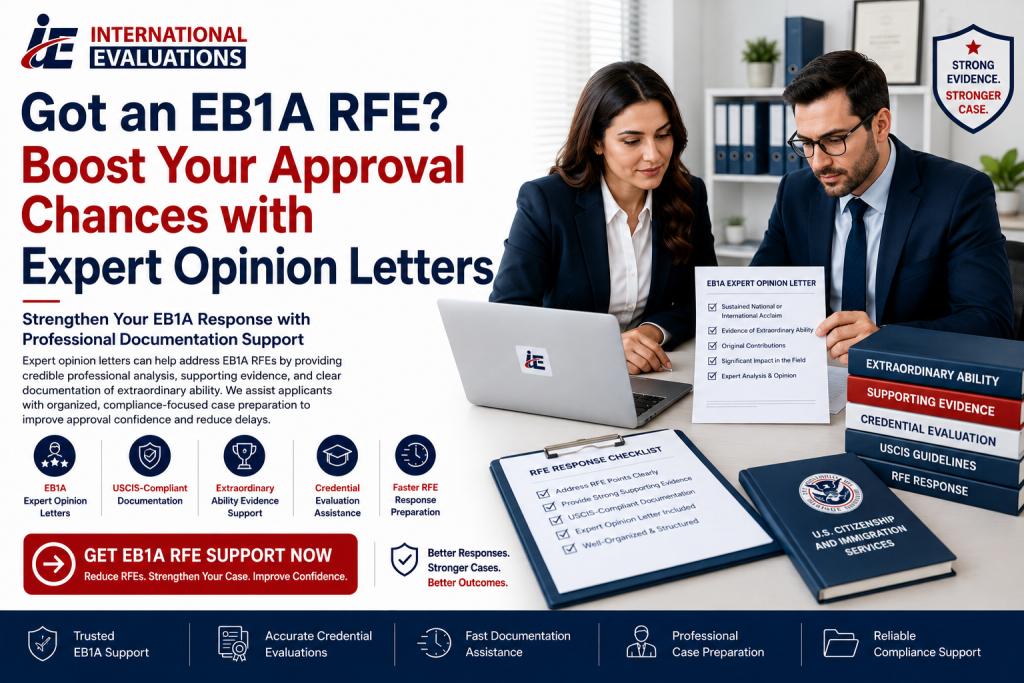
Getting a Request for Evidence (RFE) back on your EB1A green card petition can be stressful—but it doesn’t mean the end of your case. An RFE is a second chance. It is the USCIS offering you an opportunity to present additional, compelling evidence to prove your eligibility. Perhaps the best tool for responding to an EB1A RFE? A solid, well-documented expert opinion letter. At International Evaluations, we provide expert assistance for EB1A petitioners receiving RFEs. With a network of over 170 US-based professors from top universities like Harvard, Stanford, MIT, University of California system, Tufts, etc. in various academic, scientific, and commercial disciplines, we assist in the creation of authoritative letters that meet USCIS’s evidence requirements and improve your petition. Let us discuss the significance of an EB1A RFE, what it signifies for your immigration process, and how our specialist letters can make a vital difference. What Is an EB1A RFE and Why Is It Issued? The EB1A visa is reserved for people who show sustained international or national recognition in a specific field—science, arts, education, business, or athletics. Despite that, EB1A has a high standard of evidence, and USCIS issues RFEs frequently when the initial paperwork isn’t strong enough to establish qualification. Some common reasons for EB1A RFEs are: Insufficient evidence supporting major awards or recognition Incomplete documentation of original work Failing to prove authorship in academic articles Poor expert testimonies that lack field-specific analysis Overgeneralized recommendation letters that fail to meet regulatory standards This is where most petitions are failing. A strong RFE response needs to move beyond general support and meet specific legal and evidentiary standards of 8 CFR §204.5(h). The Role of Expert Opinion Letters in EB1A Petitions An expert opinion letter may be the foundation of an effective EB1A petition or RFE response. Expert opinion letters are used to: Interpret the petitioner’s work in the context of the profession Illustrate the originality and impact of the applicant’s work Clarify technical or sophisticated work in terms that are understandable and evaluative in nature Compare the applicant to others in the field Link accomplishment to regulatory EB1A criteria However, not all expert letters are created equal. Letters that are generic, uninformed, or written without insight into USCIS adjudication standards may be disregarded—or worse, damage your case. How We Can Help At International Evaluations, we’ve curated a network of 170+ subject matter experts across a broad spectrum of industries—life sciences, IT, engineering, arts, academia, entrepreneurship, finance, and more. Each expert is carefully vetted not only for their qualifications but also for their ability to analyze, evaluate, and articulate achievements in alignment with EB1A criteria. Our expert letters are Field-Specific: Written by experts from your field who can authoritatively discuss your work. Regulation-Focused: Crafted to meet the evidentiary burden under USCIS regulation. Detailed and Customized: We don’t employ templates or boilerplate text. Each letter is different. RFE-Responsive: Address each issue specifically raised by USCIS in your RFE, supported with data, metrics, and professional analysis. Our Process Is Simple and Client-Focused: Initial Consultation: The client contacts us for a consultation, and based on their background and needs, we help them select the most suitable professor from our expert network. First Draft for Review: We prepare and share a tailored expert letter draft for the client’s review. Unlimited Revisions: We offer unlimited revisions to ensure the letter aligns with both the USCIS standards and the client’s expectations. Full-Service EB1A RFE Response Support Writing an effective RFE response takes more than a good letter—it’s strategic case-building. That is why we go beyond expert letters. Our complete RFE response package offers: Detailed RFE Analysis: We analyze the RFE line by line to identify what USCIS is really asking. Consultation and Document Guidance: We walk you through collecting the most relevant and supportive documents. Custom Response Drafting: Our staff assists in drafting the complete RFE response, such as professional letters, credential assessments (if required), and lawyer-approved support statements. Timeline-Conscious Service: We process matters promptly and efficiently to assist you in meeting the RFE deadline. Whether you’re working through an immigration lawyer or filing on your own, we are your reliable backend support team—ensuring no element of evidence is absent, misrepresented, or misunderstood. Why Acting Promptly on an EB1A RFE Is Important RFEs have timelines—most have an 87-day deadline. The earlier you start preparing your response, the higher your chances of putting together a solid case. Delay can lead to rushed letters, overlooked details, or incomplete packages—all of which can risk denial. Most importantly, acting promptly provides time for specialist matching, review, and even a second edit if necessary. Success Stories and Testimonials We’ve helped hundreds of professionals—from research scientists and data engineers to artists and business leaders—respond successfully to EB1A RFEs. One recent client, a biotechnology researcher, came to us after receiving an RFE questioning the significance of her publications. Our expert crafted a targeted letter, drawing connections between her innovations and real-world applications in pharmaceuticals. Her petition was approved within weeks. Our clients consistently report: Increased approval chances Stronger confidence in their cases Positive feedback from attorneys and USCIS adjudicators For more client success stories and verified testimonials, visit our Google Reviews page: https://www.google.com/search?q=international+evaluations The Bottom Line: Your EB1A RFE is an Opportunity. Rather than seeing an RFE as a roadblock, think of it as your chance to amplify your achievements, with the right support. Expert letters are your voice when you’re not in the room. Let them speak with precision, power, and authority. At International Evaluations, we are here to guide you from uncertainty to approval. With 170+ of the best experts, full-cycle RFE response service, and a track record of success, we are your trusted partner in the EB1A process. Ready to Get Started? Call us today to request a consultation or start your EB1A RFE response. Email: info@internationalevaluations.com Website: www.internationalevaluations.com Call: +1 (510) 876-0900
Only 11 Days Left: Fast-Track Your H-1B Credential Evaluations Before the June 30th Filing Deadline!
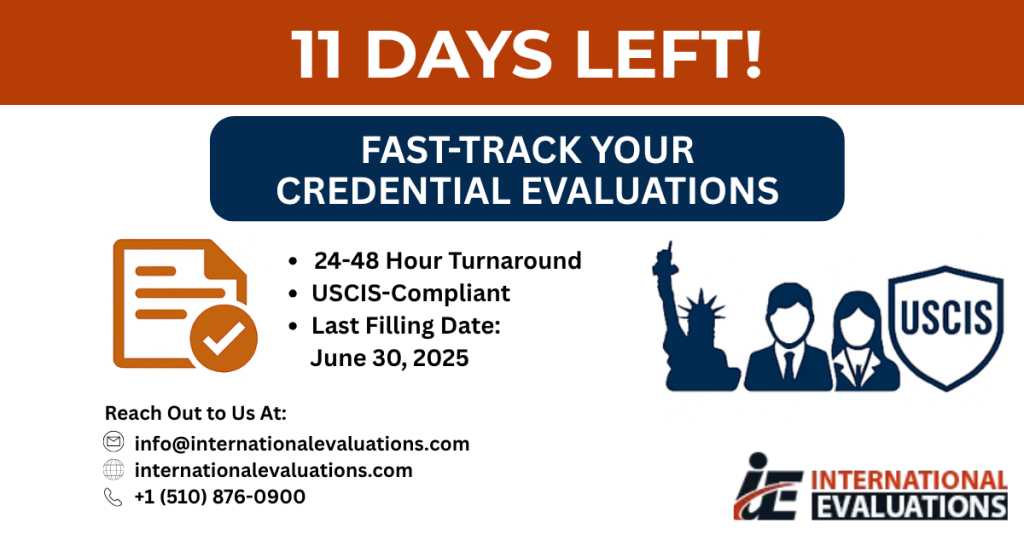
The final days of June are here, and so is the last call for H-1B petition submissions. As an immigration lawyer, employer, or international candidate, you know how Precise and detail-oriented the H-1B process is—especially in the final stretch. One of the most important, deadline-driven elements is the credential evaluation, which can either make or break a petition. At International Evaluations, we excel at quick, precise, and USCIS-conformant assessments, even under pressing deadlines, assisting you in filing confidently before June 30th. Why Time Matters The H-1B process is known for its Strict and documentation-intensive nature. Although the lottery process may be long over, successfully selected applicants have until June 30th, 2025, to file their final petitions. That includes all supporting materials—most importantly, credential evaluations for foreign degrees. Why Are Credential Evaluations Crucial? One of the most common reasons USCIS sends out RFEs (Requests for Evidence) is when they are concerned that the applicant’s foreign degree is not a U.S. equivalent in the same field. If the job title doesn’t directly reflect the degree—or if the degree is from an outside United States school—USCIS demands a credential evaluation to ensure its equivalency. Such an evaluation must be: Done by an accepted academic expert or agency USCIS, AACRAO, and DOL guideline-compliant in structure Very specific in validating the field of study, degree level, and applicability to the occupation How We Help—Fast, Reliable, and USCIS-Compliant At International Evaluations, we provide expedited H-1B evaluation services with a 24–48 hour turnaround, ideal for filing on short notice. Here’s what we offer: Education-Based Credential Evaluations We evaluate foreign academic degrees to see whether they qualify as the U.S. bachelor’s or master’s degree standard in the specific field needed for the job. Best for: Candidates holding foreign degrees in STEM, business, finance, etc. Non-accredited or lesser-known degree institutions Instances where the degree major and the job title do not directly fit Work Experience + Education Evaluations If the degree is not a perfect match for the position, we blend professional experience with educational background to demonstrate eligibility. As per USCIS guidelines, 3 years of relevant work = 1 year of academic study. Ideal for: Applicants with degrees unrelated to fields but rich career backgrounds RFEs that challenge the field of study Challenging roles in tech, management, or analytics that require adaptable backgrounds Expert Opinion Letters (Specialty Occupation Justification) When USCIS questions whether the job is a “speciality occupation” (i.e., one requiring a bachelor’s degree), we offer formal expert opinion letters written by U.S. university professors that describe why the job satisfies USCIS requirements. This is particularly useful for: Marketing, business analyst, or management positions New or hybrid titles RFEs based on job complexity Rush Turnaround—Without Sacrificing Quality We understand how it feels to be racing against the clock. That’s why we provide: 24–48-hour processing (rush service available) Evaluations by credentialed professionals and PhD-level faculty 100% USCIS compliance Free consultation and review to assist in selecting the appropriate Professor Who We Work With? o Immigration Law Firms o H-1B Sponsoring Employers o Global Staffing and Recruiting Agencies o F-1 OPT/CPT Students Converting to H-1B No matter the industry — tech, finance, healthcare, or education — we provide the evaluations you need when you need them. Why Choose International Evaluations? We’ve built our reputation around speed, quality, and USCIS compliance. Here’s what sets us apart: 24–48-hour turnaround (rush services available) 100% USCIS-compliant reports reviewed by academic experts Unlimited revisions until you’re completely satisfied Dedicated case managers for each file Proven success with difficult RFEs and last-minute filings Other Services We Offer: Expert Opinion Letters (H-1B, EB1A, EB2 NIW) RFE Response Assistance PERM Filing Assistance Certified Document Translations We are your full-spectrum partner for employment-based immigration needs! Take Action Now — The H-1B Deadline Is Approaching With just 11 days remaining, the time to start your evaluation is now. Delays or errors in credential assessments can ruin your whole petition — but with International Evaluations, you can move forward with confidence, speed, and expert guidance. Email: info@internationalevaluations.com Phone: +1 (510) 876-0900 Website: com Final Thought: In the high-stakes race of H-1B petitioning, don’t let an incomplete or inaccurate credential evaluation hold you back. Rely on International Evaluations to get you to the deadline with confidence, clarity, and compliance.
What You Need to Know About H1B Visa Extension or Renewal
The H1B visa is a non-immigrant visa that allows U.S. employers to hire foreign professionals in specialty occupations, typically requiring a bachelor’s degree or higher in specific fields like IT, engineering, finance, healthcare, or education. The visa provides an initial stay of up to three years, which can be extended to a maximum of six years, and skilled workers often use it to gain valuable career experience in the United States. The visa also offers a pathway for individuals to explore permanent residency options in the future. If your H1B visa is about to expire, you’re probably asking questions like: “How do I renew my H1B visa?” “What’s the H1B visa extension processing time?” “Can I stay in the U.S. while waiting for my H1B extension?” “How much does an H1B visa extension cost?” We understand these concerns can feel overwhelming. Let’s break it down into simple steps so you can navigate this process with confidence. What is an H1B Visa Extension? The authorities generally grant this visa for an initial period of three years, and they can extend it for another three years. When the initial term period is nearing an end, individuals under H1B can apply for an extension in order to stay in the US and continue working with minimal disruption. Note that you can renew an extension provided you qualify for your initial H1B status. This means you need to be working for the same employer or start a new job as long as the proper filings are in place. H1B Renewal vs. Extension: Is There a Difference? People often use the terms interchangeably, but there is a slight difference between renewing an H1B and extending it. H1B Extension: An extension of your visa while staying within the six-year limit. H1B Renewal: A renewal involves renewal and getting beyond the six-year limit on H1B status, especially after spending at least one year outside the U.S. or when the individual starts the Green Card process. H1B Renewal and Extension Processing Time The most frequent question from applicants is regarding H1B renewal processing time or H1B extension processing time. Regular Processing: It takes 3 to 6 months in regular processing. Premium Processing: Gives the timeline a head start to 15 calendar days, but with extra fees. Other factors that might affect the processing time include USCIS workload, the accuracy of your application, and any Requests for Evidence, if necessary. You would therefore need a complete and accurate application to reduce unnecessary delays. H1B Visa Extension Fees: Expectations The cost of an H1B visa extension in the US largely depends on the employer and the type of extension you are seeking. The standard fees include: Filing Fee: $460 (Form I-129) Fraud Prevention and Detection Fee: $500 (for first-time petition and some changes/extension) Optional Premium Processing Fee: $2,500 What Documents Do You Need for an H1B Visa Extension? You will need to collect a list of important documents for filing an extension, including the following: Current H1B approval notice (Form I-797) A photocopy of your passport; making sure it is valid for the extension period requested. Recent pay stubs and tax documents. Employment verification letter mentioning your job description and salary details. Degree certificates, along with the evaluation report, if available. International workers will need their educational credentials evaluated. Helpful credential evaluation ensures that your qualifications meet all the standards needed when applying for an H1B visa. Therefore, it’s a critical part of your case. Tips for a Smooth H1B Extension Process Plan in Advance: Do not delay. It is best to start preparing your documents and application at least six months before your visa actually expires. Stay Consistent: Be consistent in your job title, salary, and responsibilities to that of your original H1B petition. Any significant alteration may necessitate an amendment. Seek Professional Guidance: Whether its credential evaluation or navigating the red tape of USCIS requirements, seek guidance on what to avoid and common pitfalls. Stay Informed: Processing times and fee structures may change, so continue to watch for updates from USCIS. What happens to my H1B status after I file an extension? If you have filed your application, you can continue working with your current H1B status for up to 240 days while awaiting a decision. This is to cause minimal interruption to employment; however, keeping your employer aware of the situation and monitoring the status of your application is key. Accrediting Your Visa Application with Credential Evaluation Through the H1B process, credential evaluation is an essential step toward validating the overall credibility of your qualification. For those earning degrees from abroad, it establishes that your acquired education meets U.S. expectations. Correct and on-time evaluations when applying for an initial H1B or an extension help build more persuasive applications while showcasing expertise in their field. When is an Evaluation Required for H1B Visa Renewal? Changes in Job Role or Employer When you must transfer within a company and your duties have changed appreciably or there is a change of employer during the H1B extension process, you may require an evaluation to verify that your education credentials meet the requirements of the new position. That way, you are still working in a “specialty occupation,” an H1B visa requirement. Your Education Was Attained at a Foreign Institution If you had earned your degree outside of the United States, you may be asked to provide a credential evaluation to prove that the foreign degree is equal to the equivalent needed U.S. degree for your specialty occupation. This ensures that your credentials meet the standard requirements of the H1B visa. Change in Educational Credentials Whether you obtained further qualifications after your initial H1B approval, updated qualifications could be necessary to show the new qualifications and their applicability to the H1B job you are engaged in currently. Renewal post multiple extensions or long gap If it has been some time since your H1B visa was renewed-for example, if there is a gap in employment—it might require an evaluation to determine whether you
EB1A Expert Opinion Letter and RFE: How International Evaluations Can Help You Succeed
The EB1A visa, or Extraordinary Ability Green Card, allows deserving individuals to gain permanent residency in the US. A key part of the application is the Expert Opinion Letter, which highlights the individual’s achievements and qualifications. At International Evaluations, we specialize in crafting strong Expert Opinion Letters that enhance your EB1A petition and address potential challenges. Almost Unlawful Particulars of the EB1A Visa People who have gained recognition in fields like science, arts, education, business, or sports use this type of visa. However, applicants must prove that their work is ‘of distinction’ and ‘highly respected’ in their specific field to qualify. Benefits of this visa include faster green card approval and no need for employer sponsorship or labor certification. When applying for the EB1A, it’s important to submit a strong application, including a detailed Expert Opinion Letter, as required by USCIS. Importance of the Expert Opinion Letter in EB1A Visa Requirements An Expert Opinion Letter is a detailed review of the applicant’s skills and accomplishments, written by an expert in the applicant’s field. It’s more than just a document—it’s a valuable document that helps to show how the applicant’s work meets the EB1A and demonstrates the applicant’s achievements. Key elements of a good Expert Opinion Letter: Credibility: Written by a trusted expert in the applicant’s field who can fairly assess their work. Clarity: Explain in simple language how the applicant meets the EB1A criteria, with clear examples and evidence. Relevance: Highlights how the applicant’s work matters in the industry, showing the significance of the individual’s work. A well-written Expert Opinion Letter can make a big difference in the EB1A application by providing a clear evaluation that matches EB1A requirements. Common Reasons for RFE (Request for Evidence) Even with a strong application, applicants might receive a Request for Evidence (RFE) during the EB1A process. An RFE is a formal request from USCIS asking for more information to better understand the case. If you know why you get an RFE, it can help you avoid them. Not enough proof of extraordinary ability: The applicant may not have provided enough evidence to prove their national or international recognition. Unclear documents: If the evidence is unclear or does not directly support the application, USCIS may ask for clarification. Lack of supporting documents: If reliable sources do not back the claims made in the application, USCIS may issue an RFE due to the lack of supporting documents. A strong Expert Opinion Letter reduces RFE risks by highlighting achievements and addressing weak areas. How International Evaluations Can Help At International Evaluations, we understand the challenges of the EB1A process and are here to help you succeed. We provide full support for EB1A applications, with a focus on creating effective Expert Opinion Letters that meet USCIS standards. Our support includes: Expert Opinion Letters: We take the assistance of reputable specialists from different fields to make your letter convincing, persuasive, and acceptable to USCIS. RFE Prompt Response Assistance: Upon receiving an RFE, our personnel can assist you with ways to submit your application and respond to the additional papers that are requested in the RFE. Evaluation of Foreign Documents Services: We will also review your foreign credentials and employment in case you do not meet U.S. criteria, while the review also assists your application in a greater manner. At International Evaluations, we’ve helped many clients with the EB1A process and are ready to strengthen your green card case. Conclusion Getting an EB1A qualification is a major achievement for individuals with exceptional skills. An effective Expert Opinion Letter plays a crucial role in presenting your accomplishments and addressing any issues in the application. At International Evaluations, we dedicate ourselves to helping you achieve your immigration goals. Ready to improve your EB1A application? Contact us today to learn more about our Expert Opinion Letter services and how we can help you succeed!
Understanding the EB2 NIW Visa: A Complete Guide
What is an EB2 Visa? The EB-2 is an employment-based immigration visa that allows applicants to secure U.S. Green Card status. To qualify, applicants must have an advanced degree or exceptional skills. Additionally, individuals in the U.S. who seek to change their status to Green Card holders can also apply. What is the EB2 NIW Visa? The National Interest Waiver (NIW) is a U.S. immigration option directed towards EB2 visa holders. It uniquely enables applicants to achieve their objective of becoming a U.S. citizen without a job offer. However, it’s crucial to understand the key difference between EB2 and NIW. Specifically, EB2 applicants are required to have a job offer, whereas EB2 NIW applicants are not obligated to have one. This waiver eliminates the need for both labor certification and an offer of employment. EB2 NIW Visa Requirements General Qualifications for EB2 Classification Advanced degree or exceptional ability. Specific Requirements for the National Interest Waiver: Evidence of substantial merit and national importance. The applicant must be well-positioned to advance the proposed endeavor. The endeavor’s benefits for the U.S. must outweigh the need for a labor certification. Role of the Expert Opinion Letter for EB2-NIW An Expert Opinion Letter (EOL) is essential in the EB2 NIW petition process. It provides third-party validation of the applicant’s qualifications and contributions to national interests. The EOL is based on three main criteria: Endeavor’s substantial merit & national importance. Well-positioned to advance the proposed endeavor. The benefits for the U.S. outweigh the need for a labor certification. Evidence for an Advanced Degree: Copies of transcripts, diplomas, or degree certificates from accredited institutions proving completion of an advanced degree (Master’s, PhD, or equivalent). For those substituting a Bachelor’s degree with 5 years of work experience, progressive experience can also be considered. If using a foreign degree, an evaluation (Academic Evaluation, Academic and Experience-Based Evaluation, or Course-by-Course Evaluation) should be provided to confirm U.S. equivalency. Evidence for Exceptional Ability To demonstrate Exceptional Ability, applicants must submit at least three of the listed pieces of evidence showing that their knowledge surpasses that of counterparts in the field: A letter from a college, university, or institution confirming studies in a related field. Statements from experts in the field attesting to exceptional skills, knowledge, and contributions. Membership in professional associations. Evidence of published material about the applicant. Significant contributions to the field. Recognition for achievements and contributions. Evidence of high salary or compensation. Employment in key roles at top organizations, highlighting the applicant’s impact and expertise. The Application Process Begin by completing the I-140 form (Immigrant Petition for Alien Workers) and submitting all required materials. The typical processing time for the EB2 NIW is 10 to 20 months. Applicants should plan accordingly and prepare for potential delays. Paying an additional fee can reduce the processing time to just 45 calendar days through USCIS premium processing. The premium processing fee is $2,805. Success Stories and Testimonials EB2 NIW Approved for an Islamic Finance Specialist Background: We assisted a candidate in Islamic finance and banking who sought to expand his practice in the U.S. This individual specialized in Shariah-compliant finance, offering ethical, risk-free services that respect religious values. Challenging Part: The main challenge was proving that the candidate’s work in Islamic finance, which primarily benefits the Muslim population, could meet the EB2 NIW criteria. EB2 NIW applicants must show their work benefits the country, not just a specific group. While Islamic finance benefits Muslims, its immediate impact on U.S. financial systems may not be immediately obvious. However, its principles can significantly influence the broader financial landscape over time. Solution: To address this, we crafted an Expert Opinion Letter (EOL) that redefined the national importance of Shariah-compliant financial services. Instead of focusing solely on the benefits for Muslims, we highlighted the broader impact of ethical finance practices, emphasizing their positive influence on the financial industry. Key points included: Addressing unethical financial practices. Restoring public confidence in the financial system. Fostering financial inclusion. Outcome: By framing the candidate’s work as a national benefit, transcending religious boundaries, the EOL strengthened the petition. The emphasis on ethical finance and restoring public trust was pivotal in securing EB2 NIW approval. Key Takeaway This case demonstrates that even in specialized fields, applicants can highlight the broader national impact of their work. By focusing on the ethical challenges in U.S. finance and showing how Shariah-compliant services address them, we were able to showcase the candidate’s far-reaching contributions. Conclusion The EB2 NIW visa allows professionals, entrepreneurs, and researchers to obtain a U.S. green card without needing a job offer or labor certification. Moreover, it benefits individuals with advanced degrees or exceptional abilities who have made significant contributions to their fields. It is particularly advantageous for those whose work benefits the U.S. as a whole, fostering national growth. Our case study of an Islamic finance specialist demonstrates how strategically presenting expertise can lead to success in the EB2 NIW process. The Expert Opinion Letter (EOL) aligns the applicant’s qualifications with U.S. national interests and highlights their contributions to ethics in finance. Moreover, it emphasizes their role in enhancing public trust. International Evaluations is one of the top specialized evaluation service providers for numerous visa application categories, such as academic and experience evaluations, course-by-course evaluations, or Expert Opinion Letters for EB2 NIW petitions.
What is an Expert Opinion Letter, and Why is It Important for Immigration?
What is an Expert Opinion Letter? This letter is prepared by industry leaders or professionals with specialized knowledge in a specific field. It is used to support visa petitions, particularly when the applicant’s qualifications are specialized or don’t fit a standard framework. As the name suggests, this letter provides an independent opinion from an expert about your accomplishments, experience, and qualifications. It explains how they meet the requirements for the targeted visa. In other words, the letter can also be considered a professional opinion letter. Particularly, the Opinion Letter plays a crucial role because it offers USCIS insight into your profile from a qualified authority in your field. When is an Expert Opinion Letter Important? This Letter becomes essential in two main situations: Fresh Visa Petition: When submitting your initial visa petition, an expert opinion letter works as a supporting document that adds credibility to your claims. Since USCIS officers may not be familiar with every field’s specifics, the input from an industry expert helps clearly explain your qualifications. Response to a Request for Evidence (RFE): If USCIS issues an RFE, they are requesting additional information or clarification on specific aspects of your application. In this case, the Expert Opinion Letter becomes even more critical because it directly addresses the questions raised by USCIS, thereby strengthening your application. Why is an Expert Opinion Letter Important? Several visa categories require beneficiaries to demonstrate extraordinary or exceptional abilities. For these cases, Letter is vital in establishing the unique nature of the beneficiary’s expertise. The expert provides an independent opinion, affirming that the beneficiary’s credentials are indeed unique or extraordinary. This is required for various visa types, including EB-1A, EB-1B, EB-1C, EB-2 NIW, O-1, H-1B, L-1A, L-1B, and TN. What Does an Expert Opinion Letter Include? An effective Letter typically includes the following: Expert’s Qualifications: The letter should highlight why the expert is qualified to offer such an opinion. Evaluation of the Applicant’s Achievements: It provides specific examples of the applicant’s accomplishments and explains why they meet the visa requirements. Connection to Visa Standards: The letter should link the applicant’s qualifications directly to the requirements of the targeted visa, showing how they fulfill those standards. Reference to Supporting Documents: It may reference key documents that back the claims, such as awards, publications, patents, or work experience. Why Choose International Evaluations for Your Expert Opinion Letter? At International Evaluations, we work hard to ensure that our expert opinions meet USCIS’s standards and strengthen your application. With over 130 industry experts across various fields, we ensure that we connect you with the right professional who understands your specific industry. Our thorough evaluations will provide the detailed analysis needed for a successful visa application. Here’s what you can expect from our services: Complete Analysis: We analyze your qualifications in detail, ensuring that the letter directly addresses the visa criteria. Quick Turnaround: Time is essential, especially for RFE responses. We offer fast, efficient service to ensure timely submissions. Professional Quality: We take pride in producing high-quality letters that will stand up to USCIS scrutiny, improving your chances of visa approval. Expert Opinion Letter Cost At International Evaluations, we aim to offer affordable services without compromising quality. Typically, the cost for letters ranges from around $500. An Expert Opinion Letter is an invaluable tool for U.S. visa applications requiring extraordinary ability, professional achievements, or specialized skills. Whether for an initial petition or an RFE response, a well-crafted letter from a qualified expert is crucial. Conclusion At International Evaluations, we provide professional opinions that help strengthen the credibility of your application, increasing your chances of success. Contact us today to learn how we can assist you in navigating your move.