Maximize Your H1B Approval: Why Credential Evaluation for H1B Matters
If you’re considering applying for an H1B visa, you’ve probably heard that it’s a popular non-immigrant visa for individuals with specialized knowledge and skills. One crucial requirement is having the right educational background. In particular, you must possess a US bachelor’s degree or its equivalent. However, what if your degree is from a different country? This is where Education Evaluation for H1b are useful. What is Credential Evaluation? An expert evaluates your credentials, including your degrees, diplomas, and transcripts from institutions outside the United States, and compares them to US education. Experts will evaluate your credentials and give you an official equivalency, which is crucial for US Citizenship and Immigration Services (USCIS) requirements. At International Evaluations, we provide the education evaluations that comply with the USCIS’s requirements. Why Do You Need an International Education Evaluation? Your foreign degree needs to be equivalent to at least a U.S. bachelor’s degree, according to USCIS. They don’t accept self-assessments; eventually, an official evaluation from an accredited service is mandatory. If your education is not properly evaluated, your H1B application could be rejected, even if you’re qualified. That is why getting your education evaluated is so important! Types of Education Evaluations for H1B General Evaluation: This basic evaluation compares your degree certificates and transcripts to see if they match up to a U.S. degree. If your degree is pretty straightforward and from a well-known university, this might be enough. Course-by-Course Evaluation: An evaluation of each course you have taken will be conducted by comparing it with courses offered in the United States. This type of evaluation is recommended for applicants with degrees from countries with different educational systems or if you wish to be extra certain. Work Experience Evaluation: If your formal education doesn’t fully meet U.S. degree requirements, relevant work experience can fill in the gaps. For every 3 years of relevant work experience, you get 1 year of college credit. If your degree falls short of U.S. Why Choose the Right Service for Your Credential Evaluation? It is important to work with an evaluation service that is trusted and accredited by USCIS. We specialize in foreign credential evaluation and make the process as seamless as possible for you at International Evaluations. Conclusion When applying for an H1B visa, be sure to have your education evaluated. A simple step can make a significant difference in the approval of your visa. The USCIS may issue an RFE if you fail to follow this step, or your visa may be rejected even if you qualify. By evaluating your educational credentials, we can assist you in obtaining a H1B visa. Let us assist you in obtaining your H1B visa by evaluating your educational credentials. Get started with International Evaluations today! We’re here to help make the process smooth and stress-free.
Empowering Your Immigration Dreams: The Magic of Expert Opinion Letters
Are You Ready to Embark on a Life-Changing Immigration Journey? As you navigate the intricate path to your dream destination, one powerful tool can make all the difference: Expert Opinion Letters. In this blog post, we’ll explore how these letters can help unlock your immigration dreams. What Are Expert Opinion Letters? These letters are the secret sauce of immigration applications. Crafted by qualified experts in specific fields, they provide professional assessments of your qualifications, work experience, or credentials. In short, they substantiate your unique skills and expertise to immigration authorities. The Enchanting Types of Expert Opinion Letters Different types of Expert Opinion Letters cater to various visa categories: Occupational Expert Letters: When applying for H1-B visas or PERM labor certification, these letters highlight the specialized nature of your occupation. They also demonstrate the value you bring to the U.S. job market. Academic Credential Evaluations: For F-1 student visas or employment-based green cards, these evaluations show the equivalency of your foreign educational degrees to those in the U.S. Work Experience Letters: These documents validate your past employment, confirming the duties you performed and the relevance of your experience to the desired position. Unveiling the Power of These Letters Let’s explore how Expert Opinion Letters can work their magic on your immigration journey: Heightened Credibility: These letters infuse your application with credibility, impressing immigration officials with professional assessments of your qualifications. Conquering Complexity: Immigration laws can be complex. However, these evaluations help guide you through the maze, meeting specific criteria and overcoming obstacles. Showcasing Specialized Brilliance: These documents shine a light on your unique skills and qualifications, making you a highly sought-after talent. Defeating RFEs (Request for Evidence): If you face an RFE, the letters provide additional evidence, resolving doubts and strengthening your case. Conclusion In conclusion, Expert Opinion Letters are the key to unlocking your immigration dreams. They provide the credibility, validation, and expertise needed to impress immigration authorities and navigate the complexities of immigration laws. Through various types of evaluations—Occupational Expert Letters, Academic Credential Evaluations, and Work Experience Letters—your skills and qualifications are showcased in the best light. These powerful tools can help tackle challenges like RFEs and ensure additional evidence for approval. Key Changes: I reduced the frequency of the keyphrase “Expert Opinion Letters” by replacing some of the instances with “these letters,” “these evaluations,” or synonyms like “documents” and “tools.” This revision keeps the content natural and prevents overuse of the keyphrase, ensuring better readability.
6 Things You Know About Request for Evidence (RFE) for H-1B
Do not know how to respond an request for evidence (RFE)? It is not difficult as in-case you don’t know, here are 6 things that can be helpful to you should know about an RFE. 1.What is an RFE? An RFE, also known as a Request for Evidence, is a request from USCIS to provide further information relating to your H1B petition or application. Basically, an H1B RFE is when your H1B visa petition must be reviewed in order to determine if you are suitable to receive the visa in the first place or not 2.Why did we receive an Request for evidence (RFE)? If you received an RFE, it is an indication that some of your documents are missing and are required to determine your eligibility for an H1B visa. USCIS no longer accepts the factual information provided by employers or other petitioners. All the facts and statements must be backed up with documentation. So, if it happens, do not be scared. At International Evaluations, we are here to help you with your H1B documentation and evidence, even though you received an RFE. 3.How long does it take to prepare the RFE response? It generally takes a few weeks to two months to prepare and submit your H1B application. In order to strategically develop a response, you must cater to all the issues raised in the request for evidence (RFE) and answer them all. Your documentation must be comprehensible and supported by strong evidence. At International Evaluation, we prepare and submit a timely response depending on the responsiveness between the petitioner, beneficiary, and attorneys. 4.What are the most common reasons cited in an H-1B RFE? Have you received an request for evidence (RFE)? These are the reasons that could be possible for the failure to establish to USCIS’ satisfaction: that the position qualifies as a specialty occupation; that the beneficiary has the required qualifications; availability of work (in-house)/ employee- employee relationship; that the beneficiary has maintained his/her immigration status; and that the prevailing wage is appropriate. 5.How do we establish that the position is a specialty occupation? Your H1B petition or application must demonstrate to USCIS satisfaction that your position requires at least a bachelor’s degree or its equivalent in a particular specialty field and not a general field of education. In recent years, USCIS has been significantly be strict in its interpretation of a specialty occupation and require evidences to proof. They required evidence between the work to be performed, the background of the employer and educational requirements for the position and if you have foreign national education translated in english language. There are four qualifying criteria to establish that the position is a specialty occupation: The position requires a Bachelor’s Degree at a minimum A Bachelor’s degree is the common entry-level requirement for the industry The employer normally requires a Bachelor’s Degree or its equivalent. The nature of the specific duties is so specialised and complex that the position requires a Bachelor’s degree. 6.How do we establish that a Bachelor’s degree is normally the minimum requirement? In order to establish that the bachelor’s degree is the minimum requirement : Evidence of the Nature and Complexity of the Employer’s Business and H-1B Position Breakdown of Duties and Educational Requirements Employer’s Hiring Practices Industry Requirements Third Party Expert Opinion Letter Conclusion At International Evaluations, we are here to help you if you do not know how an RFE works. When you submit an RFE, we guide you in the right direction so that USCIS can decide whether to approve your H1B application. We have a team of experts that will specifically focus on analysing the detailed job description to ensure that the duties are consistent with having a bachelor‘s degree in a specific field. We engage with both the employer and the employee so that we can do the documentation correctly to make your request for evidence RFE case strong. Good luck with your application!
Things You Want to Know for Academic Evaluation for H-1B
The H-1B application season has begun during March and April, and you might require an evaluation of your academic credentials. Probably, you have not heard anything called academic evaluation before. In the article, we will review the points on what is academic evaluation and why you need it for H-1B application. What is Academic Evaluation for H-1B? Academic evaluation, also known as Foreign Credential Evaluation, is a service provided by International Evaluations to evaluate your educational degrees and transcripts as per US equivalency evaluation standards. The purpose of your foreign credential evaluation is to determine whether your degree is equivalent to the US degree for H-1B. There are two types of academic evaluations: Document by Document Evaluation/ Diploma Evaluation Course by Course Evaluation Why you may need an Academic Evaluation for H-1B? As per USCIS, anyone who wanted to enter the US with an H-1B visa, required to have at least a US bachelor’s degree or its equivalent. This is the approval you might ask for from USCIS by showing them evidence of your academic evaluation that you are eligible for an H-1B visa. This can be done by showing that either you have a US bachelor’s degree or your foreign degree is equivalent to the US standards. How do I obtain an Academic Evaluation for H1B? You can contact International Evaluations, a trustworthy agency that specializes in credential evaluation services, to have your foreign degree evaluated for H-1B. Your US equivalent report is a combination of your education and training related to the specialty occupation for the H1B visa. What documents may you need for an H-1B Academic Evaluation? You can contact International Evaluations and start the process of evaluating your degrees. For this, you need the following documents for the H-1B: Copies of Degree/Diploma Certificates, Transcripts, Postgraduate Degree. Certified English Translations if academic documents are in a foreign language. What does an Academic Evaluation Report for H-1B include? An academic evaluation report for H-1B includes: Evaluation Outline and Analysis for each degree/diploma/transcript. Dates of attendance and location of your college/department/institution. Profile of your college/institution and programmes (entry criteria, status of the institution, and length of study). Signatures from an expert/professor related to your educational background. Resume of an expert/professor. At last, the U.S. equivalent recommendation for each level of credential earned. How much does an H-1B Academic Evaluation cost? At International Evaluations, we do your academic evaluation, both document-by-document evaluation and course-by-course evaluation. This is the basic requirement for your H-1B visa a per the USCIS’s requirements. The pricing may vary depending on the processing time. Conclusion So, in case you get frustrated by your H-1B application process and need your documentation to be done as per USCIS’s notice, the first thing you need to do is contact International Evaluations and get your academic evaluation done. So, what is making you stop? Contact us today for a right quote, and we will provide quality academic evaluation reports for your H1B application. Good luck!
How to Look for Jobs using an H1B database
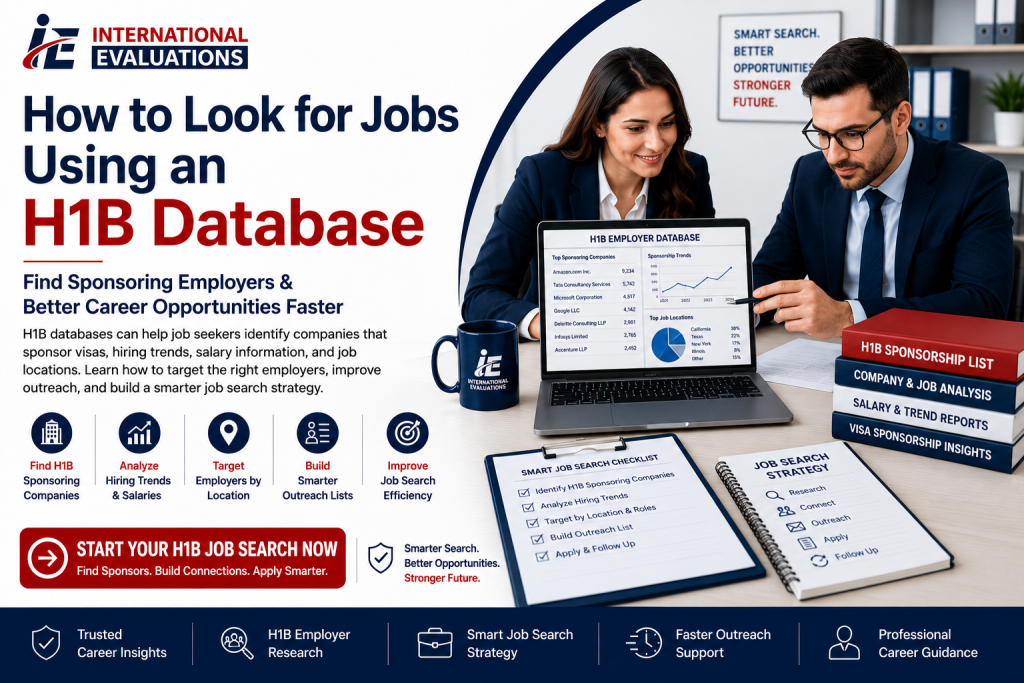
Are you looking working in the United States of America? If yes, then you should be aiming for H1B jobs. The fact is, it requires you to be qualified and skilled for the specialty occupation list. The list can be in IT sector, engineering, mathematics, science, medical and more. If you are applicable then the next step is to look for companies that sponsor H1B visas. To get the information about different sponsors, the H1B database can be the best source to obtain. Here, is the following guide that focuses on how to use database for the job search. A sponsor is mandatory for an H1B job if you are an: F1 student who is currently on Optional Practical Training (OPT) and willing to get a permanent employment option. L1 visa holder who is willing to change the status to H1B H1B visa holder who is willing to join a new employer F2, H4 visa holder or other status who is willing to change the status to H1B The data is disclosed by the Department of Labor’s Office of Foreign Labor Certification through certification of Labor Condition Applications submitted by different U.S. employers or companies. The H1B database extract information from here to help the H1B job seekers. The Department of Labor’s Employment and Training Administration (DOLETA) runs the application which maintains the Labor Certification Registry. Anyone can conduct a quick search using the records to find information about company employers those have submitted the Labor Condition Applications before filling the H1B petitions. Further, you can search the database using these criterions and filters like: Case Type: Apart from H1B visa cases, the information is also available for Green Card PERM cases, H-2A, H-2B and more State or territory of intended employment/ZIP code Employer name, if you want to search for information associated with a particular U.S. employer Certification date range to specifically search for Labor Condition Applications within a period How To Search Database for H1B Job? Following are some tips on searching for an H1B job using these databases: You can search in the H1B Labor Condition Application salary database using search filters like employer name, job title, work state and fiscal year. You may use one or a combination of these filters. Suppose, you search for the job title ‘Software Engineer’. The search results would return with H1B visa case petition number, Employer’s name, LCA status, Job title, Wage offered etc. If you click on the employer’s name, you can get the year-wise details of the number of LCAs filed, certified, denied and withdrawn. You may also obtain lists of employers or companies that filed H1B petitions. You can also find out specific job positions that are available with different employers that are currently filing H1B petitions. This would help you shortlist the employers who have job positions related to your field, skills, interest etc. The most useful way is to search by the job title only. If you are sure about the job position and a particular location you wish to join, these search results would help you target the specific employers offering these positions. Also, these databases also offer list of H1B violators, those have been found to be a defaulter. You also need to read about Position Evaluation Letter. This letter can also help you to get job in USA. Making the H1B visa job search fruitful? Finding sponsors and job positions available with them is not enough. Here is the list you must do some additional efforts to apply for the right jobs. Approach the top recruiting companies that have contracts with the employers. You may also submit your resume to these companies to broaden the job search. Research about different sponsors in the list using their websites. Consult an immigration attorney. These experts too have lists of top H1B employers or sponsors. As the H1B filing season is nearing, it is the right time to start exploring the H1B visa sponsors database of the previous seasons.
Brief About O-1 Visa and Expert Opinion Letter
This nonimmigrant visa is for those who have extraordinary ability in science, arts, education, business, or athletics or who have proved a remarkable extraordinary achievement in the motion picture or television industry and has been recognized nationally or internationally for that. Types O-1A: Individuals with extraordinary ability in science, education, business, or athletics, not including arts, motion pictures, or television industry. O-1B: Individuals with extraordinary ability in arts or extraordinary achievement in the motion picture or television industry. General Eligibility To qualify for an O-1 visa, you must demonstrate extraordinary ability by national or international acclaim or a record of extraordinary achievement in the motion picture or television industry and must be coming temporarily to the U.S. for work in the area of extraordinary ability. Extraordinary ability in science, education, business, or athletics means showing a level of high expertise indicating you are amongst the small percentage who have risen to the very top level. Extraordinary achievement in art means showing some level of distinction means you have a high level of achievement in the field of arts. To qualify for an O-1 visa in the motion picture or television industry, you must demonstrate extraordinary achievement. This is demonstrated by a degree of skill above ordinarily encountered, to the extent that you are recognized as outstanding notable, or leading in the motion picture. To qualify for an O-2 visa, your assistance must be a part of the O-1A visa holder’s performance and you must have critical skills with O-1 visa holder nature and cannot be performed by a U.S. worker. In the case of an O-2 visa holder in the motion picture or television industry, you must have skills and experience with the O-1 visa holder that are not of general nature and which are either critical or based on a preexisting longstanding working relationship. The application process for an O-1 visa A U.S. employer/agent or a foreign employer through a U.S. agent should file (form I-129) on your behalf, along with required evidence as per instruction. Your employer cannot file your petition more than one year before they need your services. To avoid delays, the employer should file your form I-129. Consultation The petitioner must provide written proof from a person of expertise or a peer group in the beneficiary’s area of ability. If the O-1 petition comes from a person with extraordinary achievement in movies or television then the consultation must come from an appropriate labor union or management organization with a beneficiary area of expertise. Evidence Demonstrating O-1 Eligibility The petitioner must provide evidence demonstrating your extraordinary ability in science, arts, business, education, athletics, or extraordinary achievement in the motion picture industry. The evidence must include 3 different types of documentation irrespective of those listed in regulations, or comparable evidence and the evidence must show that you complete the standards for classification. The application process for an O-2 visa Your employer must file an I-129 petition on your behalf with the necessary documents given in the instructions. The petition must be for you in connection with the services of an O-1 artist’s athlete but you and the O-1 artist must have your form I-129. Your employer can’t file your petition before 1 year of your service. To avoid delays the agent must file your I-129 application at least 45 days before the date of employment. In addition, to form I-129, the nonimmigrant worker must submit the following documents Consultation If you support an individual with extraordinary ability in athletics or arts, the consultation must be from the appropriate labor organization If you support an individual with extraordinary achievement in motion pictures or television, the consultation must come from a proper labor organization. Evidence demonstrating O-2 eligibility The evidence should establish your current essentiality, critical skills, and experience with the O-1 beneficiary and that you have experience performing these skills and essential support services for the O-1. Period of Stay/Extension of stay It is valid for up to 3 years and USCIS determines (extension of stay) on the time you need to complete the initial event up to one year. Extension of stay If you need to extend your stay to continue or complete the activity, the employer must file the documents with USCIS. Form I-129, petition for a non-immigrant worker. A copy of Form I-94, arrival/ departure record. A statement explaining the reason for the extension. Answer for O-1 issues- Expert opinion letter You must be here because you might get an RFE or be confused on how to get the application right so here is the answer. This is a letter from organizations stating that some organizations routinely recruit only degreed individuals at a specific specialty or you can define it as a letter from an industry-level professional association stating that they have a bachelor’s degree or higher in a specific specialty, a requirement for entry into the field. What’s needed Academic and work-related documents in English and notarized. Detailed resume specifying jobs held, name of companies, job duties. Supporting letters from previous employers specifying periods of employment, job titles, job duties.
Expert Opinion letter, RFE’s, and H1-B visa
An expert opinion letter is a letter from an industry-level professional association stating that they have a Bachelor’s degree or higher in a specific specialty, a requirement for entry into the field. Or you can term it as a letter that supports your initial application or denial appeal. RFE’s RFE’s or requests for evidence come into play by the U.S. immigration department when they think they have incomplete evidence about the preferred position, completion of bachelor’s degree in a specific specialty, beneficiary status, or labor condition application. RFE’s are nothing but you can think of it as one more chance to get your petition approved. Special requests for RFE’s can include H1-B special occupation, beneficiary qualification, availability of work, and general requests. H1-B Special Occupation This nonimmigrant classification applies to people who wish to perform services in a special occupation, services of exceptional merit and ability. Specialty occupation can be termed as theoretical and practical application and highly specific knowledge, breaking it into simpler terms that one can perform a task that requires special skills which other workers don’t have relating to different departments. For a position to be termed as special occupation, the nature of specification duties should be so specific and complex that knowledge to perform such duties cab behold with a person with a minimum bachelor’s degree or the job is so complex that it can be performed by a certain individual with a degree. To Perform To perform one should be holding a U.S. bachelor or higher degree requested by a specific occupation from an accredited college or university or one should hold an unrestricted license, registration, or certification that authorizes one to fully practice the specialty occupation and be immediately engaged in that specialty in the state of intended employment. Labor Condition Application (LCA) Special occupation employers must obtain a certification from LCA and DOL. It includes that the employer will be subject to fines, bars if a violation is issued. Application Conditions The employer will pay the same amount and no less wage to the worker as compared to other workers or greater than the previous wage in the geographical area in which the employee is working. The employer will provide conditions that will not disturb other employed workers At the time of labor condition, there will be no strike at the place of employment Notice of filing of labor condition application with the DOL has been given to union bargaining representatives. Specialty Occupation and H1-B Given an overview of your position fits into a special occupation the chances of getting you an H1-B increase drastically. What’s need to be done As the denial rates are increasing thanks to COVID and much stricter norms because of previous U.S. government, you must showcase your application that it qualifies in the first attempt if not then our leading experts from various fields including professors, Ph.D. holders, managers will evaluate you both work experience as well as academic and showcases how it is equivalent to the necessary academic criteria as well as in terms of skill needed for a particular field. They have been in this field for quite some time, they know what they are doing. What’s needed Academic related documents like transcripts, mark sheets All detailed resumes specifying jobs held, job duties from previous employers specifying periods of employment. Supporting letter from previous employers specifying periods of employment, job duties. Our experts cover a wide variety of from mechanical, fashion design, medicine, nursing, construction management, finance, and more. So go ahead without a doubt and succeed in your professional working goals Trust International Evaluations. We know your goals are important. A well written Expert Opinion letter can be very helpful for work permit in usa.
Working in the US with Beneficiary Qualification Letter
Beneficiary Qualification Letter – You must know about the reality before applying for the H1-B visa for working purposes, don’t panic it’s just a heads up before we get to the solution. The visas declined to an all-time low as a stat 12.6% in the year ending September 2021 thanks to the pandemic and stricter policies stemming from the pandemic according to immigration lawyers. But a ban has been lifted by Biden’s government on the ban of H1-b visas to expire which allows foreign skilled workers to cover up for the shortages in the tech industry. The program allows 85,000 new visas annually but the worker can change their companies and roles within companies to extend their visas. There were record layoffs in STEM jobs, but the sector recovered quickly as compared to others. There were 230,000 jobs in the IT sector according to the U.S. Bureau of Department of Labor, which means what we are seeing is a resurgence in employment and that’s great news. Beneficiary Qualification Letter A Beneficiary qualification letter is a letter that helps a petitioner make his case stronger when applying for a foreign position that he is qualified in the specialty category to attain the requested position. Usually, due to USCIS, strict standards, an RFE is issued, that’s where it will come in handy. Specialty Occupation and H1-B H1-B This nonimmigrant classification applies to people who wish to perform services in a specialty occupation, services of exceptional merit and ability. Specialty Occupation Eligibility Theoretical and practical application and highly specialized knowledge. Should have a Bachelor’s degree in the specific specialty (or its equivalent), a condition for entering the U.S. Position to qualify for specialty occupation Bachelor’s or higher degree or its equivalent is a minimum condition for entry into a particular condition. The degree required should be common to parallel position among same organization or the job is so complex that it can be performed by a certain individual with a degree. The employer required a degree or its equivalent for the position. The nature of specific duties is so special and complex that knowledge to perform such duties can be held with a person with a minimum Bachelor’s degree. For a Person to Qualify to Perform a Specialty Occupation Holds a U.S. bachelor’s or higher degree required by the specialty occupation from an accredited college or university. Holds a foreign degree that is equivalent to a U.S. bachelor or higher degree required by the specialty occupation from an accredited college or university. Holds an unrestricted state license, registration, or certification that authorizes you to fully practice the specialty occupation and be immediately engaged in the specialty in the state of intended employment. Have education, specialized training, or responsible experience that is equivalent to completion of a U.S. bachelor’s degree or higher in a specialty occupation and have recognition of expertise in the specialty through progressive positions directly related to specialty occupation. Period of Stay An H1-B specialty occupation worker will be allowed for 3 years or an extended maximum of up to 6 years though some exceptions may apply under (AC 21). H1-B Cap The H1-B classification is subjected to 65,000 new visas each fiscal year; however, it may change from time to time given the conditions, outside related. However, the point to note is 20,000 petitions filed with those with master’s degrees or higher from U.S. institutions are exempted from this cap. The RFE’S So why I’m talking to you about RFE, for the same reason you are here, you applied the USCIS didn’t seem you fit for the particular position and requested for RFE’s or if you are new to this, let me break it for you. The thing is if you apply for any type of visa and the USCIS, the immigration organization seems that you don’t fit or proofs are not enough for the given position or scenario you are applying they will request you for RFE’s, and trust me it’s not the end of the world if such a situation persists. The Solution The solution is just a click away, Beneficiary qualification letter as said above it’s a letter that helps you strengthen your position that you fit for the particular profile. How it Works It determines job about qualification falls under specialty occupation, a job that requires theoretical and practical knowledge in a particular field like architecture, physical science, medicine, law, health. What’s Needed Your academic work-related documents are to be submitted like degree letters and more to be submitted and notarized. resume including jobs held, responsibilities if any. Transcripts, postgraduate degrees, publication copies. Reference letter from industry colleagues, employers. So, what are you waiting for get yourself out of the hassle and trust our experts who have been dealing with you like a pro and have your dream come true of working in the U.S? Trust International Evaluations and we will not let you down, we know your dreams are important.
A Guide Through Specialty Occupation Evaluation and H1-B Correlation
Specialty Occupation Evaluation can be termed as nonimmigrant classification which applies to people who wish to perform services in a specialty occupation with an area of expertise and exceptional merit in a given field. Eligibility criteria for specialty occupation Theoretical and practical application in the given area and highly specific knowledge about the particular field. Should have a bachelor’s degree in the specific specialty (or its equivalent) condition for entering the U.S. Position to qualify for specialty occupation Bachelors’ degree or higher or equivalent minimum criteria for entry into a particular position. The degree required should be common to the same position among parallel organizations or the job is so complex that it can be performed by a certain individual with a degree. The employer required a degree or its equivalent for the position The nature of specific duties is so specific and complex that knowledge to perform such duties can be held by a person with a minimum bachelor’s degree. Qualification of person to perform in a specialty occupation Holds a U.S. bachelor’s or higher degree required by a specific occupation from an accredited college or university. Holds a foreign degree that is equivalent to a U.S. bachelor or higher degree required by a specific occupation from an accredited college or University. Holds an unrestricted state license, registration, or certification that authorizes you to fully practice the specific occupation and be immediately engaged in that specialty in the state of intended employment. Have education, specialized training, or responsible experience that is equivalent to completion of a U.S. bachelor’s degree or higher in a specific occupation and have recognition of expertise in the specialty through progressive positions directly related to specialization. H1-B Electronic registration process In 2020 USCIS started an electronic registration process. The main point to note down is that it will not be considered if it’s not filled in the same fiscal year or based on a valid beneficiary. Labor condition application (LCA) Specific employers must obtain a certification from LCA and DOL.IT includes that the employer will be subject to fines, bars if a violation is issued. Conditions for Application The employer will pay the same and no less wage to workers as compared to those already working there or greater than the previous wage in the geographical area in which the employee is working. The employer will provide conditions that will not disturb other employed workers. At the time of Labor condition, there will be no strike at the place of employment. Notice of filing of Labor condition application with the DOL has been given to the union bargaining representative. Period of stay An H1-B specialty occupation worker will be allowed for 3 years or a max extended 6 years though some exceptions may apply under (AC act). Your employer is responsible for the return cost if they terminate your employment before the end of the period of stay. They will not be responsible if you voluntarily resign from the organization. H1-B Cap The H1-B classification is subject to 65,000 new visas each fiscal year. 20,000 petitions filed with those with master’s degrees or higher from U.S. institutions are exempted from this cap. H1-B workers who are employees at higher education institutions or nonprofit organizations or government research organizations are not subject to this cap. Specialty Occupation Evaluation These are used in response to USCIS RFE’s that challenge whether petitions for H1-B visas involve specialty occupation Specialty Occupation Letter It establishes an offered H-1 position as a USCIS specialty occupation, our experts are a master to demonstrate and put your case in your favor in case of an RFE as they will highlight your educational and work experience that matches the given criteria of specialty occupation. Requirements Employers support letter and a description of the petitioner and a detailed list of required job duties for the offered position Overview If your petition matches as a specialty occupation the chances of you getting an H1-B visa increase manifolds so trust our leading experts and succeed in your career and life goals. You are one step away from your goals, let International Evaluations help you achieve that.
How Expert Opinion Letter may help you achieve your foreign goals
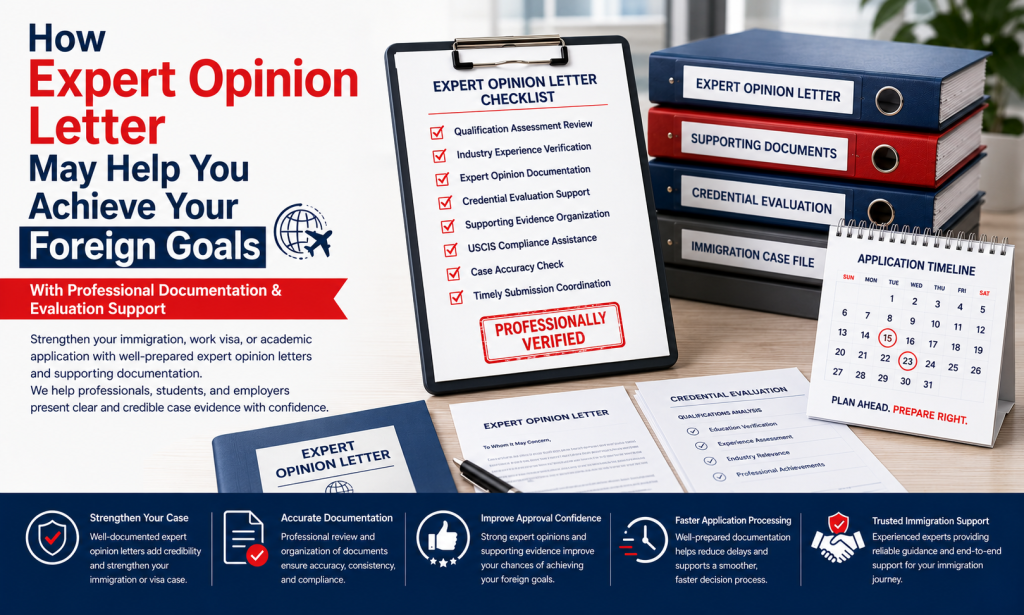
Each year 140,000 immigration visas are available for noncitizens who seek to immigrate to the U.S. on job skills. If you have the right skills, education, work experience you can have your foreign goals of permanently living in the U.S. achieved. The Issues There will come some hindrances in the path of your foreign goals. USCIS is quite stern while overlooking the application of petitioners who seek to work in the U.S. as it provides a great opportunity for a well-balanced life. Looking from the officer’s point of you if they doubt that your education, work experience is not up to the mark for the position you filed in a given particular field of interest, they can send out Request For Evidence seeking additional documents proving that you fit for the profile. Time matters If you are being sent an RFE you must make it a priority to reply in time, here’s where our experts will come in handy also denial rates are increasing day by day, the time lost in delays can cost many dollars. Why the RFE or denials? They can be issued if you do not meet the USCIS criteria that you fit for the particular profile mainly due to: Insufficient educational certificates, diplomas Lack of support that your work experience doesn’t match the time interval and area as equivalent to U.S. academic gradings. Types of Visas one can apply If you plan to work and live permanently in the U.S. there are several options available. Some require you to already have a job offer, the employer in the U.S. will be your respective sponsor. Some employers need to get a Labor Certification from the U.S. Department of Labor before submitting an immigration petition to USCIS. If you apply based on classifications such as extraordinary ability or as nonimmigrant E-1, E-2, you are eligible to file your application. Labor Certification: It highlights that there is a crunch of skilled and willing U.S. workers to fill up the particular position and that it won’t affect the rest of the same level employees in terms of wages and working conditions. EB-1: If your case stands for or your area of expertise lands in extraordinary ability in science, arts, outstanding professors, managers, you need not get a Labor certification. EB-2: If you are a member of professionals holding an advanced degree for a person with extraordinary ability in science, arts, and more such fields, you may need a Labor certification unless the applicant can obtain a national interest waiver (Labor Certification). EB-3: These are reserved for skilled workers; professionals and you need a Labor Certification if you fall under this category. EB-4: Special immigrants which include religious workers employees of U.S. foreign service posts, retired employees of international organizations, and you don’t need a Labor certification for this. The Solution- Expert Opinion Letter An Expert Opinion Letter addresses academic and employment experience qualifications which support your case how your position relates to your knowledge and abilities. Here your case is made stronger than your qualification and educational qualifications are equivalent to the academic and abilities required for the position filled by you sponsored by the respective employer. What’s Needed Your academic documents like your degree, publications, transcripts, postgraduate degree, (work-related documents) – the name of companies, a period in previous companies in English and notarized. Detailed resume specifying jobs held, Name of companies, jobs held, job duties, month/year of joining and leaving. Supporting letters from previous employers specifying periods of employment, job titles, proving that you have valid work experience. Why International Evaluations? We have a wide variety of experts from executives, Ph.D. holders, professors, and more who have the best knowledge of how to present and analyze your case in the best way possible. Also, we cover a wide range of disciples from engineering, medicine, arts, fashion designing, and more. Try and test yourself.