A Guide through H1-B RFE (Request for Evidence)
An RFE stands for Request For Evidence, this is issued upon by USCIS (US Citizenship and Immigration Services) mainly due to lack of primary evidence issued by the petitioner (employee). RFE for H1-B Visas Usually, people come into panic mode when an RFE is issued, just put it simply that your application is not rejected and is being considered that you give required or satisfactory proofs required for an H1-B visa. USCIS is stern considering the H1-b visa policy, especially when under Trump Administration, so if an officer feels that the proofs are not enough, they will send out an RFE. Why RFE (Request for Evidence) is issued? There are many reasons why an Request For Evidence is issued, some of them are as follows: Work experience proofs, not enough: When considering an application for an H1-B visa, the officer takes notes that your work and academic proofs should be equivalent to the requirement for a particular position if they seem like something missing like academic proof like a diploma, they can issue an RFE and more such cases related to academic proofs. Relation between employee and employer: The proofs can be asked that there is valid relation between employer and employee such as that the employee reports to a specific manager who works in the company and that the company where he works and who has filed the petition are the same. Specialty Occupation: This comes in very handy if the officer doubts that the given petitioner doesn’t qualify theoretically and practically for that particular role, they can have this up against for sending out an RFE, you should provide enough proofs that you have a specialization for the given position by handing out documents from previous employers, mark sheets in area of position and experience proofs in the same area as applied. There is a deadline! When the RFE is issued, a period is given to hand out documents, usually 60-90 days. The point to be noted is that you should start counting the days when it was issued and not when you received it. Also, if you travel extensively, you should have a backup because you do not want to miss an RFE, if You do miss the deadline your application is most likely to be rejected. You must meet the deadline otherwise the organization will consider it as abandoned and in which case it will most likely come out as a denial. What you can do Expert opinion letter An expert opinion letter is an evaluation done by an expert/professor, it’s a combination of academic, experiential credentials and evaluation of a candidate in context to a specific visa category usually H1-B. Our expert will take into account your experience and academic qualifications and put that in a way to issue a degree equivalent as per USCIS regulations. Our experts will take into account the work responsibilities, position, time interval of occupation, and issue an academic equivalent as per USCIS standards and will be accompanied by expert credentials that they have the authority to grant University-level credits. What’s needed? Resume detailing jobs held, responsibilities, ethics letter, the time interval at the given position. Reference letters from previous companies verify that you have valid work experience from that particular organization. Academic records, university transcripts, and English translation of all the documents. Conclusion The H1-B visa is most likely to be issued if you have a specialist occupation, that you fit for that profile given your experiences and academic background so don’t go for any other positions rather than your area of specialty. You can go ahead with International Evaluations experienced experts if you get into this scenario. We have experts who can handle Request for Evidence.
How To Avoid RFE in Marriage Based Green Card
An Marriage Based Green Card RFE, the name suggests, is solely a call for participation for additional documentation. It means the USCIS officer reviewing your application desires additional data before he or she will build a call. An RFE doesn’t mean that your application goes to be denied or perhaps that it’s additionally possible to be denied than if you hadn’t gotten the RFE. Think of an RFE as a second likelihood to review your application and make sure that you have got provided the foremost compelling proof that your wedding is real, which you or your spouse are eligible for a marriage-based identification. It is vital that you simply reply to the Request for proof and supply the maximum amount of the requested proof as potential by the point in time indicated on the notice. If your RFE requests quite one document, you have got to send everything along in one response packet. If you don’t meet the point in time, USCIS can decide a call based on documents it already has, which usually means that your application is going to be denied. How to Avoid an RFE? The best way to handle a USCIS for proof is to avoid obtaining one within the 1st place. Despite the fact even though essentially mean that your application is going to be denied, it’ll continually end in extra delays. In most (but not all) cases, RFEs are often avoided with a completely ready application. In general, RFEs are sent any time by USCIS officer reviewing your application desires additional information—but many specific reasons are particularly common: Proof Missing of Legal Entry If the Spouse seeking a green card is already in the US you need to prove that he or she entered the US Legally. For most people, this suggests providing a duplicate of your sealed passport and/or a duplicate of your I-94 travel history, the shape that U.S. Customs and Border Protection (CBP) uses to trace arrivals and departures. If you arrived within the US by plane or boat before 2013, you bought a paper I-94. You furthermore might still get a paper I-94 if you enter the US by land from a North American nation or North American country. If you arrived by plane or boat after 2013, however, your data was entered into information, and you didn’t get a physical slip of paper. Therein case, obtaining a duplicate of your I-94 online is comparatively straightforward. If you lost your original I-94 and your records aren’t out there on the CBP website, you’ll be able to file type I-102 to request a replacement I-94. Missing Initial Proof If you did not give any documents, forms, or alternative proof necessary to prove that you’re eligible for a marriage-based positive identity, you may get an Marriage Based Green Card RFE and that’s an honest thing—certainly desirable over USCIS outright denying an application that was missing needed initial proof. The Sponsoring Spouse Lacks Sufficient Income When applying for a marriage-based green card, the U.S. national or green card holder should demonstrate enough monetary resources to support the family within the US (typically by earning a minimum of one hundred and twenty-fifth 125% of the federal impoverishment line). Failing to supply enough documentation to prove comfortable financial gain may be a common reason for RFEs. If the sponsoring significant other doesn’t earn enough, he or she will notice a co-sponsor—often a family member—who agrees to support the couple within the US. You’ll be able to see our handy guide to search out if you meet the support needs. Missing Document Translations If any of your documents are in a language apart from English, you need to give a translation created by somebody apart from you or your significant other. These translations have to be compelled to be certified, which simply means the translator should certify in writing that he or she has translated the document accurately. The certification ought to embody the translator’s name, address, and signature, further because of the date the interpretation was completed. Uncommon Cases If there are any uncommon aspects of your case, give extra explanations or proof to pre-empt queries from USCIS. As an example, if your antecedent applied for green card identification for somebody else (an ex-spouse), however, finished up retreating your identification application, you must embody a written rationalization of that scenario. Why is RFE important? If you receive AN RFE, do not panic. It doesn’t mean that the denial of your application is inevitable; solely that USCIS desires or needs additional data from you to form a call. In a way, you must be glad you did not receive an outright denial, as USCIS has the facility to issue. An Marriage Based Green Card RFE offers you a chance to correct data, give additional documentation, and win over immigration officers to approve your case. Make sure that you simply come back your RFE before the point in time given by USCIS. If you fail to reply, USCIS can either confirm that you simply abandoned your application or issue a denial, or {it can it’ll} build a final call on your case, while not the knowledge that it requested (which presumably will end in denial as well). This is why it’s necessary to vary your address with USCIS if you progress, or build arrangements for your mail to be forwarded to you if you travel extensively. If USCIS sends you an RFE, you do not wish to miss it. We, at International Evaluations will help you to solve your RFE. Our clients praise us for our great results, personable service, expert knowledge and on-time delivery.
How to Respond to Request for Evidence (RFE)?
Even strong documentation and a good cover letter can deny your petition and can result in a Request for Evidence (RFE) by USCIS. What matters is how your respond to RFE once arrives. In this article, we will see some of the most used statements made by USCIS on Respond to Request For Evidence. What is Request for Evidence (RFE)? The first question that comes to our mind, is that what is a Request for Evidence (RFE). An RFE is a tool that USCIS seeks additional information. It is when an adjudicator considers that an application or petition which lacks the required evidence for immigration in the US. The evidence shows that most RFEs are a result of missing important initial evidence. If required initial pieces of evidence are not submitted, USCIS may deny the petition that can result in the issue of an RFE. Also, if required evidence has been submitted to the USCIS but does not establish eligibility, USCIS may issue RFE. It is an important document that specifies the type of evidence required and gives the petitioner a sufficient notice period. It states sufficient information that is required to respond. If possible, RFEs should be avoided at an initial phase. It may cause an unnecessary burden both on the petitioner and USCIS. Requesting for additional evidence or returning a case can be a load. Therefore, the initial case review must be a thorough one. While submitting documents, it is taken care that the evidence or information already submitted is not resent again. What does USCIS want and is it required? – Processing the Information Once received RFE, you can discuss it with an attorney. They assess whether the legal standard stated in the RFE is accurate or not. They critically analyze your RFE and make a checklist concerning items from the USCIS perspective. This can give you much clear picture of what is required while applying for the RFE solution. Role of USCIS in RFE So, when USCIS can issue RFE? The role of USCIS is very stern as they are very particular about the documentation. It is believed that USCIS may issue RFE when the petitioner has failed to established eligibility. Here, the petitioner is an employer. It is when an employer has failed to establish employer- employee relationship that exists throughout the beneficiary’s employment with the employer. RFE must specifically state what exactly is an issue. This can be further be tailored to request specific, illustrative types of evidence that go directly to what is considered deficient. On the other hand, RFE should not request information that has already been provided in the petition. The officer should be very careful, reviewing all evidence provided with the H1-B petition to determine which elements of your petition have not been sufficiently established. Conclusion We at International Evaluations, take RFEs seriously and are committed to resolving them. We do not compromise on the quality of the documentation. We are the trusted service provider for RFEs cases and assure you that will not let your application down. Our flawless and accurate evaluation reports can assist you to make your dream come true to settle in the US.
How to Avoid an RFE on Your Immigration Visa Application?
An RFE or “Request for Evidence” on an immigration visa application is most usually a result of not providing enough evidence that USCIS requires. RFEs can be quite lengthy and difficult to understand. It can take a lot of effort to respond to. Thus, can usually delay your application for immigration to USCIS. It’s best to avoid an RFE by submitting a complete application in the initial stage. For that, you need to follow USCIS’s application instructions to the letter and include all the important documents, to avoid an RFE. To help you avoid an RFE on your immigration visa application, here are a few tips, While your application, provide all required documents or evidence While applying the file with USCIS for immigration, there are instructions available with the application form that guide you on exactly how to prepare the forms. The instructions also contain required evidence that you should include with your application for submission to USCIS. For instance, if you applying for a marriage green card, and don’t include the proof of your marriage, who will certainly get an RFE from USCIS. The documents in your application should be complete and easy to read to avoid any possibility of an RFE. Include translations of all your documents in a foreign language USCIS does not accept the documents you submitted as evidence if they are in a language other than English. It is assured that if you do not provide a certified English language translation to USICS, then you may receive an RFE. Your documentation must be translated into English by a translator. This is so that the representative reviewing your application can understand it. Legal translation services must be consulted in order to maintain its integrity. At International Evaluations, we provide an excellent translation service, that is trustworthy and reliable. Also, we choose those translators those can produce document accurate with no language or spellings mistakes. Income of Visa sponsor’s Usually, an RFE happens, if the application is incomplete. In family-based immigrant visas, an RFE can happen if the petitioner sponsoring on behalf of the beneficiary. In case the sponsor’s income is not enough, or you don’t provide enough information to show that your sponsor’s income is not high enough, USCIS may send you RFE. USCIS may make a stronger case about your sponsor’s financial standing. Sometimes, you may even require to find an additional sponsor. Provide proof of legal entry In case if you are submitting your immigration application from inside the U.S., you must submit proof that you entered the United States legally. You can show this with your records and passport with the stamp. In case if you don’t provide evidence that is a must for the legal entry, you could receive an RFE. This is to clarify the details of your arrival in the US. Conclusion To summarize, the best way to avoid an Request For Evidence is to submit a complete application the first time. At International Evaluations, we check out the complete guide for step-by-step guidance in completing your application. We also check to ensure you are not missing any important information while processing your application. In case, you receive an RFE, we can help you to prepare an expert opinion letter, beneficiary qualification letter, etc to help you in solving RFE.
What if you get H-1B Request For Evidence(RFE)?
What happens when you receive a H-1B Request for Evidence (RFE) letter from the U.S. Citizenship and Immigration Services (USCIS)? The answer is submitting an H1B expert opinion letter. One should remember it is not a denial from USCIS if you receive a request for evidence (RFE) letter. It does not mean that your USCIS petition is denied. It can be taken positive that your petition is being considered and has been under carefully monitoring. What is the purpose of an expert opinion letter? For the expert opinion letter, an employer who makes the petition can seek an opinion letter from an expert. This is usually done from a college/university professor to evaluate the position. Specifically, in response to RFE regarding if an offered position qualifies as a specialty occupation. Also, the expert will opine whether the job responsibilities require a US equivalent bachelor’s degree in the related field. Most likely, the expert will ask for a description of the offered position. Also, the information about the H1B employer so that the expert can then evaluate the position. In such a way, s/he can offer an opinion regarding the educational requirements of the position. If the expert agrees for the position requires at least a bachelor’s equivalent degree in a related field. Then, the employer may submit the H1B expert opinion letter to USCIS that the position is a specialty occupation. Thus, the H1B expert opinion letter can be favorable to the USCIS. This is toward overcoming concerns about position meeting the H1B specialty occupation requirement. USCIS strike on Expert Opinion Letter Here listed one or more of the following factors that the USCIS has been dismissing expert opinion letter. The expert did not have sufficient knowledge of the beneficiary’s job to provide an accurate evaluation. The expert opinion was limited to the information provided by the petitioner. The is due to the insufficient job description to establish the details of the position. The expert has not done the research that was used as a basis for the conclusion that the position is a specialty occupation. The expert opinion is not in line with the other information on the record. The scenario on Specialty Occupation As we have understood, for an employer of the company to obtain approval for an H1 B petition, the position offered should be a specialty occupation. It is very important to know the definition of the specialty occupation which is 1) Occupation of highly specialized knowledge both in theory and practical application. 2) Attainment of at least a bachelor’s degree in a specific specialty (or equivalent) as a minimum requirement. Conclusion To summarize, the USCIS is very particular that a position indicated in an H1B petition qualifies as a specialty occupation. The USCIS officers have been routinely demonstrated that the experts while opine expert opinion letters cannot show their casual attitudes. This is because the job duties being considered as a specialty occupation. So, contact International Evaluations at our office or submit an online inquiry for the H1B expert opinion letter from our website. You can get a consultation from us today.
Understanding Request for Evidence for H1-B visa
Why need Request For Evidence for H1-B visa: Did you ever receive a Request for Evidence (RFEs) from USCIS on your H1-B petition? Then you may be considering your options to act quickly and to compile, submit the important documentation that will help to outcome your visa application. There are several ways to approach your RFE. However, if you do not respond to the RFE on time with sufficient documentation, your petition will be rejected. Importantly, if you get RFE, it does not mean denial of your visa application. It simply gives direction to your petition that has been considered for further evidence. It requires your qualification and a job offer from your U.S. employer, with your equivalent bachelor’s degree. There are several reasons why USCIS may issue an RFE. Some of them are mentioned here, Specialty Occupation Eligibility Determination of ‘specialty occupation’ however lies when the petitioner did not establish that the position qualifies as a specialty occupation. The USCIS, whereas request for further clarification, for more details of the role. It includes employee duties and specific knowledge like organizational, industrial or technical. Employer-Employee Relationship This happens when the petitioner did not establish that they had a valid employer-employee relationship with the beneficiary. This includes the right to control the beneficiary’s work, the ability to employ, dismiss or supervise the beneficiary, for the duration of the validity period. Beneficiary Qualifications The USCIS may take out Request for Evidence (RFE) if the petitioner did not establish that the beneficiary was qualified to perform services in a specialty occupation. Responding to an H1-B RFE Responding to the H1-B RFE depends on the facts of your visa application. A partial response may even result in a denial. In case, is you do not have a particular document, it may be helpful to submit what you have. Moreover, check the last date of submission as failure to respond within the deadline will be taken by USCIS as denial of the petition. If you’ve received an Request For Evidence for H1-B visa, then generally you should take professional advice with Foreign credential evaluators like International Evaluations. We can advise you with the best solution necessarily.
Dealing with Request for Evidence (RFE)
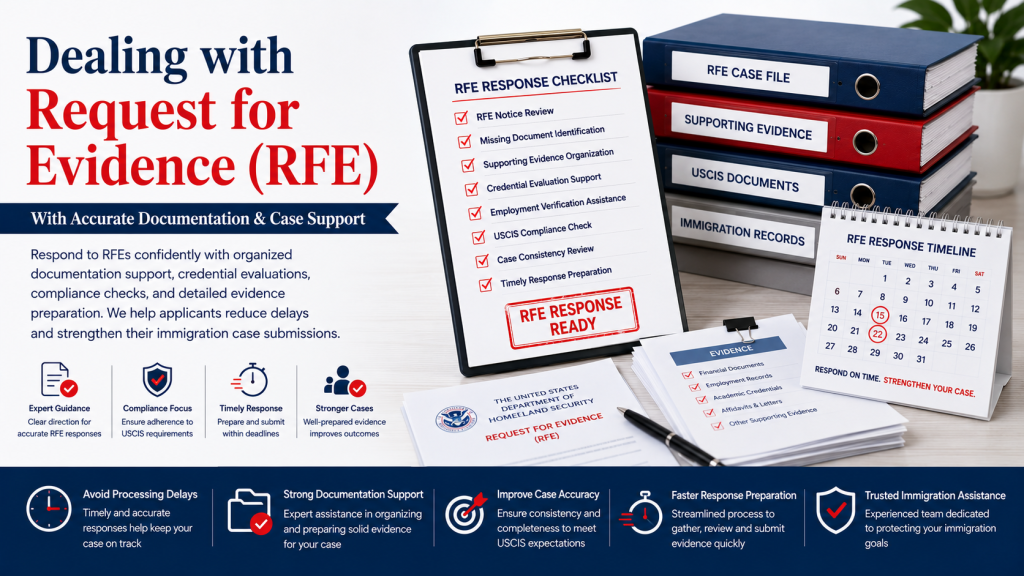
Request for Evidence (RFE) – You are a foreign national candidate and applied for an Immigration for the US. You have done all the documentation, filled out forms, and sent them to USCIS. You did your best to make sure you submit all the possible information. It’s not just documentation but your dream, the hope for better career opportunities. But, you received “Request for Evidence”. This is not what you have expected. Does that mean immigration denies your application? What is Request for Evidence (RFE)? It simply means that an applicant who has applied for immigration has to prove their eligibility for this benefit. Receiving an RFE means that you have not submitted sufficient information or your documentation to approve your application to USCIS. In other words, an RFE implies that you have to support your application with more documents. Why Do People Get RFE? Sometimes a minor mistake in the filing can be a reason for the RFE. For example, you have forgotten to include one of the necessary documentation that can be the reason for RFE. Mostly, USCIS to allow you to supplement the application with the essential documentation that you have missed. What to do if You Receive RFE? At International Evaluations, Request for Evidence are read carefully and submitted promptly before the deadline. An applicant must comply with all requests for information as thoroughly as possible in a single response. We make your response to an RFE a higher chance of approval as we help you to make your documents organized. Applicants should ensure that the information they provide is transparent and easy to locate so that there is not a single loophole in the process. In most cases, the degrees of the applicant is not recognized in the U.S. So, International Evaluations find the U.S. equivalent of your country documents and submit them along with your application. At last, people can trust us for their evaluations as many have the wrong impression that applying for immigration is just filling out forms. International Evaluations help people to avoid RFE as the procedure carried down is more systematic as we try to provide all the sufficient information initially.
Got a Visa RFE? Here’s How to Fix It Right and Fast
Receiving a Request for Evidence (RFE) from USCIS can feel overwhelming, especially when your immigration status, job offer, or green card depends on timely approval. But an RFE is not a denial. It’s an opportunity to strengthen your petition and fix documentation gaps before a final decision is made. Most RFEs happen not because applicants lack qualifications but because evidence is incomplete, unclear, or not presented according to USCIS requirements. A strong and rapid response can protect your timeline and significantly improve your chances of approval. At International Evaluations, we assist attorneys and applicants in addressing RFEs quickly, accurately, and strategically so immigration cases move forward without delays. Whether your case involves H-1B, I-140, EB-1, EB-2, EB-3, O-1, or PERM, a well-prepared RFE response can be the turning point in getting your petition approved. Why RFEs Happen and Why Responding Correctly Matters USCIS issues RFEs when documentation does not fully satisfy eligibility criteria. Even small inconsistencies can lead to additional scrutiny, delayed processing, or potential denials. Common triggers include: Missing academic or employment evidence Incorrect degree equivalency Inconsistent job descriptions or duties Questions about specialty occupation requirements Missing expert analysis Unclear experience qualifications Incomplete employer information USCIS expects clear, consistent, and properly structured evidence. We ensure your RFE response addresses every concern thoroughly and professionally. How We Help You Fix an RFE Quickly and Correctly We follow a structured, USCIS-compliant process that resolves deficiencies and provides a strong evidence package tailored to the specific RFE issued. 1. Complete RFE Review and Evidence Assessment We start by examining the RFE in detail, including all USCIS questions and required clarifications.We review your existing filing, including: Petition forms Employer letters Education credentials Experience records Job descriptions Supporting documents We identify what is missing, conflicting, or unclear and provide a clear action plan for what needs to be added or corrected. 2. Accurate and USCIS-Ready Credential Evaluations If your RFE involves education or degree equivalency concerns, we prepare: U.S. bachelor’s, master’s, or doctorate equivalency Field-specific evaluations Specialty occupation justification Our reports reference accredited academic standards and recognized comparative systems so your degree meets USCIS expectations. 3. Work-Experience-Based Evaluations for H-1B and I-140 Many RFEs request proof that experience can be counted toward degree equivalency. We prepare: Education plus experience equivalency Expert analysis for technical roles Senior-level specialty evaluations Evaluations tailored to USCIS RFE language These evaluations directly respond to USCIS concerns and strengthen eligibility claims. 4. Expert Opinion Letters for Complex or High-Level RFEs When USCIS questions job duties, specialty occupation requirements, or advanced qualifications, expert letters can resolve concerns quickly. We provide: Professional industry opinion letters USCIS-aligned analyses of specialized roles Job duty clarification and justification Letters tailored for H-1B, O-1, EB-1, EB-2, and PERM RFEs These letters add authority and credibility to your response. 5. Consistency and Accuracy Check Across All Evidence Many RFEs arise due to simple inconsistencies across documents. We conduct a detailed review of: Dates Job titles Degree names Institution details Transcripts and certificates Employer descriptions We ensure every document aligns perfectly before submission so no new issues arise. 6. Fast Turnaround for Urgent RFE Deadlines USCIS RFE deadlines are strict. Missing the deadline can result in denial. We offer: Twenty-four-hour expedited evaluations Forty-eight-hour comprehensive evaluations Same-day corrections and updates Rapid expert opinion letters Your RFE response stays fully on schedule. Why Attorneys and Applicants Trust Our RFE Services USCIS-compliant evaluations Fast and reliable processing Expert-authored documentation Experience with complex RFEs Clear and detailed reporting High approval rates for RFE responses We help eliminate uncertainty and build a response package that addresses USCIS concerns head-on. How a Strong RFE Response Improves Your Case Outcome A complete and well-prepared RFE response leads to: Higher approval chances Stronger documentation for attorneys Clear and credible evidence Reduced chances of further review Faster final decisions Improved confidence in meeting USCIS criteria We help you transform an RFE into an opportunity to strengthen your case. Conclusion: Fix Your RFE Correctly and Without Delays An RFE doesn’t have to derail your immigration plans. With the right documentation, expert evaluation, and quick processing, you can resolve USCIS concerns and move forward confidently. For fast, accurate, and USCIS-compliant RFE support: info@internationalevaluations.com +1 (510) 876-0900 www.internationalevaluations.com International Evaluations — Your Trusted Partner for Strong, Fast, and Effective RFE Responses. FAQs 1.How quickly can you help with an RFE? We provide twenty-four-hour and forty-eight-hour expedited services depending on the complexity of the RFE. 2.Can you help with RFEs related to degree equivalency? Yes. We specialize in providing USCIS-compliant academic and experience-based evaluations for RFE responses. 3.Do you assist with job duty or specialty occupation RFEs? Yes. We offer expert opinion letters and detailed analyses tailored for H-1B, I-140, O-1, and other categories. 4.What if my documents have inconsistencies? We identify and correct inconsistencies so your response package is clean and fully aligned. 5.Do you provide expert opinion letters? Yes. Our experts prepare letters for STEM, engineering, IT, research, and other specialized fields.
When Strong Profiles Face RFEs: How Independent Expert Opinion Letters Help Clarify Immigration Cases
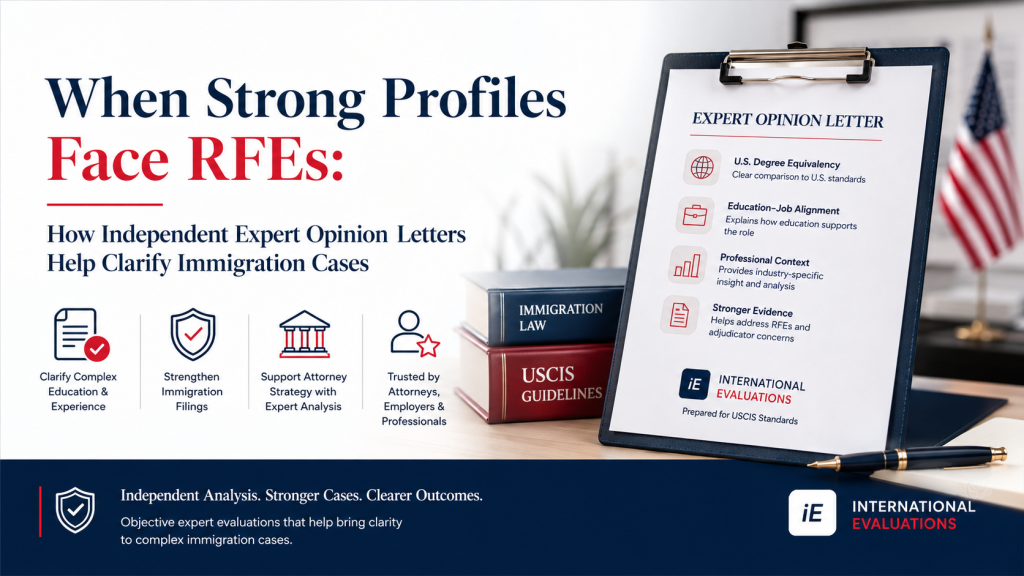
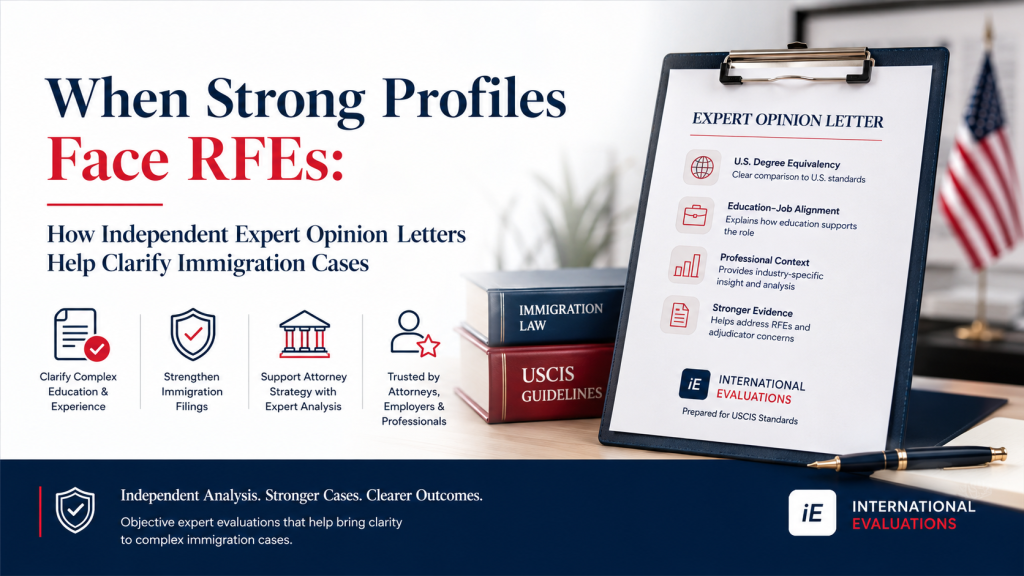
In today’s U.S. immigration landscape, even well-qualified professionals and employers encounter delays, RFEs, or additional scrutiny. This is especially common when cases involve foreign education, non-traditional career paths, or roles that USCIS reviews closely for specialization or distinction.In many of these situations, the issue is not eligibility, but how the evidence is presented and understood. Independent Expert Opinion Letters (EOLs) play an important role in helping attorneys and adjudicators clearly evaluate complex academic and professional backgrounds within the framework of U.S. immigration standards. The Real Challenges Behind RFEs and Delays Across employment-based immigration categories, common issues repeatedly arise: Degrees earned outside the U.S. that are unfamiliar to adjudicators Education that does not appear to directly match the job title Hybrid or interdisciplinary roles Progressive experience gained abroad Extraordinary ability claims that lack contextual explanation Without clear, structured explanations, adjudicators may raise questions — even when the underlying profile is strong. This is where independent expert documentation becomes valuable. What an Expert Opinion Letter Actually Does An Expert Opinion Letter is an independent academic or professional assessment that explains how an individual’s education, experience, or expertise compares to U.S. standards. EOLs are commonly used to help: Clarify U.S. degree equivalency Explain how education aligns with job duties Provide professional context for specialized or advanced roles Support attorney-led arguments in complex filings They do not replace legal strategy — but they support it with objective analysis. Who Benefits Most from Expert Opinion Letters? Immigration Attorneys Attorneys often use EOLs when: A case involves non-traditional education or experience Prior RFEs need to be addressed with clearer documentation Adjudicators may question role complexity or specialization Well-structured EOLs integrate smoothly into legal filings and help present evidence in a clear, defensible manner. Employers Sponsoring Foreign Talent Employers frequently face questions such as: Does this role qualify as a specialty occupation? Why is a specific educational background required? How does this position differ from entry-level roles? Expert evaluations help explain job complexity and educational alignment, strengthening the overall evidentiary record. Highly Skilled Professionals Professionals applying under H-1B, O-1, EB-2, EB-3, or EB-1A categories may encounter challenges when: Their degree title differs from U.S. norms Their career path spans multiple disciplines Their achievements require industry-specific context Independent expert documentation helps translate these profiles into language that adjudicators can readily evaluate. Expert Opinion Letters by Visa Category (Practical Use) H-1B – Specialty Occupation Why a role requires specialized knowledge How education aligns with job duties Support for foreign or non-traditional degrees O-1 – Extraordinary Ability Provide professional context for achievements Explain industry recognition and expertise Support distinction claims with objective analysis EB-2 / EB-3 / EB-1A – Employment-Based Green Cards Establish U.S. degree equivalency Evaluate progressive professional experience Support PERM and I-140 filings with expert analysis Why Attorneys and Employers Work with International Evaluations International Evaluations provides independent Expert Opinion Letters and evaluations through a network of 300+ U.S. university professors and experienced industry experts across a wide range of academic and professional fields. Objective, well-reasoned analysis Clear documentation aligned with adjudication standards Supporting attorney-led immigration filings Reliable turnaround based on case complexity Each evaluation is prepared with attention to accuracy, clarity, and professional independence. Frequently Asked Questions Are Expert Opinion Letters mandatory? No. They are supporting documents, commonly used in complex or high-scrutiny cases. Do Expert Opinion Letters guarantee approval? No document can guarantee outcomes. Final determinations are made solely by USCIS. How long does the process take? Most evaluations are completed within 5–7 business days, depending on complexity. Who prepares the evaluations? Qualified U.S. university professors and industry experts, supported by experienced evaluation professionals. Independent Documentation That Helps Reduce Uncertainty Immigration cases often involve more nuance than checklists alone can capture. When educational or professional backgrounds are complex, independent expert analysis can help bring clarity to the evidence presented. International Evaluations works alongside immigration attorneys, employers, and professionals by providing carefully prepared documentation that supports well-structured filings. Important Disclaimer International Evaluations is not a law firm and does not provide legal advice. All Expert Opinion Letters and evaluations are independent academic or professional assessments prepared for informational and evidentiary support purposes only. Final determinations are made solely by USCIS and/or the reviewing immigration attorney. Contact Us Website: www.internationalevaluations.com Email: info@internationalevaluations.com ☎️ Phone: (510) 876-0900
How to Respond to an H-1B RFE and Improve Approval Chances
Receiving a Request for Evidence (RFE) from USCIS for your H-1B visa application can feel stressful and confusing. You’ve already spent months preparing, filing, and waiting—only to get a notice that says more proof is needed. But here’s the truth: an RFE is not a denial. It’s an opportunity. USCIS is saying, “We see potential in your case, but we need stronger evidence to approve it.” When handled correctly, your RFE can actually become your second chance to win approval. At International Evaluations, we’ve helped thousands of applicants, employers, and immigration attorneys successfully respond to RFEs — turning uncertain cases into success stories. In this guide, we’ll show you how to understand your H-1B RFE, respond effectively, and improve your approval chances. Why Did USCIS Send an H-1B RFE? USCIS issues an RFE when your petition doesn’t clearly demonstrate eligibility under the H-1B program requirements. The goal is to ask for clarification, missing documentation, or stronger evidence before making a final decision. Here are the most common reasons H-1B RFEs are issued: Specialty Occupation Issues – USCIS questions whether your position truly qualifies as a “specialty occupation” requiring a bachelor’s degree or higher. Degree Equivalency Concerns – Your foreign degree title or major doesn’t seem to match the U.S. degree requirement for your job. Beneficiary Qualifications – USCIS doubts whether your education or work experience makes you eligible for the role. Employer-Employee Relationship – They need proof that the employer has the right to control the employee’s work, especially if the job involves third-party worksites. Unclear Job Duties – The job description appears too general or doesn’t align with the occupational code used in the petition. Third-Party Placement Evidence – Missing end-client letters or contracts that confirm the employee will work under the petitioner’s supervision. Each of these situations can be resolved — with the right documentation and a strategic approach. What Should an H-1B RFE Response Include? A successful H-1B RFE response isn’t about overwhelming USCIS with pages of documents. It’s about clarity, relevance, and structure. Here’s what a strong RFE response package should contain: A Point-by-Point Cover Letter A well-structured cover letter that clearly references every issue raised in the RFE. This letter acts as a roadmap for the adjudicating officer and connects each USCIS question to your supporting evidence. Expert Opinion Letters Written by qualified university professors or industry-recognized experts, these letters explain how your job qualifies as a specialty occupation and how your education or experience meets the requirements. Academic and Work Experience Evaluations An official evaluation from a credentialed evaluator shows that your foreign degree (or combination of education and work experience) is equivalent to the required U.S. degree. Employer Documentation Include organizational charts, project descriptions, contracts, and client letters that prove the employer-employee relationship and clarify the nature of the work. Certified Translations If any document is in a language other than English, ensure it’s professionally translated and certified. USCIS will reject incomplete or inaccurate translations. Additional Supporting Evidence Provide any updated or newly available evidence—such as professional certifications, company credentials, or new project details—that strengthen your case. How International Evaluations Helps You Respond Confidently At International Evaluations, our goal is to help you close every gap identified by USCIS. Our specialized team creates documentation that not only meets but exceeds USCIS standards. Here’s how we can help: Expert Opinion Letters Our letters are prepared by credentialed university professors and seasoned industry experts who understand USCIS requirements. Each letter is tailored to your specific occupation and petition details. Academic & Work Experience Evaluations We provide professional evaluations that confirm your foreign education or combined experience meets U.S. academic standards. Certified Translation Services We ensure every non-English document you submit is properly translated and formatted to USCIS standards. RFE Response Assistance Our team provides guidance on what to include, how to structure your cover letter, and which documents best address each concern raised in the RFE. Fast Turnaround Times Most RFEs allow only 30 to 87 days for response. We understand these tight deadlines and ensure you get accurate, USCIS-ready documentation — quickly. Why Attorneys and Employers Trust International Evaluations USCIS-Compliant Documentation – All our reports, evaluations, and expert letters meet the latest USCIS formatting and content guidelines. Trusted by 170+ Experts – Our team includes professionals from fields like STEM, business, healthcare, engineering, and law. High Success Rate – Our RFE support documentation has helped turn countless denials into approvals. Attorney-Ready Reports – We work closely with immigration attorneys to ensure every evaluation supports the legal argument of the petition. Personalized Attention – Each case is handled individually — no templates, no shortcuts, just precise, customized work. How to Improve Your Approval Chances When you receive an H-1B RFE, time and accuracy matter most. Here are some proven tips to maximize your chances of approval: Read the RFE Carefully – Identify every point USCIS is questioning. Missing even one can lead to denial. Stay Organized – Create a checklist of documents and responses corresponding to each USCIS request. Work with Experienced Evaluators – Only USCIS-recognized evaluations and expert letters carry real weight. Don’t Delay – Start your response immediately; even gathering simple documents can take time. Avoid Overloading USCIS – Focus on quality, relevance, and clarity. Extra, unrelated documents can confuse adjudicators. Turning RFE Challenges Into Approvals Many applicants fear that receiving an RFE means their case is doomed — but that’s far from the truth. In reality, most successful H-1B approvals happen after an RFE response. With the right strategy, professional documentation, and timely response, you can transform your RFE into an opportunity to prove your qualifications beyond doubt. At International Evaluations, we’ve seen it happen thousands of times. Applicants who once faced uncertain outcomes are now working legally in the U.S., thanks to strong, USCIS-compliant evaluations and expert-backed documentation. Don’t Wait — Act Fast! An RFE response window is limited, and every day counts. If you’ve received an H-1B RFE,