USCIS May Deny Certain Petitions Without an RFE: What the August 2026 Evidence Update Means for Your Documentation
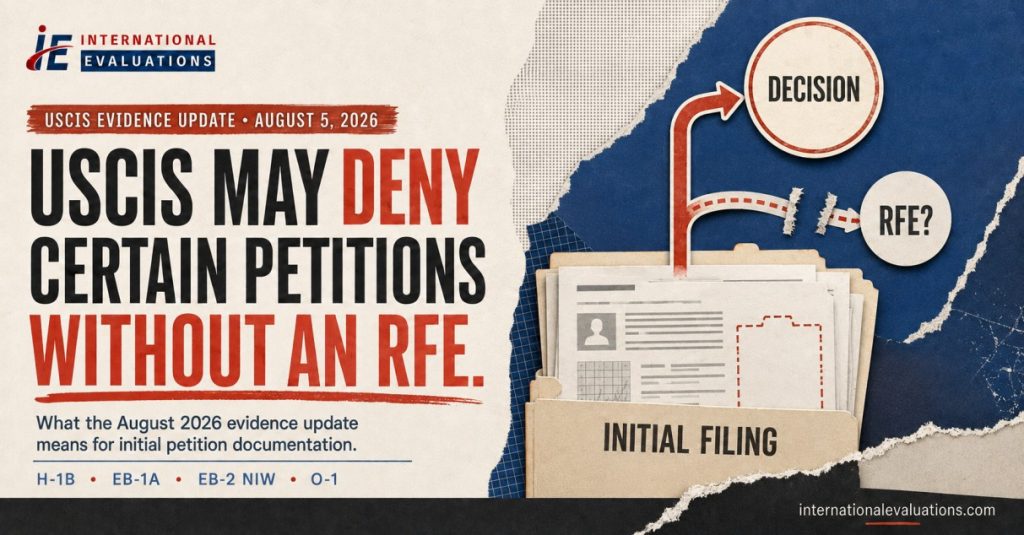
On August 5, 2026, U.S. Citizenship and Immigration Services (USCIS) issued Policy Alert PA-2026-05, updating its guidance on evidence, Requests for Evidence (RFEs), and Notices of Intent to Deny (NOIDs). Under the updated guidance, USCIS officers may deny certain benefit requests without first issuing an RFE or NOID when required initial evidence is missing or when the evidence submitted does not establish eligibility. USCIS may also deny without an RFE or NOID when there is no legal basis for approval. The policy took effect immediately and generally applies to benefit requests pending or filed on or after August 5, 2026, unless otherwise specified. The update is not limited to one immigration category. This article focuses on EB-1A, EB-2 National Interest Waiver (NIW), O-1, and H-1B petitions because these matters may involve detailed professional evidence, independent expert analysis, foreign-credential evaluations, translations, and documentation explaining specialized work. The practical takeaway is straightforward: petitioners should not assume USCIS will always provide another opportunity to submit missing or insufficient evidence before making a decision. This article provides general information only. It is not legal advice. For guidance concerning a specific petition, consult a qualified immigration attorney. What Changed? USCIS may not always request additional evidence The petitioner or applicant bears the burden of establishing eligibility for the requested benefit at the time of filing and through adjudication. The initial submission should include the evidence required by the applicable regulations, form instructions, and USCIS guidance. USCIS may still issue an RFE or NOID when an officer determines that additional evidence or an opportunity to respond is appropriate. However, the updated policy restores officer discretion to deny certain benefit requests without first issuing either notice when required initial evidence is missing, the existing record does not establish eligibility, or there is no legal basis for approval. A filing with material evidentiary gaps may therefore be decided based on the record already submitted. See the USCIS Policy Manual, Volume 1, Part E, Chapter 6. RFE and NOID deadlines may be shorter than the maximum The maximum response period for an RFE is generally 12 weeks, or 84 days, although shorter maximums apply to certain benefit requests. A USCIS officer may set a shorter response period based on the circumstances of the case. The maximum response period for a NOID is generally 30 days. The deadline printed on the notice controls, and USCIS generally may not extend the response period beyond the applicable maximum. Attorneys and filing teams should review any RFE or NOID promptly because preparing an expert letter, evaluation, translation, or other specialized documentation may require significant lead time. The August 2026 policy alert changes the mailing-time guidance Policy Alert PA-2026-05 states that USCIS is aligning mailing timeframes with the applicable regulatory period instead of the former 14-day accommodation for certain notices mailed outside the United States or issued by an international USCIS office. When a notice is served by mail, three days are generally added under the applicable service rule. Because USCIS webpages and policy materials may be updated at different times, the specific notice received in the case and counsel’s case-specific calculation should control. Petitioners should confirm all response deadlines with their immigration attorney. A partial response may lead to a decision on the existing record Submitting only part of the evidence requested in an RFE or NOID may result in USCIS treating the response as a request to decide the matter on the existing record. Filing teams should follow the notice carefully and consult counsel before submitting a partial response. Why This Matters for EB-1A, EB-2 NIW, O-1, and H-1B Petitions These petitions often involve more than collecting documents. Depending on the classification, the record may need to explain: The significance of the beneficiary’s work or professional contributions. How the beneficiary has influenced or contributed to the field. Whether the beneficiary’s achievements have received independent recognition. How the beneficiary’s education and experience relate to the proposed work. The scope, relevance, and potential impact of a proposed endeavor. The relationship between specialized job duties and the required academic background. A résumé, publication list, patent, degree certificate, or job description may establish important facts but may not, by itself, explain their professional or technical significance. When immigration counsel determines that additional subject-matter analysis is relevant, an independent expert opinion letter may provide professional context. A credential evaluation may explain the U.S. equivalency of a foreign degree, while an education and experience evaluation may assess a combination of academic preparation and qualifying professional experience. These documents are not required in every case. When they are relevant, counsel may consider whether they should form part of the initial evidentiary record rather than assuming they can be added after an RFE. EB-1A Petitions EB-1A petitions may include evidence relating to awards, judging, published material, original contributions, scholarly articles, leading or critical roles, high compensation, or other qualifying achievements. Independent expert and recommendation letters may help explain the importance of the beneficiary’s work. A useful letter should: Explain the expert’s relevant qualifications. Define the beneficiary’s area of work or specialization. Identify the materials the expert reviewed. Discuss the beneficiary’s specific contributions. Explain why those contributions matter within the field. Connect the expert’s analysis to the supporting evidence. A useful letter should not merely label the beneficiary “extraordinary” or repeat statutory language. It should provide reasoned, case-specific professional analysis. An expert letter can supplement the evidentiary record, but it does not replace primary evidence or the legal analysis prepared by immigration counsel. See the USCIS Policy Manual guidance on extraordinary ability . EB-2 NIW Petitions An EB-2 NIW petitioner must first establish eligibility for the underlying EB-2 classification and then address the three NIW requirements: The proposed endeavor has substantial merit and national importance. The beneficiary is well positioned to advance the proposed endeavor. On balance, it would benefit the United States to waive the job-offer and labor-certification requirements. USCIS guidance emphasizes the importance of describing the proposed endeavor with specificity and supporting