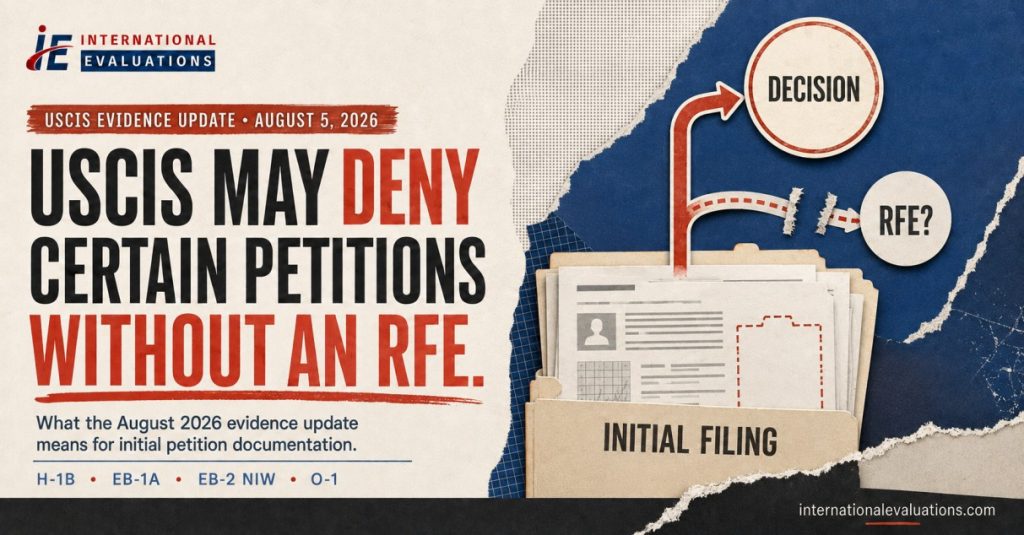
On August 5, 2026, U.S. Citizenship and Immigration Services (USCIS) issued Policy Alert PA-2026-05, updating its guidance on evidence, Requests for Evidence (RFEs), and Notices of Intent to Deny (NOIDs).
Under the updated guidance, USCIS officers may deny certain benefit requests without first issuing an RFE or NOID when required initial evidence is missing or when the evidence submitted does not establish eligibility. USCIS may also deny without an RFE or NOID when there is no legal basis for approval. The policy took effect immediately and generally applies to benefit requests pending or filed on or after August 5, 2026, unless otherwise specified.
The update is not limited to one immigration category. This article focuses on EB-1A, EB-2 National Interest Waiver (NIW), O-1, and H-1B petitions because these matters may involve detailed professional evidence, independent expert analysis, foreign-credential evaluations, translations, and documentation explaining specialized work.
The practical takeaway is straightforward: petitioners should not assume USCIS will always provide another opportunity to submit missing or insufficient evidence before making a decision.
This article provides general information only. It is not legal advice. For guidance concerning a specific petition, consult a qualified immigration attorney.
What Changed?
USCIS may not always request additional evidence
The petitioner or applicant bears the burden of establishing eligibility for the requested benefit at the time of filing and through adjudication. The initial submission should include the evidence required by the applicable regulations, form instructions, and USCIS guidance.
USCIS may still issue an RFE or NOID when an officer determines that additional evidence or an opportunity to respond is appropriate. However, the updated policy restores officer discretion to deny certain benefit requests without first issuing either notice when required initial evidence is missing, the existing record does not establish eligibility, or there is no legal basis for approval.
A filing with material evidentiary gaps may therefore be decided based on the record already submitted. See the USCIS Policy Manual, Volume 1, Part E, Chapter 6.
RFE and NOID deadlines may be shorter than the maximum
The maximum response period for an RFE is generally 12 weeks, or 84 days, although shorter maximums apply to certain benefit requests. A USCIS officer may set a shorter response period based on the circumstances of the case. The maximum response period for a NOID is generally 30 days.
The deadline printed on the notice controls, and USCIS generally may not extend the response period beyond the applicable maximum. Attorneys and filing teams should review any RFE or NOID promptly because preparing an expert letter, evaluation, translation, or other specialized documentation may require significant lead time.
The August 2026 policy alert changes the mailing-time guidance
Policy Alert PA-2026-05 states that USCIS is aligning mailing timeframes with the applicable regulatory period instead of the former 14-day accommodation for certain notices mailed outside the United States or issued by an international USCIS office. When a notice is served by mail, three days are generally added under the applicable service rule.
Because USCIS webpages and policy materials may be updated at different times, the specific notice received in the case and counsel’s case-specific calculation should control. Petitioners should confirm all response deadlines with their immigration attorney.
A partial response may lead to a decision on the existing record
Submitting only part of the evidence requested in an RFE or NOID may result in USCIS treating the response as a request to decide the matter on the existing record. Filing teams should follow the notice carefully and consult counsel before submitting a partial response.
Why This Matters for EB-1A, EB-2 NIW, O-1, and H-1B Petitions
These petitions often involve more than collecting documents. Depending on the classification, the record may need to explain:
- The significance of the beneficiary’s work or professional contributions.
- How the beneficiary has influenced or contributed to the field.
- Whether the beneficiary’s achievements have received independent recognition.
- How the beneficiary’s education and experience relate to the proposed work.
- The scope, relevance, and potential impact of a proposed endeavor.
- The relationship between specialized job duties and the required academic background.
A résumé, publication list, patent, degree certificate, or job description may establish important facts but may not, by itself, explain their professional or technical significance.
When immigration counsel determines that additional subject-matter analysis is relevant, an independent expert opinion letter may provide professional context. A credential evaluation may explain the U.S. equivalency of a foreign degree, while an education and experience evaluation may assess a combination of academic preparation and qualifying professional experience.
These documents are not required in every case. When they are relevant, counsel may consider whether they should form part of the initial evidentiary record rather than assuming they can be added after an RFE.
EB-1A Petitions
EB-1A petitions may include evidence relating to awards, judging, published material, original contributions, scholarly articles, leading or critical roles, high compensation, or other qualifying achievements.
Independent expert and recommendation letters may help explain the importance of the beneficiary’s work. A useful letter should:
- Explain the expert’s relevant qualifications.
- Define the beneficiary’s area of work or specialization.
- Identify the materials the expert reviewed.
- Discuss the beneficiary’s specific contributions.
- Explain why those contributions matter within the field.
- Connect the expert’s analysis to the supporting evidence.
A useful letter should not merely label the beneficiary “extraordinary” or repeat statutory language. It should provide reasoned, case-specific professional analysis.
An expert letter can supplement the evidentiary record, but it does not replace primary evidence or the legal analysis prepared by immigration counsel. See the USCIS Policy Manual guidance on extraordinary ability
.
EB-2 NIW Petitions
An EB-2 NIW petitioner must first establish eligibility for the underlying EB-2 classification and then address the three NIW requirements:
- The proposed endeavor has substantial merit and national importance.
- The beneficiary is well positioned to advance the proposed endeavor.
- On balance, it would benefit the United States to waive the job-offer and labor-certification requirements.
USCIS guidance emphasizes the importance of describing the proposed endeavor with specificity and supporting it with relevant evidence. See the USCIS update on EB-2 NIW guidance.
When relevant, an independent expert letter may help explain:
- What the beneficiary proposes to do in the United States.
- The professional, scientific, technical, economic, or societal relevance of the proposed work.
- How the beneficiary’s record relates to the proposed endeavor.
- The significance or potential application of the beneficiary’s prior contributions.
- How the proposed work may have implications beyond one employer or local organization.
The analysis should address the beneficiary’s actual proposed endeavor. A general discussion of the profession or industry may not provide sufficient case-specific context.
O-1 Petitions
O-1 petitions require evidence of extraordinary ability or achievement in the relevant field. Depending on the O classification and the facts of the case, the record may include evidence relating to original contributions, critical or leading roles, awards, published material, high remuneration, commercial or critical success, or other qualifying achievements.
O-1 petitions generally require a written advisory opinion, sometimes called a consultation, from an appropriate U.S. peer group, labor organization, management organization, or person with expertise in the beneficiary’s area of ability, subject to applicable exceptions and category-specific requirements. See the USCIS O-1 classification guidance.
An independent expert or recommendation letter used to explain the beneficiary’s work is not necessarily the same as the formal O-1 advisory opinion. Immigration counsel should determine which documents are required and how each document fits into the filing.
H-1B Petitions
An H-1B filing may need to establish that the offered position qualifies as a specialty occupation and that the beneficiary is qualified to perform it. The evidence may address the position’s specific duties, the specialized knowledge required, the employer’s actual business operations, and the relationship between the duties and a directly related degree specialty.
When relevant, a credential evaluation may assess the U.S. equivalency of foreign education. An education and experience evaluation may provide an academic assessment of the beneficiary’s education and qualifying professional experience in relation to the position’s stated requirements. Counsel should determine how the evaluation fits the legal and regulatory requirements applicable to the H-1B petition. An independent expert opinion may provide professional context concerning the duties, industry practices, or education-to-duties relationship.
These documents do not replace the employer’s evidence, the Labor Condition Application, or counsel’s legal analysis. Counsel should determine which evidence is appropriate for the specific filing. See the USCIS H-1B specialty-occupation guidance.
Documentation Checklist
Before filing an employment-based petition, the petitioner and counsel should review the applicable form instructions and determine what initial and supporting evidence the classification requires.
Required initial evidence
Confirm that the filing includes the forms, fees, signatures, and initial evidence required by the applicable regulations and current USCIS form instructions. Supporting documentation cannot cure a missing legal or procedural filing requirement in every situation.
Foreign degrees
When a credential evaluation is relevant, it should clearly identify the credential, institution, country, field of study, applicable educational system, evaluation methodology, and stated U.S. equivalency.
A general statement that a foreign credential is equivalent to a U.S. degree may not address every issue raised by a particular petition. Credential evaluations are not required in every case; counsel should determine whether one is appropriate.
Education and professional experience
When professional experience is being considered together with education, the evaluation should describe the records reviewed, the methodology applied, and the basis for the conclusion. Any experience relied upon should be supported by appropriate documentation.
Independent expert letters
The expert’s background should align with the subject matter of the requested opinion. The letter should identify the materials reviewed and provide a clear, reasoned, case-specific analysis rather than broad conclusions or repeated legal language.
Translations
Any foreign-language document submitted to USCIS must generally be accompanied by a complete English translation. The translator must certify that the translation is complete and accurate and that the translator is competent to translate from the foreign language into English.
Consistency across the record
Review dates, degree titles, institution names, job duties, employment periods, publications, awards, and professional titles. The forms, petition letter, résumé, evaluations, expert letters, translations, and exhibits should be factually consistent.
How International Evaluations Can Help
International Evaluations provides non-legal documentation support for immigration attorneys, employers, and petition beneficiaries. Depending on the requirements identified by counsel or the filing team, our services include:
- Independent expert opinion letters for EB-1A, EB-2 NIW, O-1, and H-1B matters.
- Recommendation-letter documentation coordination, when requested by counsel and subject to the recommender’s independent review and approval.
- Academic credential evaluations.
- Education and experience evaluations.
- Certified translations.
- Supporting-documentation preparation for issues identified in an RFE or NOID, based on the scope determined by counsel.
International Evaluations has access to a network of more than 350 U.S. professors and subject-matter experts across academic, scientific, technical, medical, business, and professional fields.
Based on the subject matter and requested scope, we identify potential experts whose backgrounds align with the case. The selected expert independently reviews the supporting materials and determines whether—and to what extent—the requested opinions can be professionally supported.
The expert retains control over the analysis, revisions, conclusions, and final approval of the letter. Clients and counsel may review a draft for factual accuracy and completeness, but any change affecting the expert’s professional opinion remains subject to the expert’s independent review and approval.
Preparation timelines depend on the service, scope, completeness of the materials, and expert availability. Expedited service may be available for eligible matters.
If your attorney or filing team has identified a need for an evaluation, translation, or independent expert letter, contact International Evaluations:
Phone: +1 (510) 876-0900
Email: info@internationalevaluations.com
Consultation: Book a free consultation
Official USCIS Sources
- USCIS alert: USCIS to Reduce Frivolous Immigration Benefits Requests by Reinforcing Evidence Standards
- Policy Alert PA-2026-05: Evidence, Requests for Evidence, and Notices of Intent to Deny
- USCIS Policy Manual, Volume 1, Part E, Chapter 6: Evidence
- USCIS Policy Manual guidance on EB-1 extraordinary ability
- USCIS guidance on EB-2 National Interest Waiver petitions
Disclaimer
International Evaluations is not a law firm and does not provide immigration legal advice, determine eligibility for an immigration benefit, or control filing strategy.
We provide credential evaluations, education and experience evaluations, independent expert opinion letter coordination, translations, and other non-legal documentation support used in immigration and employment contexts. Independent expert letters and credential evaluations are not required in every case.
Our services and documents do not guarantee approval or any particular outcome from USCIS, the U.S. Department of Labor, or any other receiving authority. This article provides general information about a published USCIS policy update and should not be relied upon as guidance for a specific matter.
For advice concerning a petition, RFE, NOID, response deadline, or filing strategy, consult a qualified immigration attorney.